
Technology · News & analysis
Compass 4xe: how SNOW mode manages its two electric motors
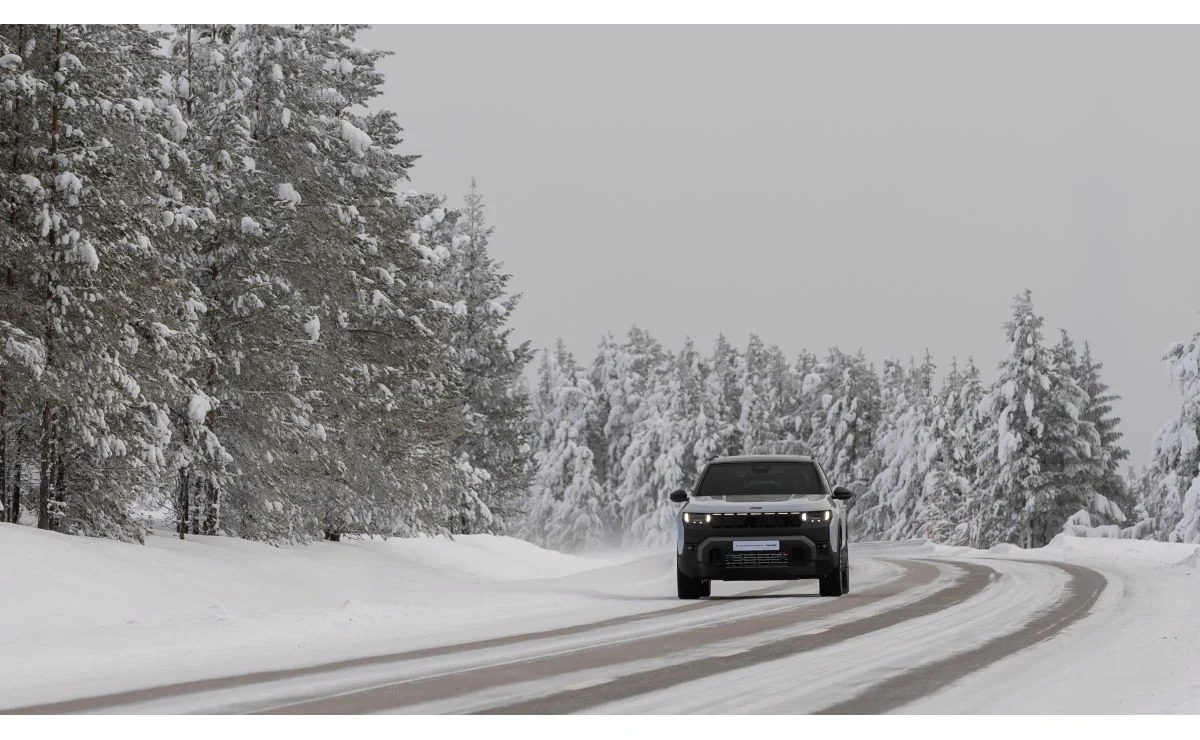
Jeep’s 5 November Capability Stories episode shows the electric Compass 4xe on snow and ice in Arjeplog, Sweden. Its useful technical detail is a specific calibration choice: SNOW keeps both axles driven while softening power delivery. Here, 4xe identifies the new twin-motor electric vehicle, rather than the earlier plug-in hybrid Compass.
What matters
On a slippery surface, controlling the torque reaching the wheels matters. SNOW combines progressive response, specific traction-control and ESP settings, and drive to both axles.
A motor at each axle, with electronically managed torque
Jeep specifies 157 kW and 345 Nm for the front motor and 132 kW and 232 Nm for the rear. Separate, electronically balanced motors allow the two axles to be managed individually. The release also quotes 375 hp for the vehicle. The individual motor figures describe components; adding them is not a substitute for the stated system output.
According to Jeep, the motor-speed controller detects wheel slip, adjusts torque to dynamic load and damps driveline oscillation. Coordination with ABS and ESP connects propulsion with braking and stability functions. The significance extends beyond having a second motor: the way its effort is adjusted, and how progressively that happens, also matters.
Source: Jeep — Compass 4xe on snow and ice, 5 November 2026 ↗
What SNOW changes about the response
Selec-Terrain offers AUTO, SPORT, SAND & MUD, SNOW and 4WD LOCK. For SNOW, Jeep describes 80% of maximum power, progressive delivery, dedicated traction-control and ESP calibrations, and all-wheel drive continuously engaged. It also specifies conservative, balanced slip thresholds at both axles.
The engineering rationale is straightforward: requesting more torque than a tyre can transmit causes wheelspin before the motor’s capability can be used. A gentler pedal response helps the driver request effort the surface can accommodate. That makes sense on ice even in a powerful car. The 80% figure describes the announced calibration; it is not a measurement of constant output throughout the filmed drive.
Source: Jeep — Compass 4xe on snow and ice, 5 November 2026 ↗
Accelerating out of a corner and stopping are different tasks
When pulling away or accelerating after a corner, two driven axles provide more wheels across which to distribute the traction demand. Their contribution depends on the grip each finds. As a functional example, reducing torque at an axle that begins to spin fits the slip-management strategy described by Jeep; the announcement does not provide a measured sequence of that manoeuvre.
During braking, two propulsion motors do not create additional tyre-to-road adhesion. Speed, surface and tyres remain critical. Jeep’s film demonstrates movement through snow but supplies no stopping distances, full tyre specification or independent comparison. That is the relevant limit when assessing the safety message.
Source: Jeep — Compass 4xe on snow and ice, 5 November 2026 ↗
What Arjeplog shows, and what to check before travelling
The Swedish setting presents the vehicle’s control strategy in winter conditions. It is a manufacturer demonstration, rather than an Autohaus road test. Applying the explanation to a journey means knowing how to select the mode, checking the tyres actually fitted, and adapting speed and following distance to the road.
A mode name cannot identify a winter tyre or establish that an individual car has the right equipment for a particular route. Our tyre-label guide explains wet-grip ratings, which address a different test from behaviour on snow or ice. These are complementary checks when preparing the vehicle.
Source: Jeep — Compass 4xe on snow and ice, 5 November 2026 ↗
Up to 606 km WLTP and European orders
Jeep says European orders are open and quotes up to 606 km WLTP for the Compass 4xe described. That is an announced homologation reference, rather than the distance achieved during the Arjeplog filming. The release gives no route consumption from which to calculate that vehicle’s cold-weather range.
Winter suitability involves both traction and energy planning. SNOW addresses the former; cabin and battery heating belong to the latter. Our heat-pump guide develops that energy context. The actual version, equipment and delivery terms still need confirmation in the purchase market.
Source: Jeep — Compass 4xe on snow and ice, 5 November 2026 ↗
Jeep’s explanation shows why a powerful electric vehicle offers a gentler snow setting: it helps meter the effort of its two motors. The demonstration explains that strategy, while tyre grip and stopping distance remain essential parts of the winter assessment.
Sources & editorial policy
Written by Autohaus Zephyr from the linked sources. Manufacturer figures are attributed claims, not our own tests. The practical comparisons and clearly identified examples are editorial analysis. Market availability and specifications require confirmation for the exact car.
Corrections: [email protected]
How we work →Keep reading
- Aquaplaning: how to reduce the risk and respond if the car loses grip
- Tire labels: how to compare grip, noise and efficiency without a false shortcut
- Heat pumps in electric cars: when they matter and how to check before buying