
Technology · News & analysis
BMW and E.ON expand V2G: unpacking Germany’s €720 bonus
BMW and E.ON announced on 18 November that their German Vehicle-to-Grid offer is expanding to the new BMW i3, iX4 and iX5 alongside the iX3. The maximum €720 annual incentive rewards eligible connection time. It is not guaranteed net profit, and it does not establish that the service or tariff is available in Spain.
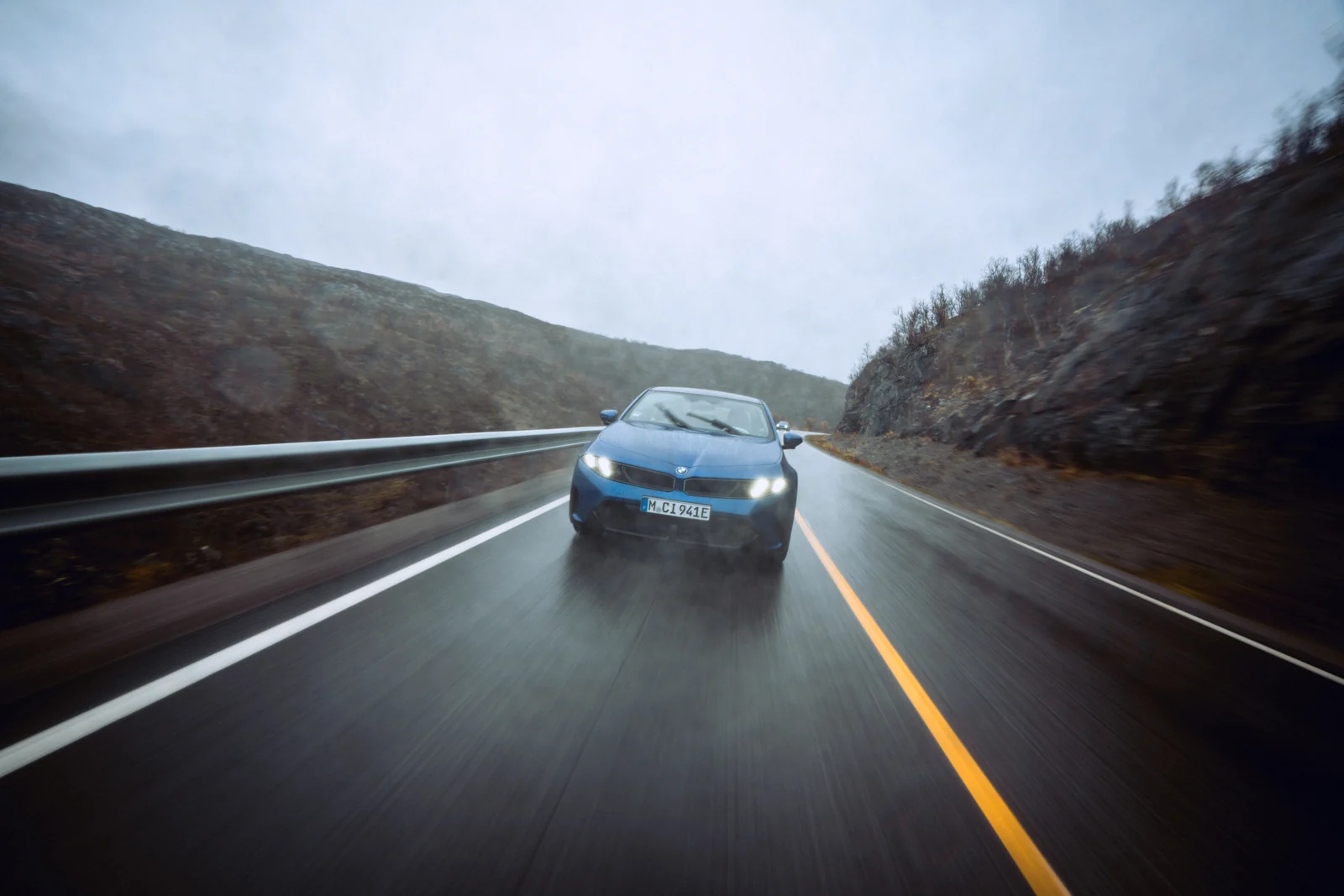
What matters
Assess the compatible car, wallbox, metering and local contracts as one system before putting a value on V2G.
What changes from the original German launch
The development is an extension to more sixth-generation eDrive models, rather than the invention of bidirectional charging. BMW and E.ON date their original German announcement to September 2025 and the opening of orders for the iX3 package to February 2026. Three further models are now being added. Readers following the new iX4 should distinguish this energy-service expansion from the earlier announcement of the vehicle itself.
The package brings together a compatible car, the bidirectional BMW Wallbox Professional and E.ON’s ÖkoStrom Home & Drive V2G tariff. The contract and installation form part of the system; they are not optional administrative details. A plug that fits, or a large battery, does not establish compatibility. Naming a model also does not mean that every older generation, powertrain or household installation can feed electricity back into the grid.
Source: BMW Group / E.ON · 2026-11-18 ↗ · BMW Group / E.ON · 2026-02-09 ↗
The €720 maximum comes from eligible hours
The published rule pays €0.24 for each hour connected to the wallbox with V2G activated, up to 250 hours per month. That produces a monthly ceiling of €60 and €720 across a year if the maximum is reached every month. It rewards availability whether or not charging or discharging occurs in a particular hour. Buying the car alone does not earn €720, nor is the amount assured without eligible connection time.
As a simple arithmetic example, rather than a model of an actual bill, 100 qualifying hours in a month would produce a €24 bonus. Accumulating 300 hours would not lift the published monthly ceiling beyond €60. This turns the headline into a useful household question: will the car spend enough time connected at the contracted location? A driver who normally parks on the street or uses another charger cannot budget for the same incentive merely because the vehicle is compatible.
Source: BMW Group / E.ON · 2026-11-18 ↗
Exported energy is a separate calculation
The November announcement additionally states compensation of €0.42 for each kWh fed back into the grid. This pays for energy, separately from the hourly connection bonus. A hypothetical 10 kWh export would therefore represent €4.20 of gross remuneration at that rate. It would not establish a €4.20 profit: the charging cost of that energy, losses and applicable contractual conditions are still missing from the calculation.
Document dates matter here. February’s order-opening announcement quoted €0.40 per exported kWh. Our explanation of the current expansion uses the €0.42 announced on 18 November without assuming that existing contracts change automatically. Combining an old export rate, an earlier wallbox promotion and the new expansion could create an imaginary offer that does not match the terms available to an individual customer. Obtain the actual contract rather than assembling one from several press releases.
Source: BMW Group / E.ON · 2026-11-18 ↗ · BMW Group / E.ON · 2026-02-09 ↗
Free kilometres are a theoretical equivalence
BMW translates the maximum bonus into approximately 13,500–16,000 theoretical kilometres for an i3 50 xDrive, using electricity at 32.97 cents/kWh and WLTP consumption of 13.5–16.1 kWh/100 km. Dividing €720 by €0.3297/kWh produces about 2,184 kWh under that assumption. Applying the stated consumption then converts energy into distance. This is not an independent measurement of a driver completing that many kilometres at no charging cost.
A different electricity price, configuration or real-world consumption changes the equivalence. Charging losses and household requirements also matter when comparing bills. The i3’s North Cape–Tarifa journey is a different kind of evidence, describing distance and charging time for a particular operation. Combining that trip with the financial illustration would not justify promising that a buyer can reproduce either the journey’s result or the advertised annual saving.
Source: BMW Group / E.ON · 2026-11-18 ↗
Departure targets and battery protection
According to the partners, the algorithm controls charging and export while accounting for a desired minimum state of charge and departure time. Its purpose is to offer grid flexibility while maintaining the user’s mobility requirements. Those targets need to reflect actual use. Requiring a very full battery at short notice creates a different operating window from leaving the vehicle connected for many hours with more flexibility over stored energy.
BMW says its intelligent functions keep the battery within an optimal operating range to protect its lifetime. We treat that as a manufacturer statement, not as independent long-term degradation evidence. Before signing, request the current warranty, installation, control and service-exit terms. Vehicle-to-Grid, powering a home and supplying an external appliance are different applications. Availability of one does not prove the others work with the same equipment, nor that the installation will supply a house during a power cut.
Source: BMW Group / E.ON · 2026-11-18 ↗
What this means outside Germany
The economic offer described is directed at Germany. Importing a compatible BMW into Spain does not automatically bring the tariff, grid approval or installation with it. A useful enquiry covers vehicle and software eligibility, bidirectional charger, meter and supply point, electricity-purchase and export contracts, fixed costs and cancellation terms. Only with those answers can a household compare total costs with an installation that simply charges its car.
The release also describes one-way smart charging for electrified BMW and MINI models with compatible tariffs. Shifting charging to favourable times does not make every plug-in hybrid or AC wallbox V2G-capable. We do not add those separate incentives to the €720 ceiling. Our report on Chery’s V2G disclosure helps distinguish development stages and ecosystems: a technology announcement and a territorially defined commercial service establish different things.
Source: BMW Group / E.ON · 2026-11-18 ↗
The expansion makes V2G relevant to more customers who meet the German service conditions. Elsewhere, its useful lesson is to check the entire system and separate connection bonuses, energy exports and net costs before assigning a saving to the car.
Sources & editorial policy
Written by Autohaus Zephyr from the linked sources. Manufacturer figures are attributed claims, not our own tests. The practical comparisons and clearly identified examples are editorial analysis. Market availability and specifications require confirmation for the exact car.
Corrections: [email protected]
How we work →Keep reading
- BMW i3 from North Cape to Tarifa: what 2h 46m of charging tells us
- BMW iX4: what has been announced and what to check before buying
- Chery showcases Volt-dragon and V2G: what a complete station must prove