
New cars · News & analysis
Škoda Kodiaq: 200 kW plug-in hybrid and Laurin & Klement trim
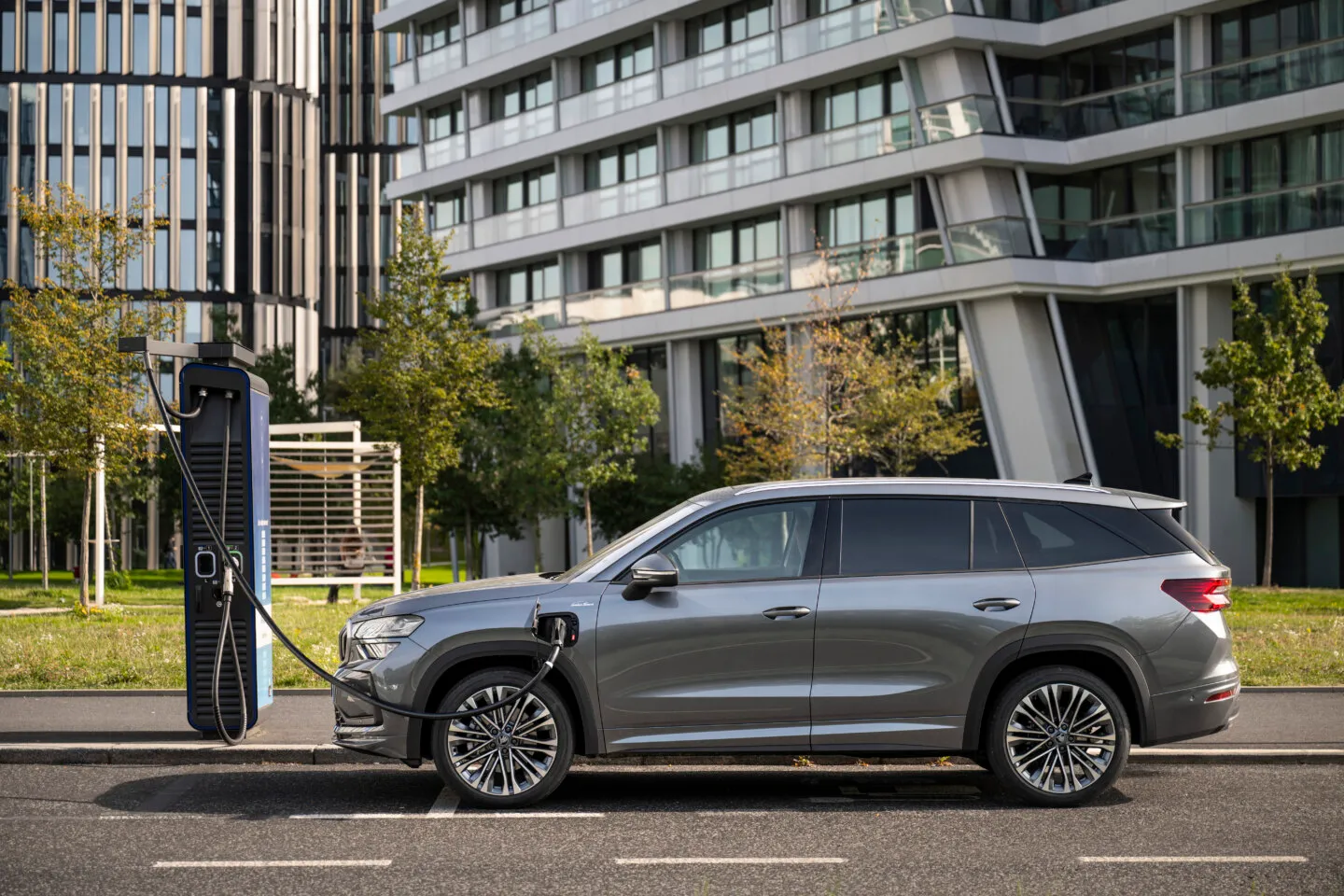
The Kodiaq update adds a plug-in hybrid and Laurin & Klement trim. System output and usable battery capacity help with comparisons, but the decision also depends on how you will charge the car and the exact seating and towing configuration.
What matters
Do not choose on the 200 kW figure or trim name alone: confirm the specification of the exact car and work out whether your routine allows regular charging.
What has been announced—and what has not
The update announced on 22 October 2026 expands the current Kodiaq range with a plug-in hybrid rated at 200 kW system output and a Laurin & Klement trim. It is not an announcement of an entirely new generation. That distinction matters when comparing news, offers and specifications: a range update does not, by itself, establish that every version or every item of equipment has changed.
Škoda quotes a 25.7 kWh gross and 19.7 kWh net battery, with DC fast charging up to 50 kW. It also lists 130 kW for the petrol engine and 85 kW for the electric motor. Those two component ratings should not be added to obtain the car’s output: the stated combined system figure is 200 kW. The announcement alone does not establish real-world range, consumption, a full charging time or performance in every condition.
Gross and net capacity answer different questions
Gross capacity describes the battery’s nominal total energy; net capacity is the portion the system makes available to propel the vehicle. For an initial comparison between plug-in hybrids, the net figure is often more useful because it is closer to the energy available for electric driving under the car’s control. It is not, however, a distance guarantee. Speed, temperature, gradients, climate control and driving style can all affect the result.
For this Kodiaq, the difference between the announced 25.7 kWh gross and 19.7 kWh net figures is a reason to ask which capacity a comparison uses. If an advert compares one car’s gross figure with another car’s net figure, the conclusion may mislead. As a hypothetical example, two vehicles advertised with similarly sized batteries could offer different usable amounts; you would need both technical specifications rather than infer range from one number.
When requesting an offer, ask for the net capacity listed for that version and, if electric range is central to your decision, the official figure for the exact configuration. Then compare it with your usual journeys. The announcement does not specify a range, so it would be wrong to derive one from the kWh figure or promise that it will cover a particular daily commute.
Why 130 plus 85 does not mean 215 kW
The motors in a plug-in hybrid do not necessarily deliver their maximum outputs at the same time or under the same conditions. Their individual ratings therefore cannot automatically be converted into the combined power available at the wheels. Škoda quotes 200 kW for the system even though the petrol and electric motor figures add up to 215 kW. When comparing versions, use the manufacturer’s stated combined output, not your own sum.
Peak power also does not explain how a car responds in every situation. It cannot tell you how long a performance level is sustained, how the car behaves with a charged or depleted battery, or how it responds with passengers and luggage. The available announcement does not detail those circumstances. If performance matters to your decision, request information for the specific version and describe the conditions that matter to you rather than treating a peak figure as a complete description.
A hypothetical example: someone comparing two offers might reject one because adding its motor outputs produces a bigger number than the combined output announced for this Kodiaq. That would be an invalid comparison. For each candidate, note the manufacturer’s published system output, net energy capacity and the charging conditions you can actually provide at home or work.
A plug-in hybrid only fits if you can charge
The useful question is not simply whether you have access to a plug. Ask how regularly you can connect the car, how long it will be parked and whether a charging point is available when you need it. If you can charge predictably at home or work, you can assess electric use against your normal journeys. If you rely on public chargers, include detours, waiting and uncertainty in your decision instead of assuming one will always be free.
Observe a typical week before choosing: record daily distances, the days with longer journeys, where the car sits for several hours and which longer trips recur. You do not need to invent a range for this exercise. Once the official range for the exact version is published or confirmed, compare it with those journeys while allowing for different circumstances. A routine that requires many miles between charges may not make as much use of the plug-in system as you expect.
The up-to-50 kW DC figure is an announced maximum, not a guarantee that each session will stay at that power or take a particular time to fill the battery. For a cost estimate, also ask about AC charging, times and conditions, which the announcement does not detail. Check compatibility with the charging point you would use, and do not buy a cable, installation or equipment based on details that have not been confirmed for that vehicle.
Laurin & Klement is not a substitute for checking the specification
The announcement confirms the addition of Laurin & Klement trim, but a trim name does not answer every family-configuration question. Do not assume that every car has seven seats, a particular seating layout, a specified towing capacity or a specific set of equipment. Those details may depend on the version and the vehicle on offer, and the update summary does not establish them.
Before paying a deposit, request a written specification linked to the vehicle identification or chassis number of the car being offered. Check the approved seat count, layout and included items, as well as any option you need. If towing matters, require the authorised capacity for that vehicle and confirm that it applies to its exact configuration; a figure for another powertrain or trim is not a substitute.
For a family carrying several people and luggage, a viewing or inspection should reflect real use: try access to each row, check how much room remains behind the seats in use and examine how the child restraints you use are fitted. This is a practical check, not a claim that the model has a particular configuration. If the car is not available for verification, record what remains outstanding and what must be confirmed before you commit.
Compare the cost of your routine, not just the headline
A sound decision separates the purchase price from the costs and conditions of use. Ask for an itemised offer for the specific car and confirm what it includes, which items are optional and which costs depend on charging installation or an outside service. The announcement cannot show whether this version will cost less than another: it does not provide the price applicable to each offer or your energy, fuel, parking and finance costs.
You can build your own comparison without guessing consumption. For each candidate, record the confirmed price, net capacity, available official range figures, real charging options and the distance you expect to cover in each type of journey. Keep confirmed information separate from assumptions. In a hypothetical scenario, a driver unable to charge at home who mostly makes long trips might gain less practical benefit from plugging in than someone who can charge frequently; the individual result depends on their circumstances and cannot be guaranteed in advance.
Do not treat maximum figures as a running-cost estimate. Ask for the assumptions behind any cost projection and how it changes if you charge elsewhere or a larger share of your driving requires the petrol engine. If finance, warranty or maintenance terms are offered, review the document that applies to that vehicle and buyer. The range announcement defines none of those terms.
Questions answered
Do the 130 kW and 85 kW motors give the Kodiaq 215 kW?
No. Those are the quoted outputs for the petrol and electric motors; Škoda states a combined system output of 200 kW. Do not add the individual figures as if both were always available at the same time.
Does the 25.7 kWh battery figure mean that much energy is usable?
Not exactly. The announcement distinguishes 25.7 kWh gross from 19.7 kWh net. For comparisons of available energy, confirm the net capacity of the specific version; neither figure alone determines range.
Does Laurin & Klement trim guarantee seven seats or towing capacity?
The announcement does not confirm either. Check the seat count and authorised towing capacity in the specification and documents for the exact vehicle before committing.
This Kodiaq adds a 200 kW plug-in hybrid option and Laurin & Klement trim to the current generation, but those headlines are not enough to choose. The decision depends on a workable charging routine, information for the exact version and a configuration that meets your needs for seats, luggage or towing. Get unspecified details in writing and verify the seller, payment and terms before making a reservation.
Sources & editorial policy
Written by Autohaus Zephyr from the linked sources. Manufacturer figures are attributed claims, not our own tests. The practical comparisons and clearly identified examples are editorial analysis. Market availability and specifications require confirmation for the exact car.
Corrections: info@autohauszephyr.ch
How we work →Keep reading
- BMW iX4: what has been announced and what to check before buying
- Peugeot RCZ Vision: the concept coupé’s return—and its limits
- Škoda Octavia full hybrid: what it means and what to check before choosing