
Motor · News & analysis
Four museum Porsches for Dubai: reading each car’s own history
Porsche announced on 11 November that four historic cars from its museum would join Icons of Porsche, scheduled in Dubai for 21–22 November: a 1998 911 GT1, 917 KH, 550 A Spyder and 804 single-seater. The exhibition connects them with the Mission S concept and the brand's sporting history. A useful reading distinguishes a design resemblance, an engineering solution and the record of a particular chassis. Those are different claims, and none establishes that a new production vehicle is available to buy.
What matters
Read the label and chassis identity as well as the silhouette; a design reference does not confirm production.
Four museum cars join privately supplied classics
The announcement distinguishes four Porsche Museum vehicles from other classics contributed by the local community. Provenance matters: a long list of models associated with design inspiration does not mean that every one is being shipped from Stuttgart. It also does not demonstrate that the cars are already installed in Dubai. This article describes the communicated programme rather than presenting planned transport or a future display as an event we attended or independently observed taking place.
For a visitor, the first step is reading the label before assigning a victory or date to the object. Model, version, year and chassis number can separate histories that appear almost identical at first glance. A restored car, a period example and another member of the same series are not interchangeable as evidence. The announced selection offers an opportunity to build a viewing route around those differences, rather than merely recognise four famous outlines and attach a model's entire history to each one.
Ask which GT1 chassis is present
The release identifies the intended 1998 GT1 as chassis 001 and distinguishes it from that year's Le Mans-winning car. Being part of the programme that achieved a victory does not make every unit the winning example. It is a small distinction in a caption but a fundamental one when interpreting a museum object. We preserve that separation instead of transferring every result associated with the model to the particular chassis announced for this display.
The Porsche Museum specification explains the move to a carbon-fibre chassis in the 1998 evolution. The engineering interest lies in how structure and bodywork can be organised around racing requirements. The 911 name does not require the GT1 to share every solution with a road-going 911. Comparing the front shape or engine position in a photograph can generate questions, but the actual construction and identity need their own documentation. A familiar badge alone does not settle either matter for an exhibition visitor.
Source: Porsche Middle East · 2026-11-11 ↗ · Porsche Museum · 911 GT1 98 ↗
Look at the 917 KH’s shape as a function
KH derives from Kurzheck, referring to the short tail. The car provides a way to consider how rear volume and airflow management respond to a racing problem. A visible resemblance to a contemporary concept can be a design quotation without establishing the same aerodynamic balance, cooling system or behaviour. Each project's requirements belong to its own era and objective. Understanding that context is more revealing than assuming a similar surface proves a directly inherited technical system.
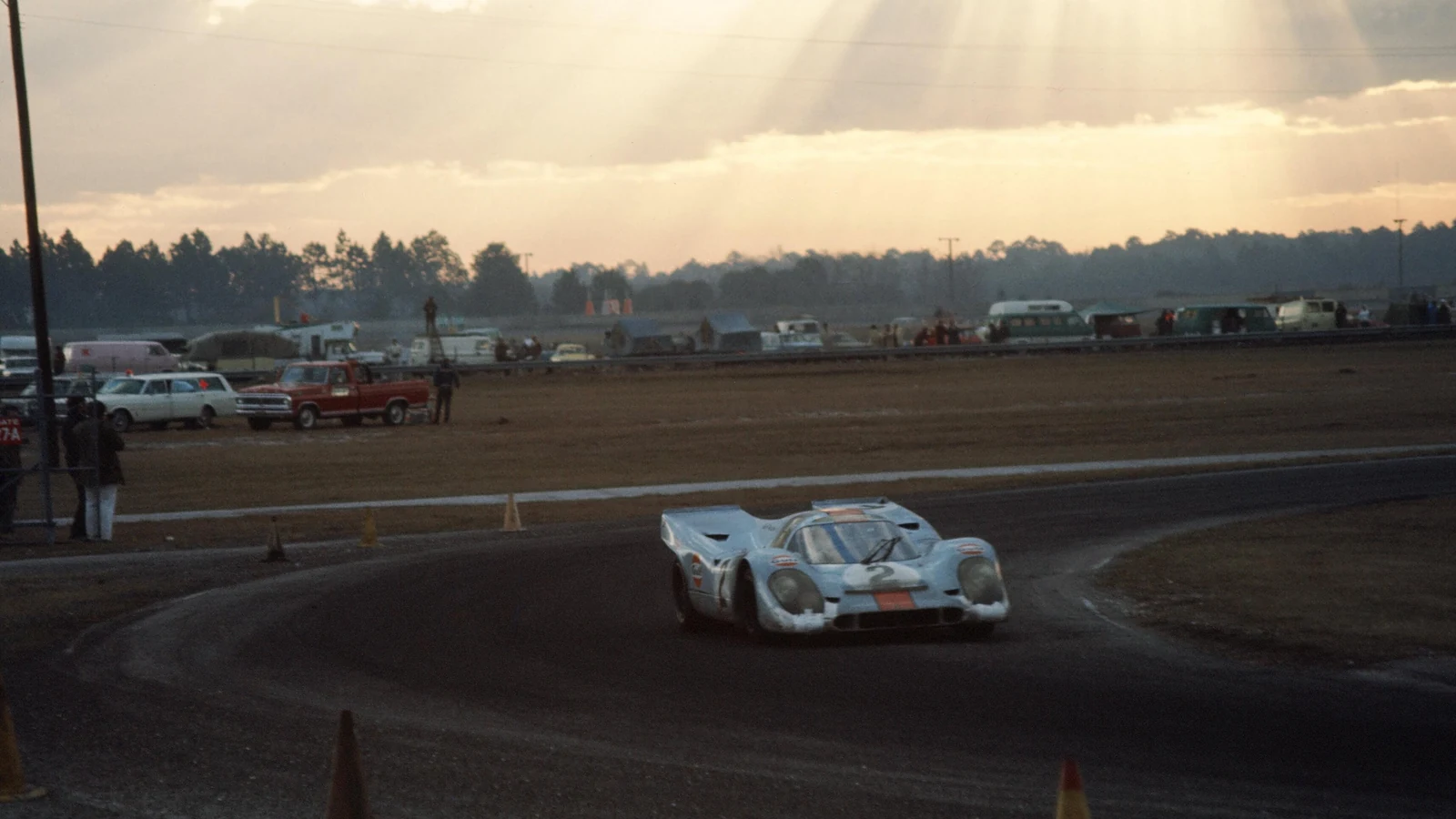
Our selected image is an official archive photograph of a 917 KH in 1970, with that historical context retained. It does not purport to show arrival at a 2026 festival or certify the chassis occupying a particular Dubai display space. The limitation does not diminish the photograph's interest: it allows proportions to be studied within a period scene. It prevents an authentic picture being turned, through an inaccurate caption, into supposed evidence of an event that happened decades after it was made.
The 550 A introduces a different scale
Porsche's official 718 history recalls Umberto Maglioli winning the 1956 Targa Florio in a 550 A. That historical reference remains separate from the exhibition programme. The model's significance does not depend on matching a modern car's power: its size, layout and pursuit of low weight offer another way to understand the compromise between available resources and a sporting task. The comparison becomes more useful when it is not reduced to sorting every vehicle by maximum speed or output alone.
The original 550 should also be distinguished from the 550 A evolution. We therefore do not automatically apply every date, figure or description attached to the generic Spyder name to this later version. Historic names can encompass different derivatives. For someone taking notes, recording the full label before searching for a specification is a simple way to reduce mistakes. It also helps when comparing photographs of visually similar vehicles whose construction, date or individual provenance may not be the same.
Source: Porsche · 718 / 550 A ↗
The 804 interrupts a single-line history
The 804 single-seater introduces Formula 1 into a group that also includes endurance machinery and small sports racers. Its presence illustrates why a manufacturer's history is not one sequence of progressively faster cars. Rules, race types and vehicle dimensions create different problems. A shared display can reveal that variety without implying that every car was a necessary intermediate stage on the way to the same road-going product or that all four competed under comparable operating requirements.
Our guide to endurance categories offers a useful modern parallel: sharing a manufacturer or period does not mean sharing a class. Beside the 804, ask what an open cockpit requires and how a single-seater differs from a closed racing car. These are observation questions rather than a modern safety assessment. They also do not justify comparing lap times from different circuits and rules as if the numbers measured identical tasks. The purpose is to understand diversity, not manufacture a universal ranking.
Mission S remains a concept
The programme presents the historic cars as references for Mission S. A reference can influence a proportion, visual signature or the way a component is displayed without reproducing an entire earlier architecture. A regional exhibition also does not turn the concept into a production vehicle with confirmed prices, ordering or deliveries. Its stage remains explicit even when a physical object stands beside real historic cars. Physical presence and production approval are separate facts that should stay separate in the reader's interpretation.
Before arranging a visit, check the organiser's dates, location and admission information. Then choose one question for each car: the GT1's identity, the 917's tail, the 550 A's scale and the 804's category. The restoration of Abu Dhabi's Porsche 924 adds another festival connection but concerns a separate event and vehicle. This approach links the stories while preserving their different evidence, owners and presentation stages, making an exhibition more informative than a collection of familiar names.
The announced selection is most valuable when read as four different engineering problems and individual identities. Its connection with Mission S provides design context without confirming production or making every historic car the winner of every race associated with its model.
Sources & editorial policy
Written by Autohaus Zephyr from the linked sources. Manufacturer figures are attributed claims, not our own tests. The practical comparisons and clearly identified examples are editorial analysis. Market availability and specifications require confirmation for the exact car.
Corrections: [email protected]
How we work →Keep reading
- Abu Dhabi’s Porsche 924 police car returns with its historic identity
- Endurance and Hypercar: How to Read a Race Beyond the Fastest Lap
- Derek Bell at 85: speed, teamwork and fuel management in endurance racing