
Motor · News & analysis
Abu Dhabi’s Porsche 924 police car returns with its historic identity
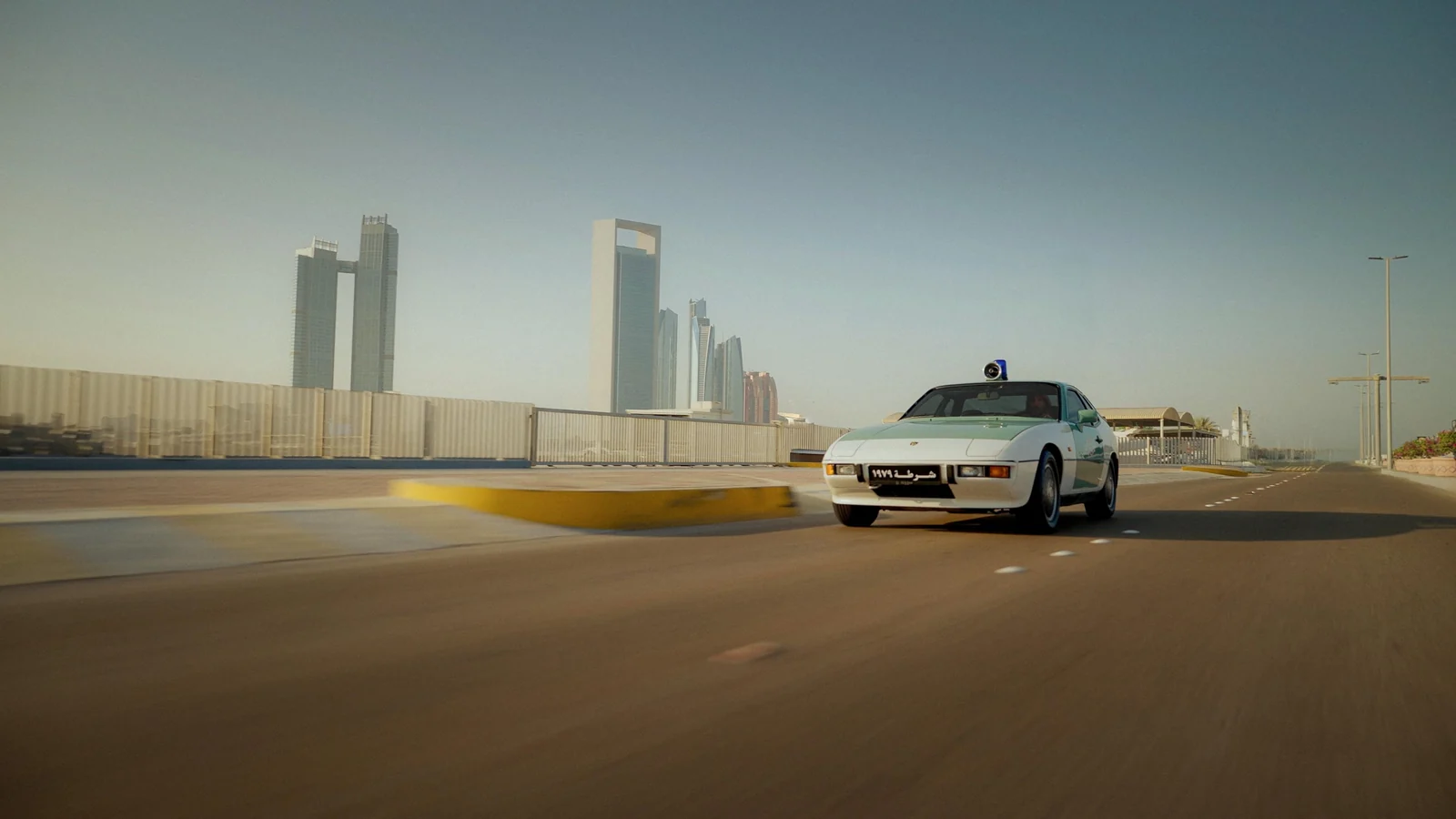
The Porsche 924 acquired by Abu Dhabi Police to escort Queen Elizabeth II during her 1979 visit has been restored by Porsche Centre Abu Dhabi and Al Ain. Porsche announced the completed project on 9 November 2026, with a first public display planned at Icons of Porsche on 21–22 November. Its significance goes beyond performance specifications: this is a particular vehicle whose working life, appearance and institutional history are central to understanding why it has been preserved.
What matters
This 924’s documentary value connects the vehicle with its police role and a restoration that even recreates its painted markings.
An escort car with a specific documented role
Porsche says the 924 was acquired for Queen Elizabeth II’s first visit to the United Arab Emirates in 1979. The manufacturer describes it as the country’s first performance police car. This is a claim about a particular institutional role. It should not be expanded into a claim that it was the UAE’s first police vehicle or the first sports car ever driven there.
The car therefore has two connected timelines: the history of the production model and the history of its service. Knowing that the 924 family was launched in 1976 would not, by itself, establish that any particular example joined a royal escort. Here, the relevant identification is supplied by the manufacturer, the restoring centre and the police in their account of the preserved vehicle.
Source: Porsche · 2026-11-09 ↗ · Porsche Middle East · 2026-11-09 ↗
Completion and a public exhibition are separate milestones
Porsche describes a completed restoration by its Abu Dhabi and Al Ain centre, part of Ali & Sons Holding. The car was formally returned to the police during a ceremony at Al Maqta Museum. That handover and the announcement dated 9 November establish the restoration milestone as reported by the parties. General public display follows a separate timetable.
The announced programme places the car at Icons of Porsche in The Square, Nad Al Sheba, Dubai, on 21–22 November. Afterwards, its intended new home is the museum in Abu Dhabi. At this review date, those future appearances remain announced plans. They are not events that have already taken place, nor proof that the restored vehicle can already be visited without checking arrangements.
Source: Porsche · 2026-11-09 ↗ · Porsche Middle East · 2026-11-09 ↗
Why recreating painted lettering matters
According to Porsche, the restoration team recreated the original painted signage instead of applying modern decals. This is a small surface detail with a substantial interpretive role. The police markings communicate what the car did. A tidy finish using a different visual language could move the vehicle away from the period identity the restoration is intended to preserve.
The choice also helps distinguish restoration from personalisation. Recovering a documented technique and appearance seeks to approach an earlier identity. Creating a new decoration serves a different purpose, even if the result is attractive. The announcement does not supply a complete replacement-parts inventory. It therefore cannot establish that every component on the restored car is the exact component fitted in 1979.
Source: Porsche · 2026-11-09 ↗
The transaxle layout explains the kind of Porsche it was
The 924 combined a front-mounted engine with a rear-mounted transmission: a transaxle arrangement quite different from the rear-engine layout associated with the 911. Porsche’s archive traces its development to EA 425, originally a Volkswagen commission. After Volkswagen withdrew, Porsche took on the project and brought the car into its own range. That background explains why its proportions represented a significant departure.
The layout distributes major drivetrain elements along the vehicle. Explaining the front engine, connecting driveline and rear transmission makes the concept understandable without assigning this police car an engine output or special preparation that the restoration sources do not specify. Its escort duty is also not an independent comparative road test. Historical purpose and measured vehicle performance remain separate kinds of evidence.
An anniversary that can tell more than one brand story
The 924 arrived in 1976, and in 2026 Porsche is marking fifty years of its transaxle family. The 928, 944 and 968 also belong to that wider history. This restoration adds a public-service career to an anniversary that can also be explored through motorsport, design or mechanical development. It gives a familiar model name a different setting.
Our reading is that a collection becomes more informative when it preserves different uses of the same kind of car. A police example raises questions about an institution, an occasion and a distinctive visual identity. A competition car leads to another body of records. Sharing a model name does not make the stories equivalent, and neither should casually substitute for the other as an illustration without context.
Source: Porsche · 2026-11-09 ↗ · Porsche · Transaxle · 2026-07-31 ↗
What a classic-car buyer can take from the project
A useful question for anyone considering a restored classic is which point in its life the work is meant to recover. The answer should connect the car’s identification, earlier photographs and a record of the work. Describing a car as “restored” does not explain which assemblies were preserved, replaced, reproduced or modernised. This is editorial guidance for evaluating other vehicles, rather than an independent audit of the Abu Dhabi 924.
Comparing the purpose with a classic-car certification such as the Maserati Ghibli SS case helps clarify the documentation involved. Neither a restorer’s name nor an attractive photograph replaces a certificate’s written scope. Porsche is reporting a heritage restoration here. We are not assigning the car an additional authenticity certificate that the source has not announced.
Planning a visit around the announced programme
Readers hoping to see the car in Dubai should check Icons of Porsche’s programme and tickets for 21–22 November. The regional announcement listed admission at AED85 and free registration for children under twelve accompanied by a ticketed adult. Those were organiser-published conditions and should be reconfirmed before arranging travel. They are not a ticket offer from Autohaus.
For a later museum visit, an announced destination does not in itself confirm opening hours, the installation date or access arrangements. Keeping these questions separate avoids planning a journey around a display that has not yet been verified. The completed restoration is the recent reported fact; the Dubai festival and subsequent museum placement are the next announced stages.
The restored 924 brings together an identifiable service history, a specific decision about its markings and a distinctive technical background. Preserving those connections is its central interest. The next public milestone will be confirming its appearance at the festival announced for November.
Sources & editorial policy
Written by Autohaus Zephyr from the linked sources. Manufacturer figures are attributed claims, not our own tests. The practical comparisons and clearly identified examples are editorial analysis. Market availability and specifications require confirmation for the exact car.
Corrections: [email protected]
How we work →Keep reading
- The 1970 Ghibli SS: what Maserati Classiche certification establishes
- Mazda MX-5: How to Assess a Lightweight Roadster Beyond Horsepower
- Porsche Approved on a used car: what to check before paying