
News · News & analysis
The Black Mambas’ Cayenne: an SUV equipped for patrol work
Porsche’s report published on 6 November shows a specific role for a second-generation Cayenne: supporting South Africa’s all-female Black Mambas anti-poaching unit. Its automotive interest lies in adapting an existing vehicle to a task through off-road tyres, protection and working equipment. This is a new account of that service, rather than a production-model launch or evidence that the donation occurred on the publication date.
What matters
Useful capability comes from preparation, people and communications working together. The vehicle’s power output alone cannot explain an operational response.
A working area rather than a visitor itinerary
The account follows ranger Vongani Masingi in Olifants West and surrounding protected areas in the Greater Kruger region of north-eastern South Africa. It describes a patrol area of approximately 200 square kilometres. That is an area, not the length of a route or the car’s daily mileage. Journeys change according to the unit’s needs.
Porsche describes gravel tracks, rocky sections and connecting asphalt roads. Rougher stretches call for a slower pace and careful line choice. A journey may cover five or ten kilometres, changing with the next request for help. The task involves carrying and linking support locations as well as negotiating an obstacle; the patrol area is not a visitor itinerary.
Source: Porsche Newsroom — Black Mambas working journeys, 6 November 2026 ↗
What has been changed on this Cayenne
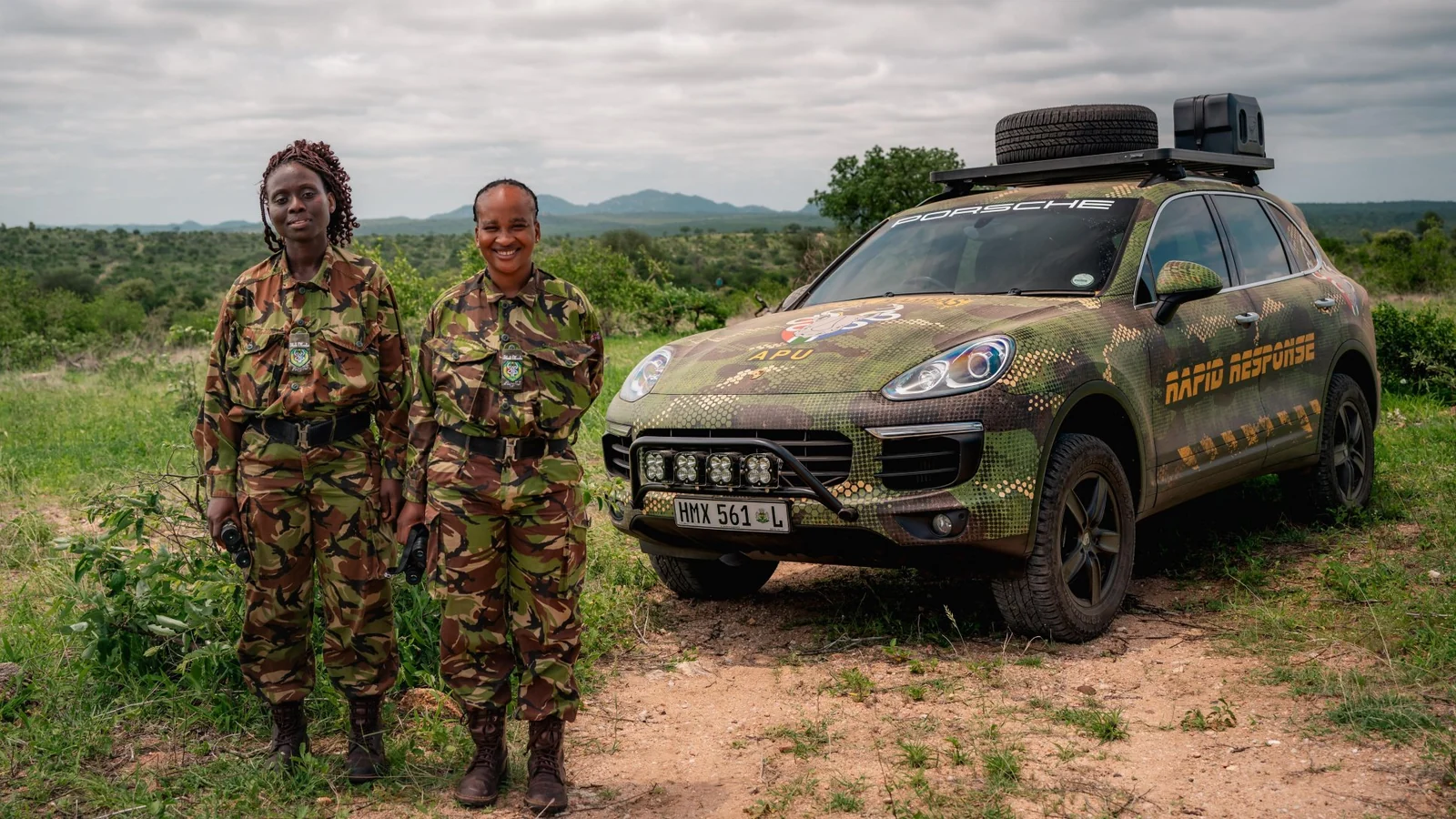
According to Porsche, Porsche South Africa donated the vehicle and Porsche Centre Johannesburg prepared it. The account lists suspension upgrades, underbody protection and off-road tyres. Additional lights support night work, while a roof rack carries a full-size spare wheel and equipment. These changes address obstacles, visibility and the needs of a working journey, rather than forming a cosmetic accessories package.
Interpreting their function, underbody protection and tyres address contact with the terrain; lights support observation at night, while a full-size spare provides a response to a puncture away from base. The vehicle must also carry people and supplies. The release gives no final payload or dimensions, so those functions do not amount to a reproducible conversion specification.
Source: Porsche Newsroom — Black Mambas working journeys, 6 November 2026 ↗
The operations room is part of the system
Masingi begins her working day checking the radio and phone that keep her in contact with the operations room. Patrols look for signs of poaching, inspect fences and watering holes, and use thermal night-vision equipment. They often work on foot and in pairs. The Cayenne transports teams and supplies and supports responses when required.
At headquarters, a map records where snares and cable traps have been found so those locations can be checked again alongside fresh territory. That knowledge directs transport and vehicle responses. Field information determines the destination; the Cayenne’s preparation helps complete the journey. This is a logistical reading of its role, without measured before-and-after response times.
Source: Porsche Newsroom — Black Mambas working journeys, 6 November 2026 ↗
Visibility serves a purpose of its own
The Cayenne’s livery identifies the Black Mambas and its response role. Porsche explains that visible patrols are intended to deter poachers. The unit described works without firearms, carrying handcuffs and pepper spray, and calls on specialist teams when additional support is needed.
Being recognisable is therefore part of the mission. Physical preparation helps the work, while the livery communicates who is present. Masingi describes finding fewer traps than in the project’s early days; that is her account of the unit’s work, rather than a measured effect attributable to the Cayenne. Conservation outcomes belong to a much wider operation.
Source: Porsche Newsroom — Black Mambas working journeys, 6 November 2026 ↗
Assessing an adapted vehicle without copying a recipe
For a used 4×4 prepared for another activity, this case suggests three checks: document its previous use, inspect modifications and establish the final configuration’s limits. Underbody protection calls for checking damage and mountings; suspension needs component and condition checks; a rack needs secure fixings and permitted loads. These are general inspection criteria, rather than findings from an examination of this car.
Function must also be separated from wear. A rack and spare wheel address a working requirement, but their presence cannot establish past loading, mounting condition or maintenance history. Tyres should be assessed through their specification and condition, rather than appearance alone. The Black Mambas’ case illustrates adaptation to a recognisable purpose. It is not universal approval for accessories or a comparative off-road test.
Source: Porsche Newsroom — Black Mambas working journeys, 6 November 2026 ↗
The report shows the Cayenne as one part of a conservation operation. Preparation, communications and knowledge of the terrain explain its role more clearly than an isolated power figure.
Sources & editorial policy
Written by Autohaus Zephyr from the linked sources. Manufacturer figures are attributed claims, not our own tests. The practical comparisons and clearly identified examples are editorial analysis. Market availability and specifications require confirmation for the exact car.
Corrections: [email protected]
How we work →Keep reading
- Compass 4xe: how SNOW mode manages its two electric motors
- How to Arrange a Car Inspection in Germany: A Buyer’s Checklist
- Tire labels: how to compare grip, noise and efficiency without a false shortcut