
News · News & analysis
Kadett and Astra at 90: the choices that reshaped the compact
Opel marked 90 years of the Kadett/Astra lineage on 18 November, tracing it back to the 1936 Kadett. Twelve generations tell more than a sequence of model names. They show changing answers to the same problem: carrying people and luggage in a compact car. The anniversary release does not make the current Astra a new launch on that date.
What matters
To understand or buy a classic, identify its generation and engineering; a shared name does not describe the whole car.
1936: the body becomes part of the structure
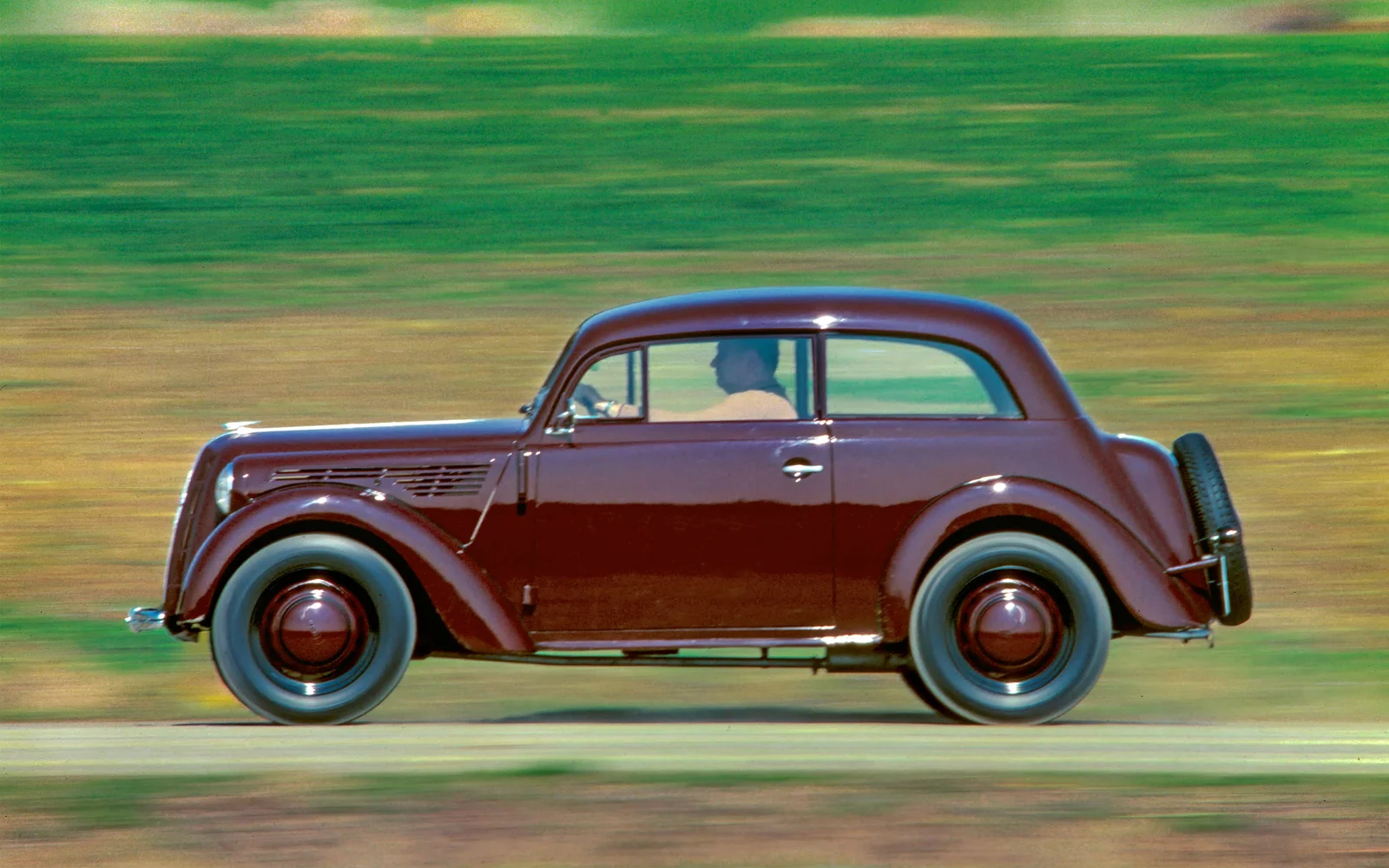
The first Kadett generation was produced from 1936 to 1940. According to Opel, it followed the Olympia in using an all-steel unitary body rather than the traditional wooden body on a separate frame. The significance went beyond the material visible outside. Integrating the structure changed weight, rigidity and production organisation. Opel gives a total of 107,608 cars for that initial period, not for the entire family across ninety years.
Its 1,073 cc engine and 23 hp belong to a very different context from today’s compact cars. Comparing that number directly with a modern hybrid would say little about practical progress. A historical reading should ask what transport the car offered and how it was built. The official archive photograph shows a 1936 Kadett in motion. It does not document a contemporary Autohaus journey or establish the condition of a particular car currently offered for sale.
Source: Opel · 2026-11-18 ↗
1962: a return, not uninterrupted production
The 1962–1965 Kadett A revived the name after the war. Its water-cooled front engine, space for four and separate luggage compartment expressed a family-car proposition different from other solutions in the German market. Opel dates the Caravan’s arrival to March 1963, using the same 993 cc, 40 hp four-cylinder engine. Celebrating the lineage does not mean a single production line had run continuously since 1936.
The Kadett B followed in 1965 and the C in 1973. The latter became the final rear-wheel-drive Kadett. A generation letter may look like a detail for collectors, but it identifies an architecture with practical consequences for component locations, parts, bodies and documentation. Before comparing classic-car listings, record the exact year and generation. Accessories or sporting modifications do not automatically turn an ordinary example into the historical version pictured in a catalogue.
Source: Opel · 2026-11-18 ↗
1979: changing the drivetrain to use space differently
The Kadett D introduced front-wheel drive to Opel in 1979. The company describes a car shorter than its predecessor, measuring 3,998 mm, yet with improved interior packaging. That change helps explain compact-car development without assuming that progress always requires greater exterior size. Mechanical layout and the allocation of space can matter as much to usefulness as the distance between the bumpers.
This does not establish that every front-wheel-drive car is automatically roomier or better than every rear-wheel-drive one. It describes a particular model’s design decision. For a present-day assessment of Astra practicality, our Opel family-car space comparison answers another question using contemporary vehicles. The purpose here is to understand the architectural change, without transferring the Kadett D’s dimensions to a car that shares its name’s heritage rather than its actual body or engineering.
Source: Opel · 2026-11-18 ↗
1984 and 1991: air, safety and a new name
With the Kadett E, Opel placed particular emphasis on aerodynamics. The retrospective compares the D’s drag coefficient of 0.39 with 0.32 for the E and 0.30 for the GSi. These figures are not fuel-consumption percentages. Drag coefficient needs to be understood alongside frontal area and driving conditions. It explains a design objective, but cannot support a promise of identical savings on every journey or erase differences between body styles.
The Astra F replaced the Kadett name in continental Europe in 1991 and, according to Opel, reached 4.13 million units between 1991 and 1997. The brand highlights front belt tensioners, belt adjustment, side reinforcement and catalytic converters across the engine range. These are milestones for that generation. They are not equivalent to a present-day Euro NCAP assessment, nor do they prove the condition of a thirty-year-old example’s safety equipment after repairs, modifications or restoration.
Source: Opel · 2026-11-18 ↗
From Astra H to L: technology reaches more buyers
The release places adaptive AFL lighting in the 2004 Astra H and the introduction of Intelli-Lux matrix LEDs to the compact segment with the 2015 Astra K. The common thread is bringing features associated with more expensive classes to a more widely sold car. Innovation must still be separated from availability. A technology introduced to a range is not necessarily standard on every trim, in every market or throughout every production year.
The Astra L generation was unveiled in 2021. Its current development encompasses several powertrains, including electric and electrified options. The anniversary release mentions design, lighting and seat improvements, but does not constitute a fresh order opening in every country. German CO₂ classes in its WLTP information are not Spanish DGT environmental stickers either. Anyone buying for Spain or importing a car still needs to check the actual configuration and documentation rather than translating a foreign-market label into an assumed entitlement.
Source: Opel · 2026-11-18 ↗
Useful history without an invented used-car promise
The ninety-year story includes advances and interruptions. It is not a warranty inherited by every car carrying an Astra badge. For a classic, prepare an identity record covering chassis number, date, body, engine, specification and later alterations. Separate a restoration to original specification from a modern conversion. That is a suggested buying method, not a statement that this magazine has inspected or certified any individual vehicle.
The 1956 Kapitän anniversary and the Rekord B associated with Nasenius concern different cars and events. Preserving those identities prevents three anniversaries becoming the same recycled report. For Kadett/Astra, the distinctive value is tracing body construction, drivetrain layout, aerodynamics and safety adoption through the compact line. This is historical analysis, not a contemporary road test or a promise that a particular classic will increase in value.
Source: Opel · 2026-11-18 ↗
Kadett and Astra show how a compact car can evolve through structural changes and shifting priorities as well as a new name. Generations, dates and engineering choices explain those ninety years better than an imagined uninterrupted commercial story.
Sources & editorial policy
Written by Autohaus Zephyr from the linked sources. Manufacturer figures are attributed claims, not our own tests. The practical comparisons and clearly identified examples are editorial analysis. Market availability and specifications require confirmation for the exact car.
Corrections: [email protected]
How we work →Keep reading
- The 1956 Kapitän: 70 years since Opel’s two-millionth car
- Rekord B: Nasenius’s 1966 European Group 1 title car
- Which family Opel fits: seats, luggage and access before litre figures