
Motor · News & analysis
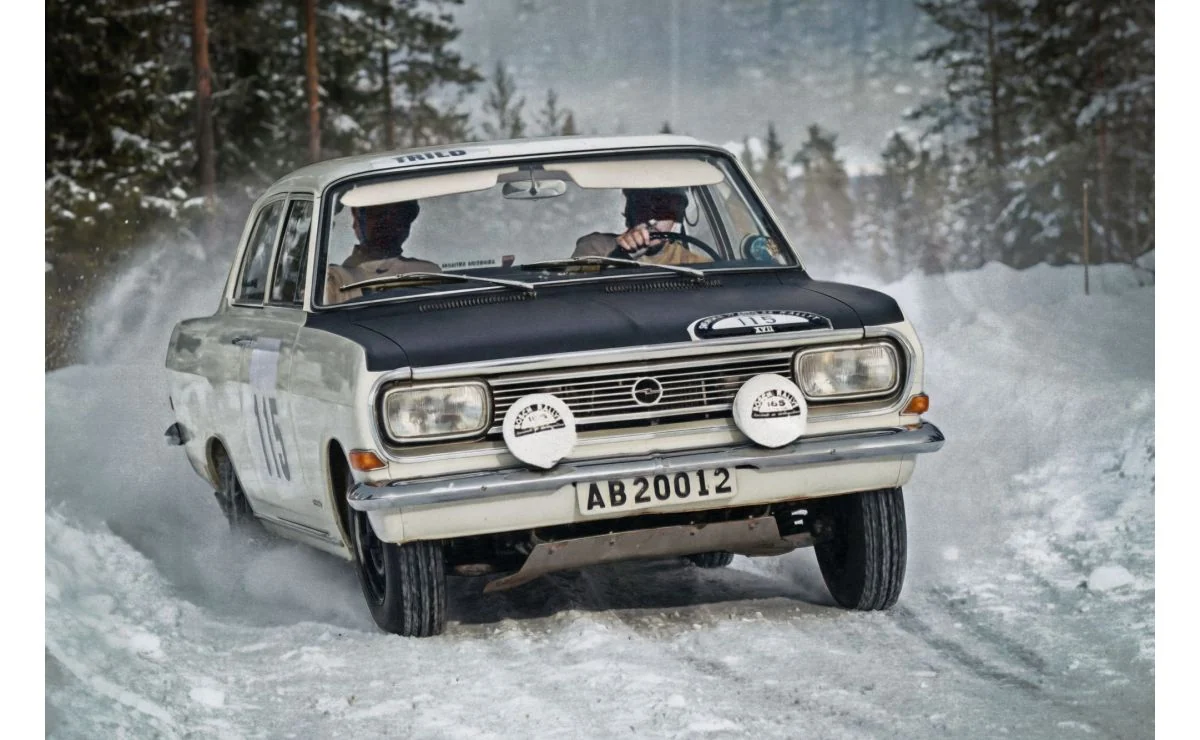
Rekord B: Nasenius’s 1966 European Group 1 title car
Sixty years on, Opel is revisiting the Rekord B in which Lille-Bror Nasenius won the 1966 European rally title for Group 1 production touring cars. Its 5 November account recalls a combination that stands out today: a competition car that also served its driver as family transport.
What matters
The production category gives the story meaning: 66 kW, 990 kg and a specification Opel describes as standard apart from tyres and dampers. The result is better understood through the complete vehicle than through engine output alone.
A January contract and two titles in one year
Nasenius began on motorcycles before moving to cars and collecting regional class and overall victories. Opel signed him as a professional in January 1966. That autumn, the Rekord B brought both the Swedish title and the European production touring-car championship, according to the manufacturer’s historical account.
The European achievement belongs to Group 1. The World Rally Championship did not yet exist, so the period competition and category are essential context. It is not a result in today’s European championship. For Opel, it was an early milestone on a path later including Walter Röhrl and Christian Geistdörfer’s 1982 world title in the Ascona 400.
Source: Opel — Nasenius and the 1966 Rekord B, anniversary report, 5 November 2026 ↗
The Rekord 1900 S: low mass and a 1.9-litre engine
The Rekord B described used a 1.9-litre four-cylinder CiH engine producing 66 kW, quoted as 90 hp in Opel’s release, and had a 990 kg kerb weight. According to the manufacturer, it retained standard specification apart from tyres and dampers. Nasenius, a father of two, also used it as a family car.
Dividing 66 kW by 0.99 tonnes gives roughly 66.7 kW per tonne, our nominal calculation from those figures. It describes the relationship between engine and mass, rather than an actual stage weight. The calculation explains why both quantities belong together when assessing a light car: occupants, fuel and luggage change the load the engine must move.
Source: Opel — Nasenius and the 1966 Rekord B, anniversary report, 5 November 2026 ↗
Why tyres and dampers matter
The two named changes act on the relationship with the surface. In engineering terms, tyres transmit acceleration, braking and cornering forces; dampers control suspension movement. On an uneven road, how the wheel follows the surface affects how effectively the car’s mechanical capability can be used.
That helps explain the Rekord’s limited preparation: using available adhesion effectively can matter as much as additional power. The account supplies no tyre dimensions or damper settings, so it is not a specification for recreating the car. Its useful detail is the choice of priorities within a category close to production machinery.
Source: Opel — Nasenius and the 1966 Rekord B, anniversary report, 5 November 2026 ↗
The 1967 Rekord C changed the balance
Nasenius moved to the Rekord C for 1967. It retained the engine and had a stated 1,025 kg kerb weight, 35 kg more than the B. Opel credits its precisely guided coil-spring rear axle with improved manoeuvrability. He also contested some races in the six-cylinder Commodore A and ended the year a narrow European runner-up.
With the same output, the C’s nominal ratio is about 64.4 kW per tonne, below the B’s. Yet Opel describes a more agile chassis. This is a concrete example of why power-to-weight cannot describe the entire response: wheel location and suspension matter too. The championship position also summarises a season, rather than a controlled comparison between the two cars.
Source: Opel — Nasenius and the 1966 Rekord B, anniversary report, 5 November 2026 ↗
Kadett, Ascona and the co-driver partnership
The move to the Rallye Kadett 1900 S in 1968 brought four overall victories. His partnership with Björn Cederberg began in 1969, followed by consecutive Swedish titles through 1971. Opel counts five national championships in its association with Nasenius. In 1972 and 1973, he drove the Ascona.
His 1977 return used a Kadett C 1200 S: seven championship rounds produced two class wins. Opel’s career summary gives 11 overall and 35 class victories, including nine and 31 respectively in its cars. The changing machinery and co-driver partnership describe a career extending well beyond the Rekord B’s single title season.
Source: Opel — Nasenius and the 1966 Rekord B, anniversary report, 5 November 2026 ↗
| Car | Output | Kerb weight | Calculated output per tonne |
|---|---|---|---|
| Rekord B, 1966 | 66 kW | 990 kg | 66.7 kW/t |
| Rekord C, 1967 | 66 kW, same engine | 1,025 kg | 64.4 kW/t |
The anniversary recovers a Group 1 achievement and a car combining competition with daily life. Moving from B to C and then Kadett changed mass, chassis and approach. That history of adaptation is richer than a comparison of engine outputs.
Sources & editorial policy
Written by Autohaus Zephyr from the linked sources. Manufacturer figures are attributed claims, not our own tests. The practical comparisons and clearly identified examples are editorial analysis. Market availability and specifications require confirmation for the exact car.
Corrections: [email protected]
How we work →Keep reading
- GSE Rally Cup: Dufour leads Lloyd by six points after Saarland-Pfalz
- WRC27: How to distinguish an approved rulebook from a confirmed car and entry
- Mazda MX-5: How to Assess a Lightweight Roadster Beyond Horsepower