
Motor · News & analysis
The 1956 Kapitän: 70 years since Opel’s two-millionth car
On 9 November 1956, Opel’s two-millionth car left Rüsselsheim: a Kapitän. Seventy years later, the anniversary is a useful way to identify that particular saloon and distinguish a brand-wide manufacturing milestone from sales of one model.
What matters
Two million was Opel’s cumulative car-production total since 1899. The commemorative Kapitän represents that history; it was not the two-millionth example of the Kapitän model.
One anniversary, two different Kapitäns
On 9 November 2026, Opel’s Italian press office recalled the car that had left Rüsselsheim exactly seventy years earlier. The company’s cumulative car count began in 1899. Its one-millionth vehicle, produced in 1940, had also been a Kapitän, but an earlier one. Sharing a name does not make the two cars the same design or allow their specifications to be exchanged.
The anniversary is about continuity in manufacturing. A representative saloon was chosen to celebrate a total which included other Opel models. Calling the event the production of two million Kapitäns would therefore make a substantial error: it would confuse the individual car selected for the celebration with the entire population being counted. For a reader looking at an archive photograph, the year, specific vehicle and body generation explain far more than the round number alone.
Gold identifies the commemorative example
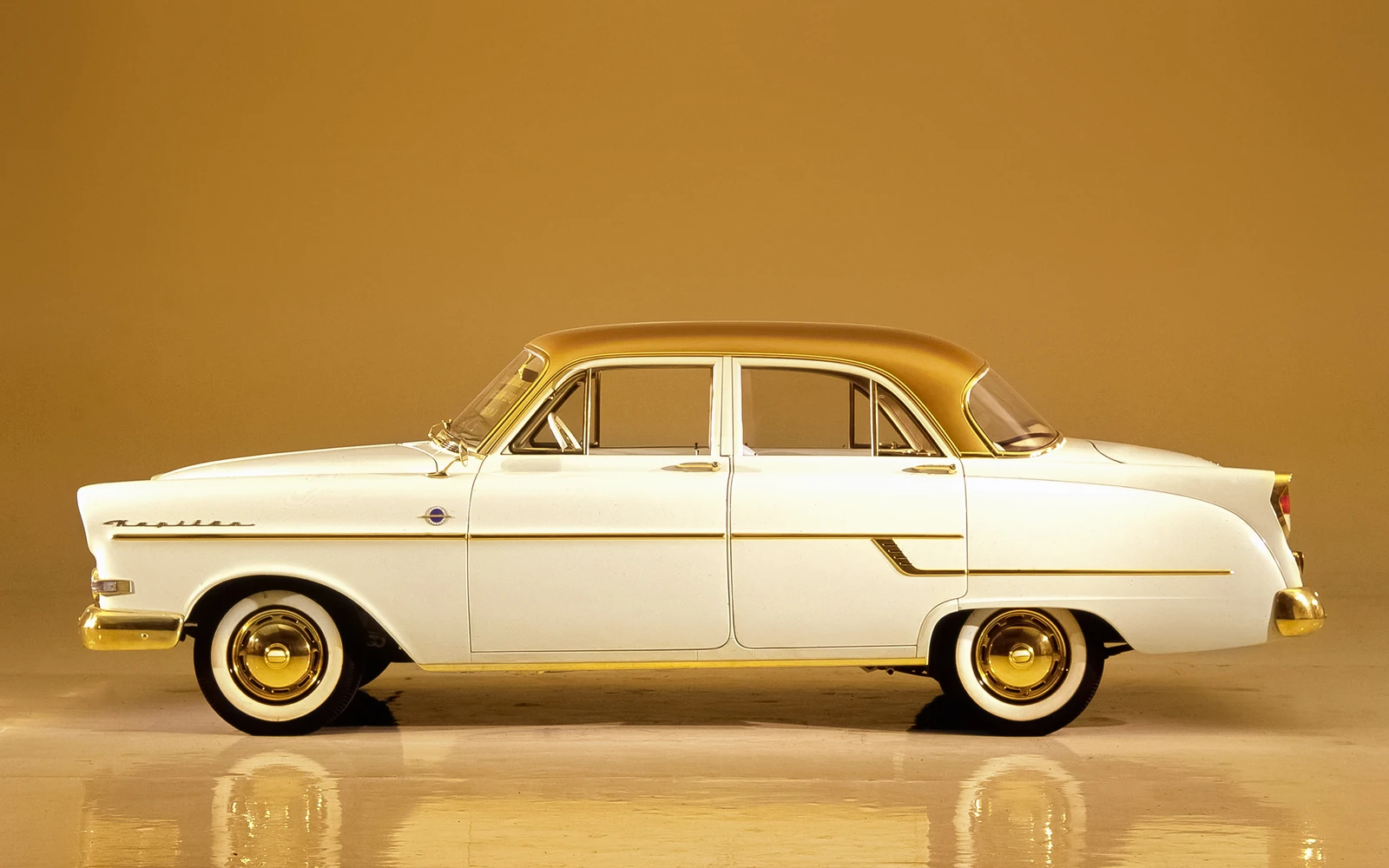
Opel’s 2022 retrospective describes the 1956 milestone car as cream-white, with 24-carat gold applied to parts that would ordinarily be chromed. That treatment makes the anniversary example recognisable, but also means it should not be used as evidence of how every ordinary Kapitän left the factory. A celebration car has its own identity within the wider production series.
The official archive photograph accompanying this article shows a four-door saloon with a gold-coloured roof and detailing. The manufacturer’s album specifically identifies it as the 1956 two-millionth Opel; its digital asset record was updated on 15 October 2025, without identifying the capture date. It helps the reader recognise the historic example. It does not establish a recent restoration, mechanical condition inspected by us or an offer for sale. Nor would another white car of the period acquire the same specification merely by looking similar.
Source: Opel · 2022-11-08 ↗
The six-cylinder specification places the 1956 version
The anniversary release describes this period of Kapitän with a 2,473 cc straight-six producing 75 PS, expressed as 55 kW by Opel. It also gives 92,555 examples for the 1955–1958 period. That second figure concerns a particular series of the model, unlike the brand-wide cumulative total of two million. The numbers have different denominators and answer different historical questions.
For someone identifying a surviving car, displacement and output are more useful than placing every 1950s Kapitän in one group. Its American-influenced outline, decorative trim and hubcaps belong to the historical description, but are not sufficient evidence of an individual vehicle’s identity without documentation. Combining the year, body and engine avoids assigning a later development to an earlier car simply because the commercial name continued.
Source: Opel Italia · 2026-11-09 ↗
The P1 and P2 belong to later chapters
The Kapitän P1 followed in June 1958, with panoramic windscreen and rear glazing extending around the sides and a different treatment of the body. Opel’s chronology associates its keyhole nickname with the rear-light shape. In 1959, the P2 brought another revised body and a 2,605 cc engine, rated at 90 PS or 66 kW in the 2026 anniversary release.
These changes give a reader practical ways to interpret a photograph. An unexplained image of a 2.6-litre P2 should not stand in for the 1956 commemorative example, even though both carry the Kapitän name. Someone assembling family records, a collection description or exhibition notes can compare the glazing, rear bodywork and displacement against the relevant version. Understanding those distinctions adds historical value without pretending that this article is a contemporary driving test of either car.
A sequence of milestones is not an annual sales table
After the two-millionth car in 1956, Opel places the three-millionth in March 1960. Its 2022 retrospective also identifies the ten-millionth as a 1971 Rekord C Caravan, the twenty-millionth as a 1983 Senator CD and the fifty-millionth as an Omega built in December 1999. The 75-millionth was a Grandland GSe made in Eisenach on 8 November 2022. Both the chosen models and the manufacturing context change along the way.
This sequence shows how individual vehicles can represent a company’s history. It does not provide current sales or market share. The intervals are unequal, and cumulative totals combine different ranges and factories over time. Nor do they establish that every historic Opel was built in Rüsselsheim: the stated Eisenach origin of the 2022 Grandland directly prevents that generalisation. The scope of each number needs to travel with its date.
A factory symbol becomes an exhibition object
Opel Classic has documented the car’s later public role. In April 2017 the manufacturer included the 1956 two-millionth Kapitän in its flagship-model display for Techno Classica in Essen. That historic release records an appearance by the car in a particular exhibition. It does not mean the 2017 exhibition remains open or establish the vehicle’s present physical location.
Its documented exhibition life adds something different to the production statistic. A preserved object allows visitors to study proportions and finishes which a written timeline can only list. Identifying that object and recording its appearances is more useful than assigning a value from its age or gold detailing. The provenance of a singular anniversary car and the condition of a different Kapitän advertised for sale are separate matters; neither should be inferred from the other.
Source: Opel Classic · 2017-04-05 ↗
Keep the different historical questions separate
The 2026 anniversary gives a current reason to revisit an event from 1956. It is neither a new-model launch nor a newly reached production total. Our article on Nasenius’s Opel Rekord concerns competition history in 1966, while the Maserati Ghibli Classiche story concerns certification of an individual car. Together they show how sporting history, vehicle identification and industrial milestones require different kinds of evidence.
The commemorative Kapitän deserves attention for its combination of engineering, body design and symbolic purpose. It stands for two million cars made by the company while retaining the identity of a particular 1950s saloon. Keeping those levels distinct lets readers enjoy the anniversary without repeating the common mistakes that arise when labelling archive images, comparing generations or describing the scale of a manufacturer’s past.
Give the two-millionth Kapitän its complete identity: Rüsselsheim, 9 November 1956, a 2,473 cc straight-six and a distinctive commemorative finish. The cumulative number belongs to Opel; the photograph and the individual history belong to this particular car.
Sources & editorial policy
Written by Autohaus Zephyr from the linked sources. Manufacturer figures are attributed claims, not our own tests. The practical comparisons and clearly identified examples are editorial analysis. Market availability and specifications require confirmation for the exact car.
Corrections: [email protected]
How we work →Keep reading
- Rekord B: Nasenius’s 1966 European Group 1 title car
- The 1970 Ghibli SS: what Maserati Classiche certification establishes