
Motor · News & analysis
Mahlangu’s BMW Art Car in a new retrospective: archive and AI kept distinct
The Esther Mahlangu online retrospective launched through Google Arts & Culture on 11 November offers a way to look beyond the decoration of her 1991 BMW Art Car. It brings together her career and visual reconstructions of memories made with artificial intelligence. Their coexistence calls for a distinction between the physical vehicle, surviving documents and images interpreted afterwards. For an automotive reader, the useful question is what the exhibition reveals about the original object and what belongs to a new way of telling its story.
What matters
A new exhibition expands the context of the 1991 Art Car; reconstructed memories are not historical photographs.
The new development is an exhibition, not another Art Car
BMW places the online launch on Mahlangu's ninety-first birthday. The BMW 525i remains the twelfth work in the collection, created in 1991; this announcement does not introduce a production model or an edition available to order. The retrospective expands access to the context of an existing artwork, bringing together six cultural institutions and more than forty-five stories. Its novelty concerns interpretation and access rather than a replacement vehicle.
That change has a practical value. A remote visitor can pause over a detail, return to an image and compare periods in the artist's career without needing a nearby temporary exhibition. A digital display also changes the apparent scale, reflections and observer's position. Looking at a car on a screen cannot reproduce the full spatial experience of standing beside it, although it can make relationships visible that a quick visit to a gallery might miss.
Source: BMW Group · 2026-11-11 ↗ · Google Arts & Culture · Esther Mahlangu ↗
This 525i was conceived for exhibition
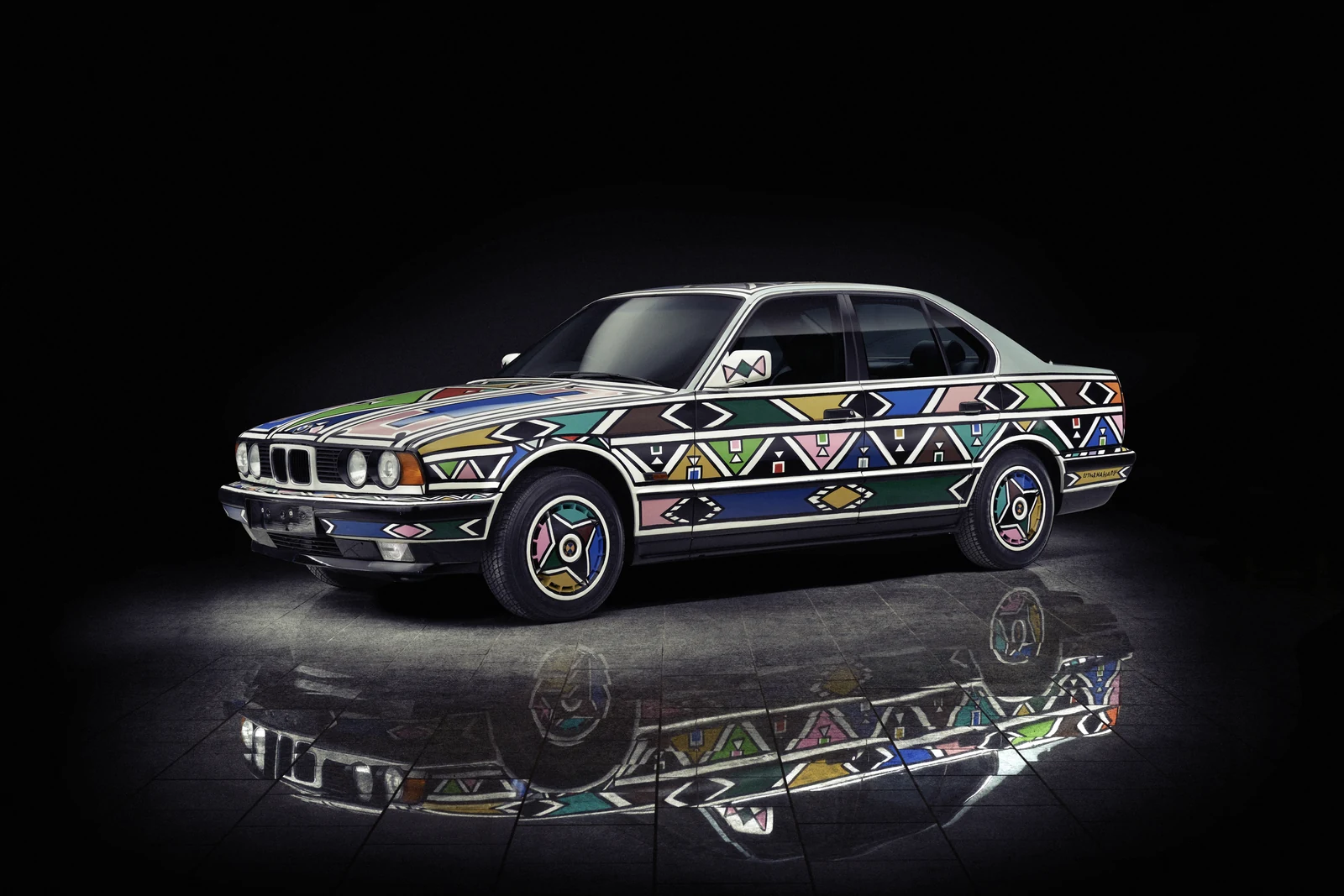
BMW identifies a 525i whose body received geometric patterns and vivid colours associated with Ndebele mural painting. The announcement also states that it was conceived exclusively as an exhibition piece and has never been driven on the road or in a race. A sporting history should not be inferred merely from membership of a collection whose origins do have a connection with motor racing. Each work has its own purpose and history.
A useful way to examine it is to follow a line as it crosses a bonnet, door or wheel arch. A composition that might otherwise occupy a flat wall encounters volumes and panel gaps that interrupt its surface. The automotive interest lies in that transformation of the support. It does not need an invented aerodynamic benefit, performance claim or special homologation to demonstrate how a vehicle's shape changes the way an artwork can be read.
Source: BMW Group · 2026-11-11 ↗
An archive photograph differs from a reconstruction
The retrospective combines archive material, artworks and digital experiences. BMW describes interviews and research used to reconstruct memories from before a documented part of Mahlangu's surviving archive. These moving sequences are visual interpretations of personal memories. They are not the work of a camera present during her childhood. Preserving that distinction keeps the project interesting without turning a contemporary storytelling technique into a document recorded at the time of the represented event.
Visitors should therefore read an image's credit and explanation before treating it as historical evidence. A recent publication date may accompany either an old photograph or a newly produced reconstruction. Those are different relationships with time. The lead image in this article is an official photograph of the physical Art Car with an identified photographer, rather than a generated frame from the sequences or a simulated artwork produced by Autohaus.
Source: BMW Group · 2026-11-11 ↗ · Google Arts & Culture · Esther Mahlangu ↗
Credit is part of the information
The selected studio photograph retains the credit of Enes Kucevic and BMW AG. Its distribution with the 11 November release does not make 2026 the car's creation year or establish the exact capture day. Nor does BMW's press distribution grant unrestricted rights to every image within Google's exhibition: different assets can have different owners and conditions. A photograph, the artwork it shows and the online presentation each require their own context.
This becomes particularly relevant when an image travels without its caption. Naming the photographer distinguishes the person who made the photograph from the artist who designed the work in front of the camera. Keeping both roles prevents an incomplete attribution. Our selection uses material offered by its issuer for editorial coverage. It does not advertise a car for sale, a commercial collaboration with Mahlangu or permission to reuse her design on unrelated products.
Source: BMW Group · 2026-11-11 ↗
Later digital projects use different possibilities
Mahlangu's relationship with BMW continued through other media. For the purposes of this retrospective, the key distinction is between the 1991 automobile and later projects involving projection or changing surfaces. Animation on a body changes over time; a fixed painting organises change through movement of the viewer. Comparing them is worthwhile because their possibilities are not interchangeable. Neither makes the earlier work obsolete or turns it into an early version of a customer feature.
An artistic demonstration of changing colour also does not establish an option available on every production vehicle. Our guide to software-defined cars makes a related distinction between demonstrating a capability, offering it on a particular configuration and supporting it through a vehicle's life. Here, however, the central purpose is cultural interpretation. The retrospective should be explored as an exhibition rather than read as a shopping specification for a new BMW.
Source: BMW Group · 2026-11-11 ↗
Visit with a specific sequence of questions
A useful visit can begin with an overall view of the 525i, move into the artist's stories and then return to details of its bodywork. On that second viewing, ask what has become visible beyond decoration. This connects support, authorship and context without assuming that everyone within a culture shares one interpretation of the car or the artwork. The goal is a more attentive encounter, rather than a single compulsory reading of every pattern.
Next, distinguish surviving photographs from reconstructed sequences and read how each was produced. Comparing the process with a historic restoration such as Abu Dhabi's Porsche 924 helps: preserving an object, documenting it and telling its story are connected activities that rely on different evidence. The online project gains depth when those differences remain visible, allowing the automobile to be understood within a wider artistic career rather than as an isolated decorated product.
Source: BMW Group · 2026-11-11 ↗
The retrospective provides an accessible way to study an automobile that is also an artwork. Its richest reading preserves the identity of the original 525i while distinguishing historical archives from digital interpretations of remembered experiences.
Sources & editorial policy
Written by Autohaus Zephyr from the linked sources. Manufacturer figures are attributed claims, not our own tests. The practical comparisons and clearly identified examples are editorial analysis. Market availability and specifications require confirmation for the exact car.
Corrections: [email protected]
How we work →Keep reading
- Abu Dhabi’s Porsche 924 police car returns with its historic identity
- Software-defined cars: what to check before you buy
- Lancia Design Days: from the Stratos to Pu+Ra design