
Market · News & analysis
Volvo announces 2,500 job reductions after a loss-making quarter
Volvo Cars reported a loss-making quarter and further workforce and cost measures on 23 October. The announcement matters industrially. Understanding it requires avoiding two shortcuts: treating every earnings measure as interchangeable, and turning a restructuring plan into an automatic prediction about the brand's survival or the value of its vehicles.
What matters
The workforce reduction is announced; reported losses, adjustments and cash need separate readings.
What the announcement changes
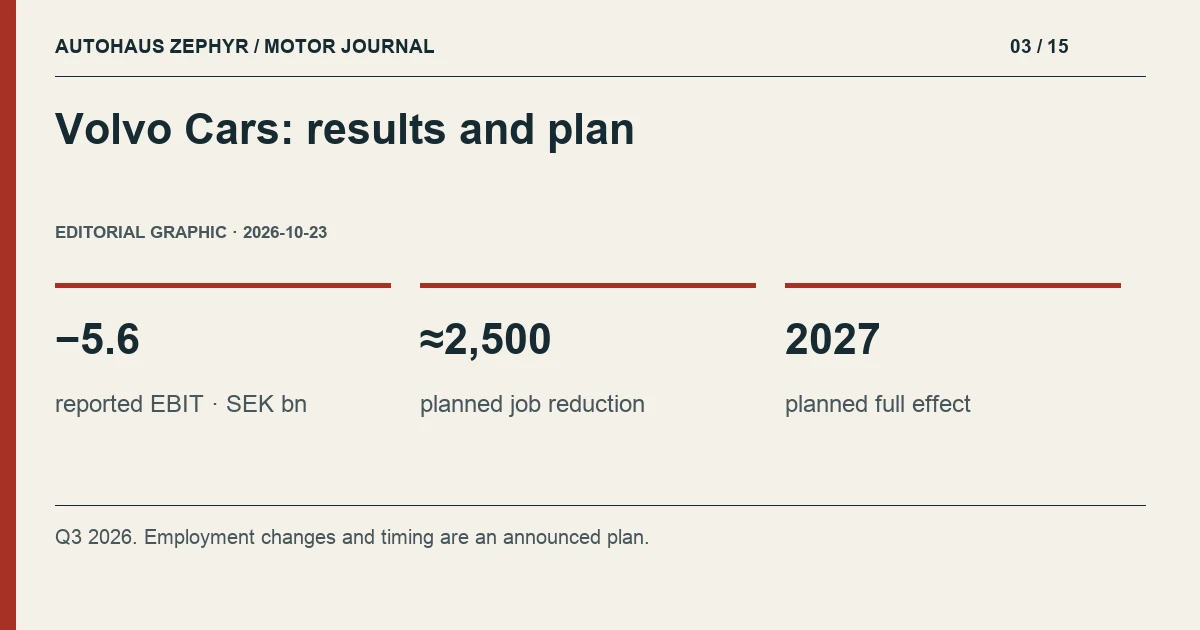
Volvo reported quarterly revenue of SEK66.9 billion, a reported operating loss of SEK5.6 billion and a SEK3.7 billion loss after specified exclusions. It announced an approximately 2,500-position structural reduction worldwide, including around 2,000 in Sweden, through several mechanisms. The full financial effects of the additional programme are expected by the end of 2027. This is a plan rather than a count of departures already completed.
Source: Volvo Cars, resultados del tercer trimestre de 2026 ↗
The quarter remains loss-making after adjustments
Reported operating loss was SEK 5.6 billion, with an −8.4% margin. Excluding income from joint ventures and associates and items affecting comparability leaves a SEK 3.7 billion loss and −5.6% margin. The adjustment changes the scale of the loss; it does not make the quarter profitable.
Volvo identifies a SEK 1.1 billion negative revaluation of US CAFE credits and recognition of SEK 0.9 billion in Polestar losses relating to the second quarter. Free cash flow was meanwhile −SEK 8.9 billion, against −SEK 4.3 billion a year earlier. That cash outflow gives a specific reason to monitor liquidity generation and costs alongside adjusted earnings.
Source: Volvo Cars, resultados del tercer trimestre de 2026 ↗
Workforce announcements require precise language
A planned reduction may combine expiring consultancy contracts, natural attrition and agreed employee exits. Those mechanisms are not interchangeable for the people involved or for the timing of costs. The aggregate figure indicates the intended scale, but cannot establish departures at a particular factory or function without further information.
Industrial assessment should consider which capabilities are retained and how knowledge transfers through the transition. A smaller organisation can reduce expenditure while still needing to protect engineering, quality and customer support. That is an evaluation framework, not a claim that these functions have deteriorated at Volvo. Evidence will come from execution and subsequent results.
European EV strength meets pressure in China and the US
Battery-electric cars accounted for 32% of Volvo’s global quarterly sales, up from 22%, and 45% in Europe. That product-mix strength coexists with regional problems: Chinese revenue fell by almost half. The company attributes the pressure there to new competitors and more aggressive pricing.
In the US, Volvo identifies tariffs and the removal of incentives for electrified cars as margin pressures. These are the company’s explanations, rather than our estimate of each policy’s effect. The industrial conclusion is more specific than declaring electric cars a success or failure: a manufacturer can expand its electric mix while struggling with production location, pricing and regional exposure.
Source: Volvo Cars, resultados del tercer trimestre de 2026 ↗
What owners and buyers should check
Corporate results do not themselves rewrite a warranty contract. For an individual purchase, the useful questions concern the responsible entity, written coverage, available service network and necessary digital services. Those conditions need checking against the actual vehicle and destination market, regardless of the day's financial headline.
Nor does the announcement imply a universal discount. Offers may vary with specification, inventory and commercial conditions without the release establishing a final price. A used car still requires checks on history, condition, battery where relevant and completed remedial work. Company accounts provide supplier context; they do not replace assessment of the product.
The product programme must progress during the cost reduction
The additional cost target is SEK 5 billion, with its full financial effect expected by the end of 2027. At the same time, Volvo retains a programme of thirteen new cars through the end of 2030. It plans to reveal one European and two China-specific models in 2027. Saving money and renewing the range are simultaneous commitments, so subsequent milestones need to cover both.
Volvo reports more than 50,000 European EX60 orders, while saying the production ramp using cell-to-body technology is taking longer than planned. It targets first deliveries of its next global electric car after summer 2027 and local XC60 production in Charleston in the first quarter of that year. Orders, manufacturing output and customer deliveries will therefore provide different checks on the recovery.
Source: Volvo Cars, resultados del tercer trimestre de 2026 ↗
Questions answered
Have all 2,500 positions already gone?
The release describes a planned structural reduction through different mechanisms. It does not establish that every departure has occurred.
Does the quarterly result change my warranty?
The result does not establish that. Coverage depends on the contract, responsible entity and conditions applying to the vehicle.
The news is a significant additional adjustment following a difficult quarter, with measures that take time to materialise. Separating reported results, adjustments, cash and execution makes progress assessable. Buyers should still verify the contract and vehicle rather than infer either from the accounts.
Sources & editorial policy
Written by Autohaus Zephyr from the linked sources. Manufacturer figures are attributed claims, not our own tests. The practical comparisons and clearly identified examples are editorial analysis. Market availability and specifications require confirmation for the exact car.
Corrections: info@autohauszephyr.ch
How we work →