
Industry · News & analysis
AutoLog in Emden: 5G and fleet control after two years of trials
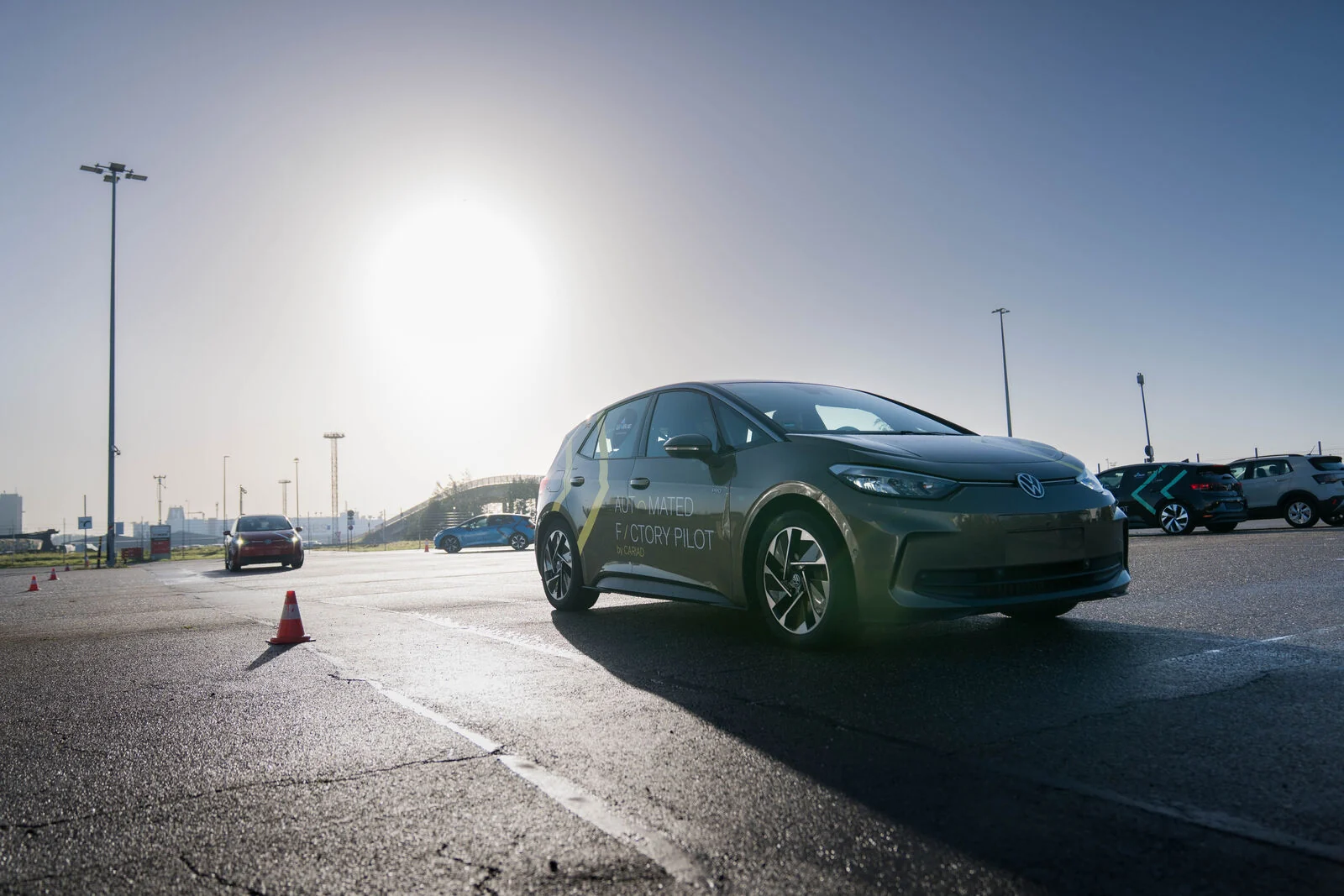
Volkswagen and its partners have concluded AutoLog’s joint testing phase in Emden. The project investigates vehicle movements within logistics areas. Its significance lies in coordinating cars, people and infrastructure, rather than announcing a self-driving product for car buyers.
What matters
Assess an automated yard as a complete operation. Moving a vehicle is only part of the job; assigning destinations, resolving conflicts and recovering from interruptions matter just as much.
What the end of testing establishes
Volkswagen announced the end of AutoLog’s joint testing phase on 28 October after more than two years of work with Deutsche Telekom, Unikie and BIBA, the University of Bremen’s Institute for Production and Logistics. Funded by Germany’s Federal Ministry of Transport, the project investigates driverless vehicle movements within actual logistics operations.
The end of trials does not end every evaluation task. BIBA says the final test series will be assessed during the remaining weeks before year-end to judge the practical applicability of the findings. The distinction matters: experience has been gained at a working site, with further work needed to decide where and how to apply it. The announcement is not a general port rollout or an autonomous feature for customers.
Source: Volkswagen Group — AutoLog testing phase ↗ · BIBA — AutoLog project scope ↗
Parking areas, routes and a busy roundabout
The site near Emden’s port contains parking areas, driving routes and a busy roundabout. Trials focused on automated vehicles interacting with manually driven ones and fitting into existing procedures. That is a different challenge from completing an empty route: the system must work where other people are already making decisions.
Volkswagen describes a digital representation of the parking areas for planning and coordinating movements. As an illustrative logistics problem, placing one car beside an exit may shorten its journey while obstructing another needed sooner. That example shows why the vacant space is not always the most useful destination: the decision must consider the next operation as well as the immediate movement.
How control, connectivity and processing fit together
The Unikie Marshalling Solution (UMS) handles overall vehicle control and coordination. Communication uses Telekom’s public 5G network, enhanced with additional capabilities for the application. UMS runs on an edge-cloud infrastructure, with processing connected through dedicated high-speed fibre close to the mobile network to support time-critical tasks.
Work is distributed across the vehicle, environment perception, communications and logistics software. Our interpretation is that its value must be assessed across the complete chain. A fast network response is insufficient if a parking state is outdated or an operation cannot resume in an orderly way after an interruption. Delay, lost connectivity and inconsistent data need different assessments; the release does not publish failure rates or recovery times.
The AVP reference and rail-loading pilot
AutoLog is guided by ISO 23374 for Automated Valet Parking. Volkswagen presents the standard as a project reference; the release does not publish certification for the site or every function. Its scope includes standardised communication and safe interaction between people, technology and other users of the logistics area.
The collaboration also tested automated vehicle loading onto rail wagons at Audi’s Ingolstadt site. Positioning a car for transfer from yard to rail adds a specific task to the Emden experience. It differs from the Audi humanoid project covered in the magazine: this pilot moves vehicles and coordinates their transfer, while the other addresses parts-logistics tasks.
Measure recovery as well as movement
A useful assessment matrix would include time to complete the whole operation, movements requiring human help, interruption duration and restoration of the work sequence. These are suggested measures, not published AutoLog statistics. Average vehicle speed could improve while a queue grows elsewhere. Studying the full flow helps distinguish an impressive manoeuvre from a more effective operation and shows where an apparent improvement may simply move a bottleneck to another stage.
For an industrial operation, those measures help establish whether automation reduces total work or merely moves a bottleneck. The linked Germany-to-Spain transport guide describes other stages of moving a car that do not disappear when a yard is automated. Emden’s contribution lies in integrating movements into an existing operation; subsequent evaluation must clarify continuity, supervision and application at other sites.
Source: Volkswagen Group — AutoLog testing phase ↗ · BIBA — AutoLog project scope ↗
AutoLog is interesting because it connects movement with an actual logistics operation. The next assessment must establish continuity, coexistence and recovery, without presenting the end of testing as universal availability.
Sources & editorial policy
Written by Autohaus Zephyr from the linked sources. Manufacturer figures are attributed claims, not our own tests. The practical comparisons and clearly identified examples are editorial analysis. Market availability and specifications require confirmation for the exact car.
Corrections: [email protected]
How we work →Keep reading
- Audi tests mobile humanoids for parts sequencing: the real automation task
- Transporting a car from Germany to Spain: choose a method, estimate costs and prepare documents