
Technology · News & analysis
Audi tests mobile humanoids for parts sequencing: the real automation task
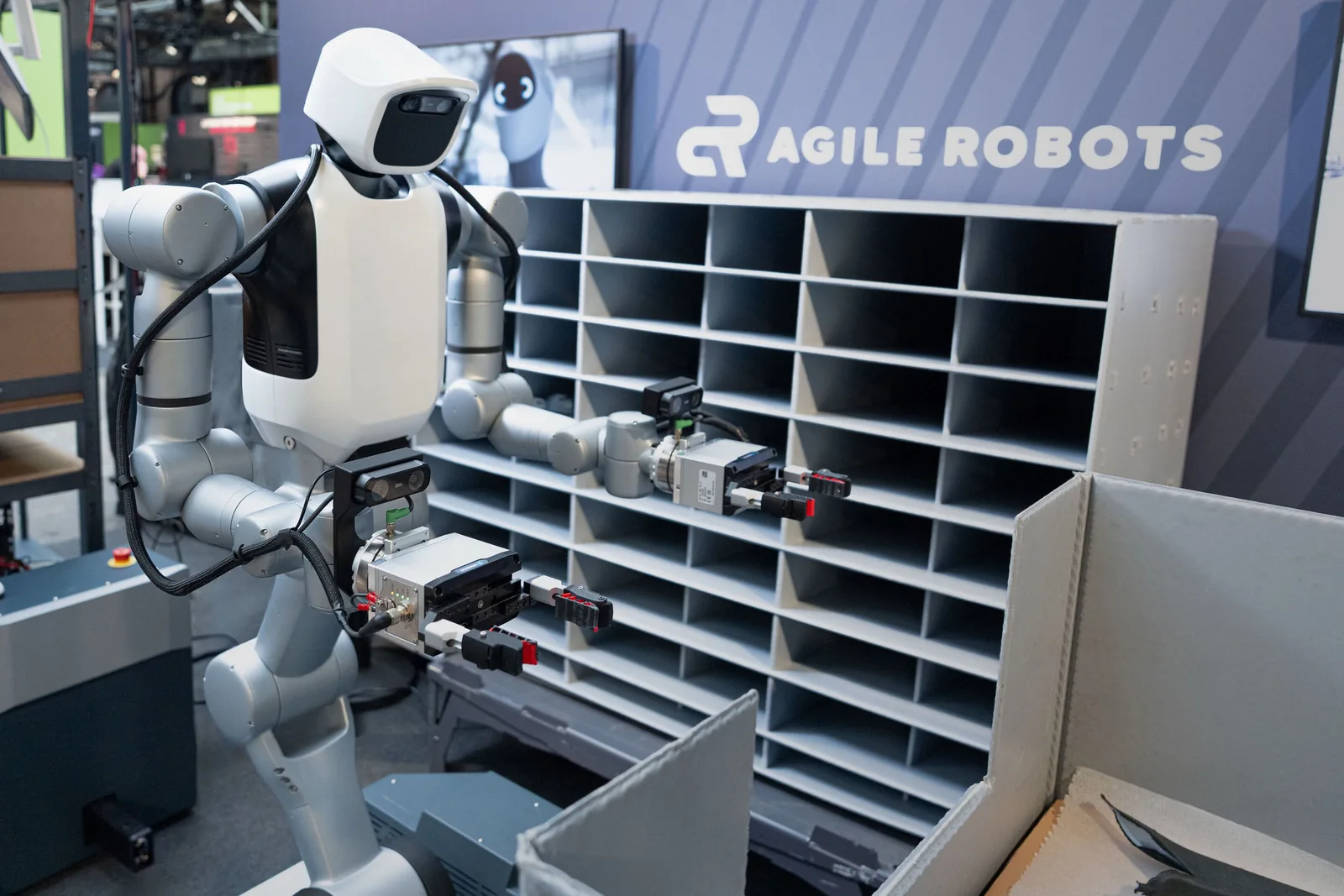
Audi and its partners announced a proof of concept on 21 October for mobile humanoids to sequence parts in Ingolstadt. The use case addresses variable and unsorted components in containers, a difficult automation task despite its daily repetition. Preparation combines Agile Robots’ machines with a Dassault Systèmes virtual twin and NVIDIA technology.
What matters
The task is mobile-robot parts sequencing; an autonomous factory and quantified workforce savings are not established.
A pilot with a defined task
Audi, Agile Robots, Dassault Systèmes and NVIDIA announced a parts-sequencing proof of concept for Ingolstadt at an event in Berlin. The release describes preparation using a virtual twin and robots combining dual-arm manipulation with a mobile base. This is an evaluated logistics use case, not established deployment of bipedal robots throughout every assembly line.
A million daily picks explains the process choice
Audi puts its daily sequencing requirement at around one million picks to get components to the correct workstation in the right order. That describes the reference logistics operation, not work already completed by the pilot’s humanoids. The Production Lab trial addresses picking components from containers and sequencing them for final assembly.
The partners identify two particular difficulties: highly variable or semi-rigid parts, and mixed or unsorted components in containers. A robot successfully grasping an item always presented in the same position tackles a different problem. Here, perception and manipulation must accommodate changing positions and packaging without continually passing exceptions back to people.
Humanoid shape is a means, not a performance measure
A machine can have a height and reach suited to existing facilities without needing two-legged walking for the task. Precise description matters. Appearance cannot establish dexterity, operational autonomy or an ability to work without oversight in every environment.
Assessment should ask which components the system can handle, how it detects mistakes and what happens when an item is out of reach. The effort required to introduce a new part reference also matters. A short video can demonstrate a successful action; productivity requires the frequency of exceptions and the human work needed to resolve them.
DELMIA and Omniverse prepare the mission before deployment
Dassault Systèmes provides a virtual logistics environment through DELMIA and its 3DEXPERIENCE platform, supported by NVIDIA Omniverse libraries. The project intends to test feasibility, timings, ergonomics and safety before physical deployment. LEO, Dassault’s virtual assistant, is presented as a future aid to accelerate that work, rather than an already proven general capability.
Responsibilities matter too: Audi defines operational requirements and supplies sequencing expertise, while Agile Robots develops the dual-arm machines with mobile bases. The announcement publishes no error rates, shift availability or validated savings. The virtual twin helps prepare the mission; industrial adoption will require checking whether performance survives the variability of real containers and shifts.
Safety and ergonomics need their own evidence
Reducing repetitive work can be a reasonable objective without proving that every deployment automatically improves working conditions. Human interaction, traffic, maintenance access and stop procedures need assessment. An intelligent component does not establish the safety of the complete installation.
Ergonomics includes work around the robot too: replenishment, rejected parts, fault recovery and cleaning. If those tasks move or become concentrated, the overall effect needs checking. This is a framework for assessing a pilot, not an allegation about Audi's project or a prediction of its workforce consequences.
Metrics that turn a demonstration into a decision
Useful follow-up would record correct parts per interval, errors, availability and intervention times. The comparison needs an equivalent baseline with consistent references and conditions. High isolated movement speed can conceal pauses that change an entire shift's outcome.
Integration, maintenance cost and flexibility then enter the decision. A technically functioning solution may still need economic or organisational adaptation. Until that assessment is available, exact savings, replaced jobs and lower vehicle prices should not be attributed to the announcement. The actual scope is narrower and therefore easier to evaluate.
Questions answered
Do these robots necessarily walk on two legs?
The source describes a mobile base and dual-arm manipulation. It should not be rewritten as a bipedal-robot deployment.
Does a virtual twin certify the pilot?
No. It supports preparation and assessment but needs physical validation and system-level safety checks.
The pilot matters because it targets variable work within real logistics. A proof of concept opens an industrial question. Repeatable results, safety and exception recovery will provide the answer. That is more useful than claiming robots already build Audi vehicles by themselves.
Sources & editorial policy
Written by Autohaus Zephyr from the linked sources. Manufacturer figures are attributed claims, not our own tests. The practical comparisons and clearly identified examples are editorial analysis. Market availability and specifications require confirmation for the exact car.
Corrections: info@autohauszephyr.ch
How we work →