
Motorsport · News & analysis
Toyota’s 2027 Dakar line-up: five Ultimate crews and a fuel-cell Hilux
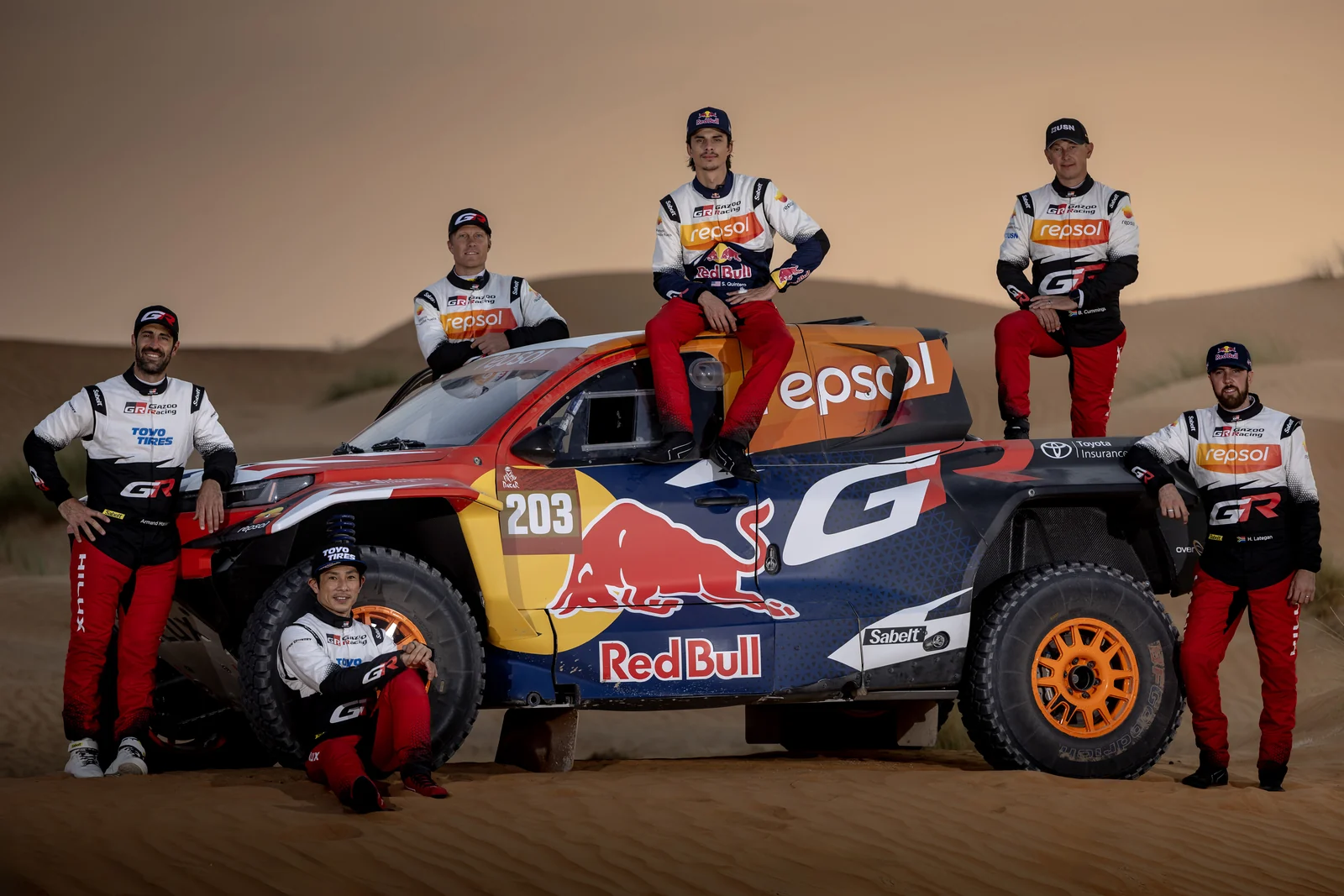
Toyota announced five Ultimate crews on 19 November, plus a sixth pairing for the fuel-cell DKR GR FC Hilux in Dakar Future Mission 1000. The 2027 Dakar is scheduled for 9–23 January between Portugal and Morocco. These are two programmes with different vehicles and objectives, rather than six entries chasing the same classification.
What matters
Follow the hydrogen project through its category and execution, without confusing it with a showroom Hilux or hydrogen combustion.
A combined line-up rather than a race result
GAZOO Racing Europe and GAZOO Racing South Africa are combining their efforts under GAZOO Racing TOYOTA. The announcement sets out the organisation and crews for a future event. Targeting victory in two categories states an ambition; it does not establish a win or confirm that every car has already completed all pre-start checks.
The interest lies in the two approaches. The Ultimate Hilux rally-raid vehicles use petrol engines, whereas the DKR GR FC Hilux explores electric propulsion supplied by fuel cells. The shared Hilux identity does not remove differences in technology, regulations or purpose. Reading only an overall leaderboard would miss much of what makes the second programme useful to follow. Its progress needs to be assessed against the demands and objectives of its experimental category.
Source: GAZOO Racing TOYOTA · 2026-11-19 ↗ · Toyota GB · 2026-11-19 ↗
The five Ultimate pairings
The Ultimate list comprises Guy Botterill and Henry Köhne; Henk Lategan and Brett Cummings; Akira Miura and Armand Monleón; Seth Quintero and Andrew Short; and Saood Variawa and Charan Moore. For Spanish readers, Monleón’s involvement offers a specific crew to follow, while retaining the distinction between driver and navigator and their respective careers.
Toyota credits Miura with five Stock-category victories in a Land Cruiser. That is not five overall Ultimate wins in a Hilux. Botterill and Köhne are preparing for their first Dakar together in 2027, while Variawa has a new navigator. Crew preparation involves communication and navigation as well as driving speed. The release describes the combination of experience and personnel, but supplies no comparative simulation that would justify predicting the finishing order of these five pairings.
What “Hilux-based” means in this competition
The Ultimate vehicles take their identity from the ninth-generation Hilux, while using lightweight tubular chassis and dedicated suspension, dampers and brakes. Their engines are based on the 3.5-litre V35A twin-turbo petrol V6. These are not ordinary dealership pickups altered only with competition tyres and stickers.
That distinction prevents misleading conclusions for road-car buyers. A tubular prototype’s result does not certify the durability of every roadgoing Hilux under equivalent loads, or make its components interchangeable with retail parts. It does not establish private-use fuel consumption either. Motorsport can support learning and development, but a claimed transfer to a production vehicle needs to identify the actual component, process or control strategy and when it reaches a homologated version. A shared badge cannot answer those questions on its own.
The DKR GR FC Hilux turns hydrogen into electricity
Dania Akeel and Sébastien Delaunay are the announced pairing for the DKR GR FC Hilux in Dakar Future Mission 1000, the category devoted to experimental vehicles and new technologies. Fuel cells generate electricity for a dedicated e-axle. This differs from burning hydrogen in an internal-combustion engine. Calling both a “hydrogen engine” hides the way they deliver power and the equipment each requires.
Toyota describes two mass-production fuel-cell stacks combined into one system and hydrogen storage tanks taken from the Mirai. The vehicle shares its tubular frame, safety cell, suspension and brakes with the Ultimate Hilux. It adds dedicated electronics, an IAV Dragoon ECU, high-voltage cooling and natural-fibre panels replacing some carbon-fibre parts. Two stacks are not two combustion engines. Using certain production components also does not make the complete vehicle a commercially available model for private customers.
Source: GAZOO Racing TOYOTA · 2026-11-19 ↗ · GAZOO Racing · 2026-10-21 ↗
What to watch when Mission 1000 begins
The development programme was already public: on 21 October Toyota described completed construction and its dynamic testing programme. That specification announced 400 kW of system output and four compressed-hydrogen tanks of the type used in the Mirai, with 8.4 kg total fuel capacity. These are declared competition-prototype specifications, rather than an independent measurement or a showroom pickup configuration.
The same specification describes double-wishbone suspension with 350 mm travel and overall weight below 2,500 kg. The 8.4 kg figure measures fuel, whereas 400 kW describes power; neither establishes range on its own. Consumption and duty cycle are still required, together with the effects of speed, terrain and load. During Mission 1000, programme execution and refuelling arrangements will be more informative than turning tank capacity into an imagined distance.
Fuel cells avoid burning hydrogen in a combustion engine, but do not establish a zero lifecycle carbon footprint. Toyota notes that hydrogen can come from different energy sources, including fossil sources, and that manufacturing, maintenance and use have other associated emissions. Environmental assessment requires that supply and operating chain to be examined. November’s line-up does not remove this limitation or establish accumulated Dakar reliability.
Source: GAZOO Racing TOYOTA · 2026-11-19 ↗ · GAZOO Racing · 2026-10-21 ↗
Why the exceptional 2027 route matters
On 30 October the organiser announced an exceptional edition between Portugal and Morocco, starting in Loulé-Faro and finishing in Marrakech. That is background from outside this report’s news window, used to verify the setting for the 19 November line-up. Saudi Arabia should not be assumed from previous editions. The announced return there in 2028 remains a future plan. The organiser’s notice retains the qualification that the dates are subject to approval by the FIA World Motor Sport Council (WMSC).
Toyota puts the 2027 route at 7,824 kilometres overall, including 4,341 timed kilometres, with twelve stages and a prologue. Total distance includes travel outside the timed sections. Dividing that total by competition time would therefore manufacture a misleading average speed. Our coverage of Toyota’s 2027 WRC programme and its 2026 WEC title concerns different championships. The SEMA prototypes similarly show why a shared brand does not establish identical approval, purpose or customer availability.
Source: GAZOO Racing TOYOTA · 2026-11-19 ↗ · Dakar · 2026-10-30 ↗
The announcement gives readers five Ultimate pairings and a fuel-cell experiment to follow using separate criteria. Execution in Portugal and Morocco is the next milestone; the present news establishes the announced preparation rather than the eventual results.
Sources & editorial policy
- GAZOO Racing TOYOTA · 2026-11-19 ↗
- Toyota GB · 2026-11-19 ↗
- Dakar · 2026-10-30 ↗
- GAZOO Racing · 2026-10-21 ↗
Written by Autohaus Zephyr from the linked sources. Manufacturer figures are attributed claims, not our own tests. The practical comparisons and clearly identified examples are editorial analysis. Market availability and specifications require confirmation for the exact car.
Corrections: [email protected]
How we work →Keep reading
- Toyota plans two WRC teams for 2027: Celica, Yaris and six drivers
- Toyota seals the WEC double: the No.8 title matters beyond Monza
- Toyota Woodland at SEMA: five prototypes rather than an accessory catalogue