
News · News & analysis
Peugeot Type 3 at 135: the road demanded more than an engine
On 17 November, Peugeot marked 135 years of the Type 3, introduced in France in 1891. Its journey accompanying the Paris–Brest–Paris cycle race shows that proving a car’s usefulness required fuel arrangements, repairs and route planning. This is a historical retrospective prompted by the anniversary release, rather than a new product launch or a present-day road test.
What matters
The Type 3’s lesson lies in completing a journey as a system: machinery, supplies and support mattered as much as maximum speed.
Four seats facing each other in 1891
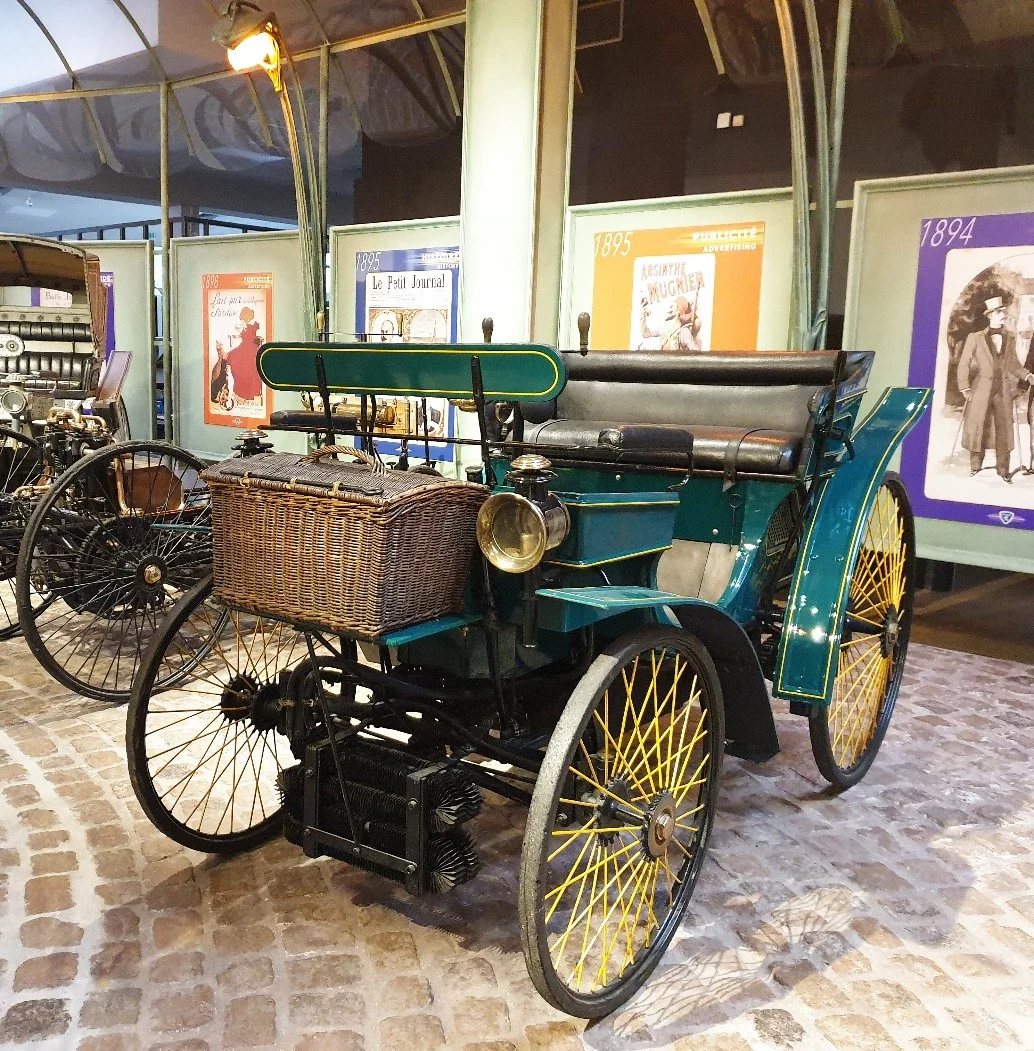
The Type 3 used a Vis-à-Vis arrangement, with four occupants sitting face to face. Peugeot dates production to 1891–1894 and gives a total of 64 examples. The layout belongs to a transition between familiar forms of transport and a new means of propulsion. It is more revealing to examine it in that context than simply to treat it as a modern car missing equipment: its design addressed different infrastructure and expectations about travel.
The museum photograph officially distributed in 2021 shows a preserved Type 3, rather than documenting the condition of the particular vehicle that made the 1891 journey. The distinction between an illustrative example and the car with a specific history matters in historic reporting. Similar care is needed when distinguishing a special-edition Citroën 2 CV from a film car: a shared model or appearance does not establish an individual vehicle’s biography.
Source: Peugeot Brasil · 2026-11-17 ↗
Preparation began before the famous route
Peugeot’s November 2026 account identifies Louis Rigoulot and Auguste Doriot as the driver and mechanical support team. Before following the cycle route, they travelled approximately 460 kilometres from Valentigney to Paris. They encountered carbon deposits in the ignition burners and petrol-pressure difficulties associated with the low position of the tank. Reaching the starting point was already part of the demonstration and the process of learning how the machine behaved beyond its home setting.
The significant point is that problems emerged before the best-known part of the journey. Today we might distinguish travelling to an event from completing its main test; here both journeys shaped the outcome. Having an engine run successfully in a workshop was insufficient. It had to keep working for hours over different surfaces, gradients and temperatures. That requirement makes the story of an early car a story about technical organisation as well as mechanical invention.
Source: Peugeot Brasil · 2026-11-17 ↗
Supply arrangements formed part of the system
The 2026 account describes fuel points prepared every hundred kilometres along the cycle race’s 1,200-kilometre route. It also relates how the crew adapted operation to more favourable morning and evening temperatures, even covering the tank with fresh grass to cool it. These are details in the manufacturer’s historical narrative, not operating instructions suitable for a modern vehicle. Their interest is in explaining the practical constraints the team needed to address during the journey.
The relationship between machinery and infrastructure is the central issue. A nominally sufficient range is of limited use without fuel available in the right place at the right time. Planned stops and the ability to deal with faults determined whether the car could continue. Fuels, systems and speeds have changed, but separating the vehicle’s technical capability from the real availability of resources remains a useful way to think about any long trip.
Source: Peugeot Brasil · 2026-11-17 ↗
Maximum speed, gradients and averages
Peugeot credits the Type 3 with up to twenty kilometres per hour on smooth, level ground and roughly four kilometres per hour in first gear on climbs. The 2026 release describes four forward ratios and reverse, a V-twin engine and a loaded weight of approximately five hundred kilograms with tools, luggage and full tanks. That is a laden condition, rather than a kerb-weight figure directly comparable with a modern specification without checking how each was measured.
The contrast between level ground and a climb is more informative than selecting one attention-grabbing speed. It shows how strongly the route and gearing shaped progress. Maximum speed should also remain separate from a journey average, which may cover a different distance or measurement boundary. Our account of modern endurance racing concerns another era and rule set, but raises a related question: what sustains an activity beyond a brief peak of performance?
Source: Peugeot Brasil · 2026-11-17 ↗
Why two official distance accounts remain separate
Peugeot’s own publications do not give one consistent figure for the entire journey. Its 2026 retrospective describes roughly 2,500 kilometres by the return to Valentigney and an average of 14.7 kilometres per hour. The November 2021 account gave 2,045 kilometres from Valentigney through Paris and Brest and back, again with a 14.7 km/h average. Neither of those sources provides a reconciliation of the journey boundaries or the historical calculation behind the difference.
We therefore do not combine the distance from one account with an inferred duration from the other and present the reconstruction as a recorded test. Their stated engine outputs differ too: 2.5 CV in the 2026 retrospective and 2 HP in the 2021 text. The supported conclusion does not depend on artificially settling those discrepancies: the Type 3 completed a long-distance demonstration associated with the cycle race. A more exact reconstruction would require further historical documentation.
Source: Peugeot Brasil · 2026-11-17 ↗ · Peugeot · 2021-11-04 ↗
What the anniversary actually marks
The 135-year count begins in 1891, when the model was introduced in France. Although the Brazilian release’s headline associates it with the first automobile to arrive in Brazil, the body does not substantiate that arrival’s date, owner or documentation. This article concentrates on the journey and engineering that the release actually describes. It does not invent a Brazilian chronology or transform a local headline into an unqualified claim of worldwide automotive priority.
The anniversary provides a reason to examine transport as a group of decisions: where occupants sit, how much to carry, how to climb a hill and where to replenish resources. Read that way, the Type 3 offers more than a small power figure beside a large anniversary. Its history does not show that present-day technology is simple by comparison; it shows that a vehicle’s usefulness has always depended on the particular conditions in which it must perform its task.
Source: Peugeot Brasil · 2026-11-17 ↗
The Type 3 is revealing for the journey it enabled and the organisation it required. Read the 2026 retrospective in its 1891 context and retain the differences between official accounts, rather than replacing them with false precision.
Sources & editorial policy
Written by Autohaus Zephyr from the linked sources. Manufacturer figures are attributed claims, not our own tests. The practical comparisons and clearly identified examples are editorial analysis. Market availability and specifications require confirmation for the exact car.
Corrections: [email protected]
How we work →Keep reading
- Rekord B: Nasenius’s 1966 European Group 1 title car
- Citroën 2 CV 007: telling the 1981 edition from a film car
- Endurance and Hypercar: How to Read a Race Beyond the Fastest Lap