
News · News & analysis
Lancia at 120: reading the twelve historic cars announced for Milan
Lancia Classiche announced twelve historic Heritage HUB cars on 17 November for Milano AutoClassica, held on 19–22 November. Its selection connects engineering, elegance and competition with today’s Gamma. This report analyses the announced programme and vehicle identities; it is not an attendance report or confirmation of every car ultimately displayed.
What matters
Automotive history becomes more useful when a model family, a version and an individual vehicle remain distinct.
Twelve historic cars across two displays
The announced structure comprises three historic cars on the official stand and nine in the Celebration area. The stand brings together a Gamma from the family introduced in 1976, a 1955 Aurelia B24 Spider and a 1983 Rally 037, alongside the new Gamma. The contemporary car is additional; it should not be included among the twelve historic vehicles supplied by the Heritage HUB.
The release also describes a 230 CV electric Gamma LX within the Celebration journey. Its presence connects periods, but does not change the historic total or establish how many separate contemporary examples were ultimately installed. Our evidence is the programme published before the show, rather than an inspection of its final layout. Because this analysis appears after the announced dates, its purpose is to interpret the selection, not invite readers to an event that has already ended.
Source: Lancia Classiche / Heritage HUB · 2026-11-17 ↗ · Lancia · 2026-11-17 ↗
Aurelia B24: Spider and Convertibile are different
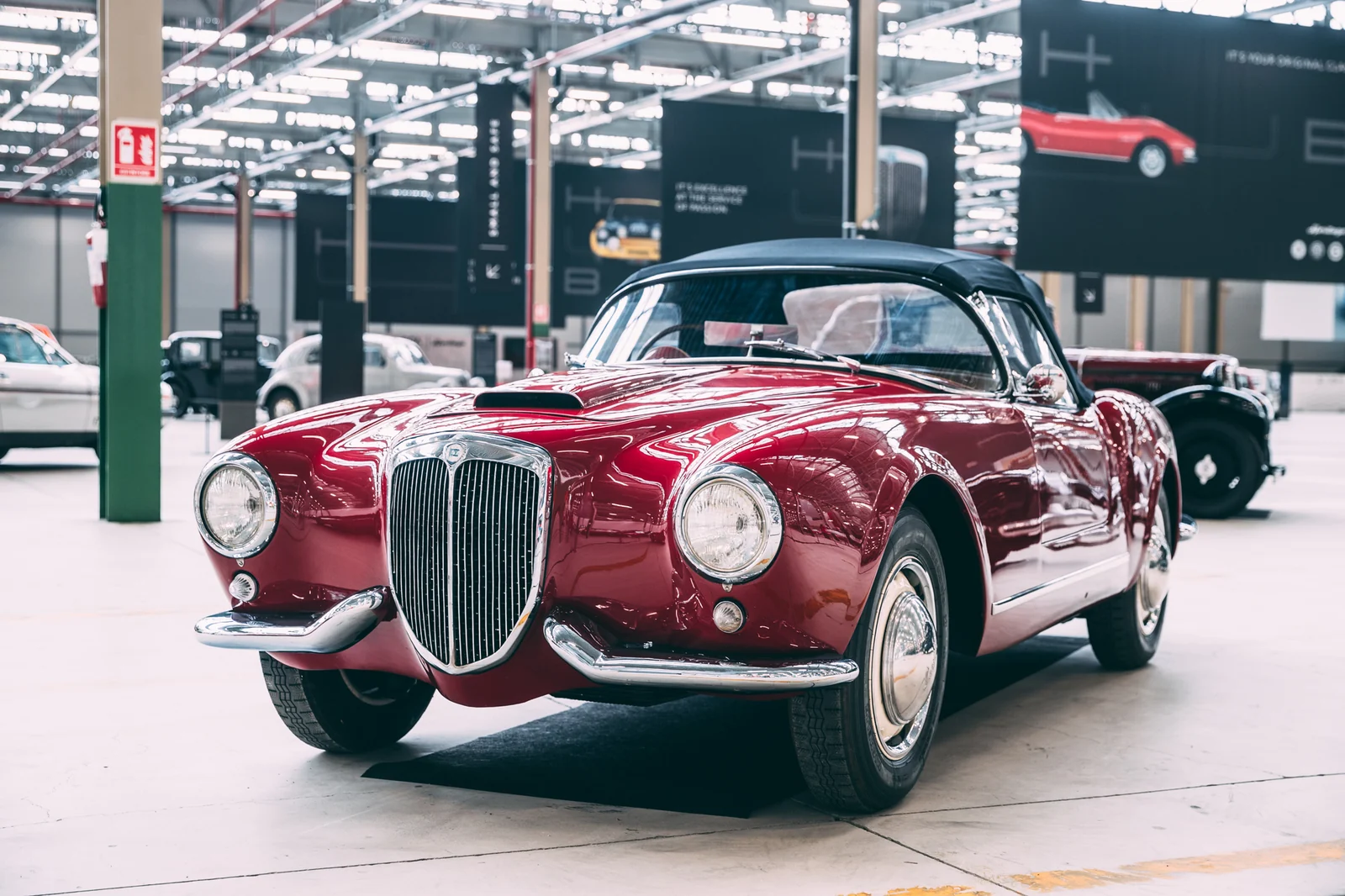
Pininfarina’s 1955 B24 Spider is identifiable through its wraparound panoramic windscreen and split front bumpers. Lancia states a production run of 240 and describes its 2.5-litre V6. Those details help identify the model; they do not authenticate an individual car or establish its current condition.
A cultural distinction prevents a common mistake. The Aurelia B24 associated with Dino Risi’s 1962 film Il sorpasso is the Convertibile, rather than the Spider in this selection. Belonging to the same family does not make their body styles interchangeable. This matters when interpreting a display and even more when assessing a collector-car advertisement: a film connection cannot replace the correct version, chassis identity and documentary record. The photograph and the story should describe the same thing, rather than borrowing recognition from a related car.
Source: Lancia Classiche / Heritage HUB · 2026-11-17 ↗ · Lancia · 2026-11-17 ↗
A returning name does not preserve an architecture
The historic Gamma in the programme combines a two-box body, Pininfarina involvement and an aluminium 2.5-litre boxer engine rated at 140 hp in the English release. Today’s Gamma is described as a European-market fastback crossover built at Melfi. Its name provides cultural continuity, while its format and propulsion belong to a different product era.
We do not assign the historic boxer engine to the current Gamma or turn the display of a 230 CV electric version into a road test. A show programme does not establish Spanish deliveries or Autohaus inventory either. Our report on the Gamma’s Italian roadshow addresses another decision: interpreting a visit and a commercial configuration. This article instead examines the relationship between generations, without creating a second launch report for the same contemporary vehicle.
Source: Lancia Classiche / Heritage HUB · 2026-11-17 ↗ · Lancia · 2026-11-17 ↗
037, Stratos and Delta represent different solutions
The 1983 Rally 037 combines a mid-mounted, supercharged engine with rear-wheel drive. Lancia identifies it as the last two-wheel-drive car to take the World Rally Championship manufacturers’ title against four-wheel-drive opposition. The historical lesson is not that rear-wheel drive is universally superior, but that a particular solution can succeed within a combination of regulations, team and execution.
The roadgoing Stratos HF represents another relationship between road car and competition, with Bertone design and a mid-mounted Ferrari V6. The three manufacturers’ titles from 1974 to 1976 belong to its sporting programme. The Delta HF Integrale Evoluzione represents the family that won six consecutive titles from 1987 to 1992; that does not mean one individual Evoluzione won all six. Separating the displayed car from its family’s career preserves the achievement without manufacturing a competition record for each surviving example.
Source: Lancia Classiche / Heritage HUB · 2026-11-17 ↗ · Lancia · 2026-11-17 ↗
Road engineering and the D50 widen the story
Celebration’s selection begins with the 1908 12 HP, subsequently named Alpha, before moving through the 1931 Artena Cabriolet and 1936 Aprilia. The latter’s unitary construction, independent suspension at all four wheels and aerodynamic work illustrate innovation outside racing. The 1957 Flaminia Berlina adds another interpretation of comfort and prestige.
Vittorio Jano’s D50 introduced a stressed-member V8 and distinctive side-mounted fuel tanks. The source describes it as the basis of the car in which Fangio won the 1956 world championship. That does not establish a Lancia Formula 1 constructors’ championship that year: the release establishes a technical lineage, without attributing that constructors’ championship to the marque. The Gamma Coupé and Thema 8.32 complete the historic group. In the latter, 8.32 refers to a V8 with 32 valves, rather than an 8.32-litre engine. Keeping these distinctions makes the engineering story easier to follow.
Source: Lancia Classiche / Heritage HUB · 2026-11-17 ↗ · Lancia · 2026-11-17 ↗
A useful identity record for the collection
A useful way to read the selection is to record each model’s body style, mechanical layout and relationship to competition. The Aurelia Spider and Convertibile do not share every visual feature; the historic and contemporary Gamma do not share an architecture merely because their names match. A roadgoing Stratos, a racing 037 and a Delta from a title-winning family require different descriptions. This short identity record ties each statement to the model actually in front of the reader.
The selected archive photograph preserves that context: it shows an Aurelia B24 Spider at the Heritage HUB, captured in April 2019 and redistributed with November’s announcement. For another interpretation of the marque, the Lancia Design Days opening explores design language and concepts. The 1959 Maserati Vignale prototype announced for AutoClassica concerns a different individual identity within the same show. Comparing those cases helps distinguish a particular car from the broader history of its manufacturer.
Source: Lancia Classiche / Heritage HUB · 2026-11-17 ↗ · Lancia · 2026-11-17 ↗
The announced selection explains more than a sequence of famous names: it shows how technical solutions change beneath familiar identities. Distinguishing families, versions and photograph context keeps the anniversary precise and useful.
Sources & editorial policy
Written by Autohaus Zephyr from the linked sources. Manufacturer figures are attributed claims, not our own tests. The practical comparisons and clearly identified examples are editorial analysis. Market availability and specifications require confirmation for the exact car.
Corrections: [email protected]
How we work →Keep reading
- Lancia Design Days: from the Stratos to Pu+Ra design
- Lancia Gamma tours Italy: how to use an early viewing
- The 1959 Vignale and GranCabrio: two interpretations of an open Maserati