
News · News & analysis
The 1959 Vignale and GranCabrio: two interpretations of an open Maserati
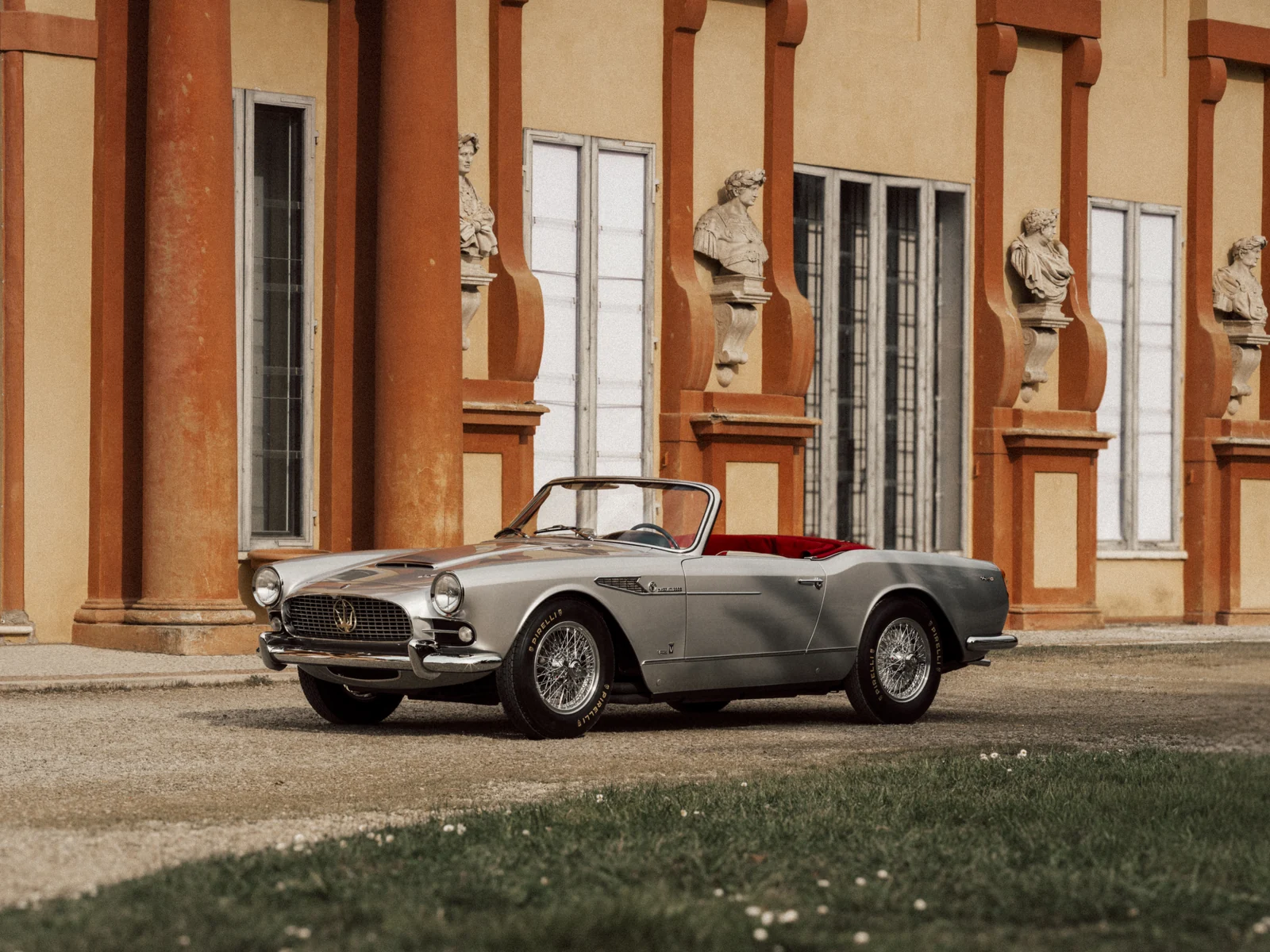
On 17 November, Maserati announced that its 1959 3500 GT Convertible Vignale prototype and 490 PS GranCabrio would share a display at Milano AutoClassica, scheduled for 19–22 November. The pairing offers a way to examine open grand touring across two eras. The classic, identified by Maserati as chassis 101.505, received its authenticity certificate in April: this week’s announcement concerns the exhibition, not a newly granted certification.
What matters
Compare identity, proportions and documentation first; a design lineage does not make a historic prototype equivalent to a current production GranCabrio.
A display with specific dates and a location
Maserati places the two cars on the Ruoteclassiche stand, B02 in Hall 16. This is the manufacturer’s announced participation in the November show, rather than a report of an Autohaus visit. The details help readers consult the official programme or organise a visit during the event. Afterwards, the historical comparison remains relevant, but the article should not be read as describing a permanent display available throughout the year.
The pairing encourages a comparison extending beyond power or top speed. The Vignale illustrates a late-1950s body-design project and the recovery of a particular surviving car. The GranCabrio represents contemporary series production. Showing them together does not launch a 3500 GT re-creation, nor establish that a feature from the prototype will appear in a future production model. It is a way of tracing design decisions across different technical and commercial circumstances.
Source: Maserati · 2026-11-17 ↗
Why the prototype needs its full name
Maserati attributes Vignale’s design to Giovanni Michelotti’s stylistic direction and dates the prototype’s unveiling to the 1959 Turin Motor Show. The release describes six examples of the project, separately from the later 3500 GT Convertible Vignale, of which it cites around 250 built between 1959 and 1964. Keeping the word prototype in the display car’s identification is therefore essential to understanding which vehicle is being discussed.
That distinction has practical implications for anyone researching a classic. Production figures for the later model do not describe this project’s exact rarity, while a photograph of an arbitrary 3500 GT cannot identify the announced chassis. Body details, archive records and the individual car’s documents need to agree. Our report on the certified Ghibli SS covers a different example; this article examines the Vignale convertible’s origins rather than repeating a general introduction to Classiche.
Source: Maserati · 2026-11-17 ↗
Restoration involves choosing a reference state
The manufacturer dates the restoration to 2023–2026, in Modena with direct support from Maserati Classiche. It describes returning the car to its Turin show configuration through archive research and examination of original characteristics. Silver bodywork is combined with ivory and red upholstery, blue carpets and gold details, a palette Maserati connects with Vignale’s identity. Colour becomes part of historical research here, as well as a visual choice for the finished car.
The useful restoration question is not simply whether the paint looks new. Ask which configuration was selected as the reference, what evidence supports it and which interventions were recorded. An immaculate car may embody an interpretation different from its historic state. Maserati identifies a particular recovery objective in this case. We have not independently inspected the finish or produced an item-by-item assessment of the components fitted to the restored prototype.
Source: Maserati · 2026-11-17 ↗
Mechanical architecture from another era
Maserati specifies a 3,485 cc straight-six with Weber carburettors, 235 PS at 5,500 rpm and a four-speed ZF manual transmission. It also lists double-wishbone front suspension, a solid rear axle with longitudinal leaf springs and Borrani wire wheels. These are manufacturer-supplied historical specifications explaining the body-and-chassis combination, rather than results measured during a present-day test of this individual example. They should be read in that context.
The difference from a modern convertible begins with operation and maintenance. Carburation, tyres, brakes, cooling and parts availability require an assessment suited to a historic vehicle. Doubling a power figure does not show that the modern car delivers precisely twice the experience or capability. The worthwhile comparison examines how each architecture addresses open-road travel within its technical circumstances, without applying a single modern performance ranking to two very different objects.
Source: Maserati · 2026-11-17 ↗
The GranCabrio provides the contemporary comparison
The announced modern display car is a GranCabrio with a 3.0-litre twin-turbo Nettuno V6 producing 490 PS, finished in Blu Emozione with a Greige interior. It is a particular version within a wider range. Specifications for the electric GranCabrio Folgore or another combustion variant should not be transferred to this V6. A shared silhouette and model family do not remove the need for a full powertrain and trim identification.
Maserati highlights four seats and a fabric roof with a stated opening time of fourteen seconds, alongside revised transmission calibration and a Country driving mode exclusive to the 490 PS version. Assessing an open grand tourer also requires checking rear-seat access, luggage space with the roof stowed, wind protection and roof operation. The manufacturer’s comfort claims do not replace those observations or an independent test under the buyer’s intended travelling conditions.
Source: Maserati · 2026-11-17 ↗
Looking at both cars without confusing their value
A comparative visit can focus on three things: proportions with the roofs open, the relationship between cabin and luggage space, and documents identifying the individual cars. Long bonnets and rear-body treatment reveal the styling language of an era; controls and materials show different priorities. None of those observations alone establishes the prototype’s market value, restoration cost or mechanical condition. Those questions require evidence beyond the fact that a car is being displayed.
BottegaFuoriserie personalisation adds context: configuring a present-day car and recovering a historic identity both involve design, but serve different purposes. One responds to a customer’s current preferences, while the other needs evidence about a previous state. Preserving that distinction makes the Milano AutoClassica pairing more informative without turning a cultural display into an appraisal or a commercial promise.
Source: Maserati · 2026-11-17 ↗
The announced pairing brings together an identified historic prototype and a current 490 PS GranCabrio. Read their design, engineering and restoration in context, retaining April as the certification date and November as the exhibition announcement.
Sources & editorial policy
Written by Autohaus Zephyr from the linked sources. Manufacturer figures are attributed claims, not our own tests. The practical comparisons and clearly identified examples are editorial analysis. Market availability and specifications require confirmation for the exact car.
Corrections: [email protected]
How we work →Keep reading
- The 1970 Ghibli SS: what Maserati Classiche certification establishes
- BottegaFuoriserie at one: how a bespoke car project is organised
- Mazda MX-5: How to Assess a Lightweight Roadster Beyond Horsepower