
New cars · News & analysis
Jeep Scrambler SRT Concept: independent suspension for desert driving
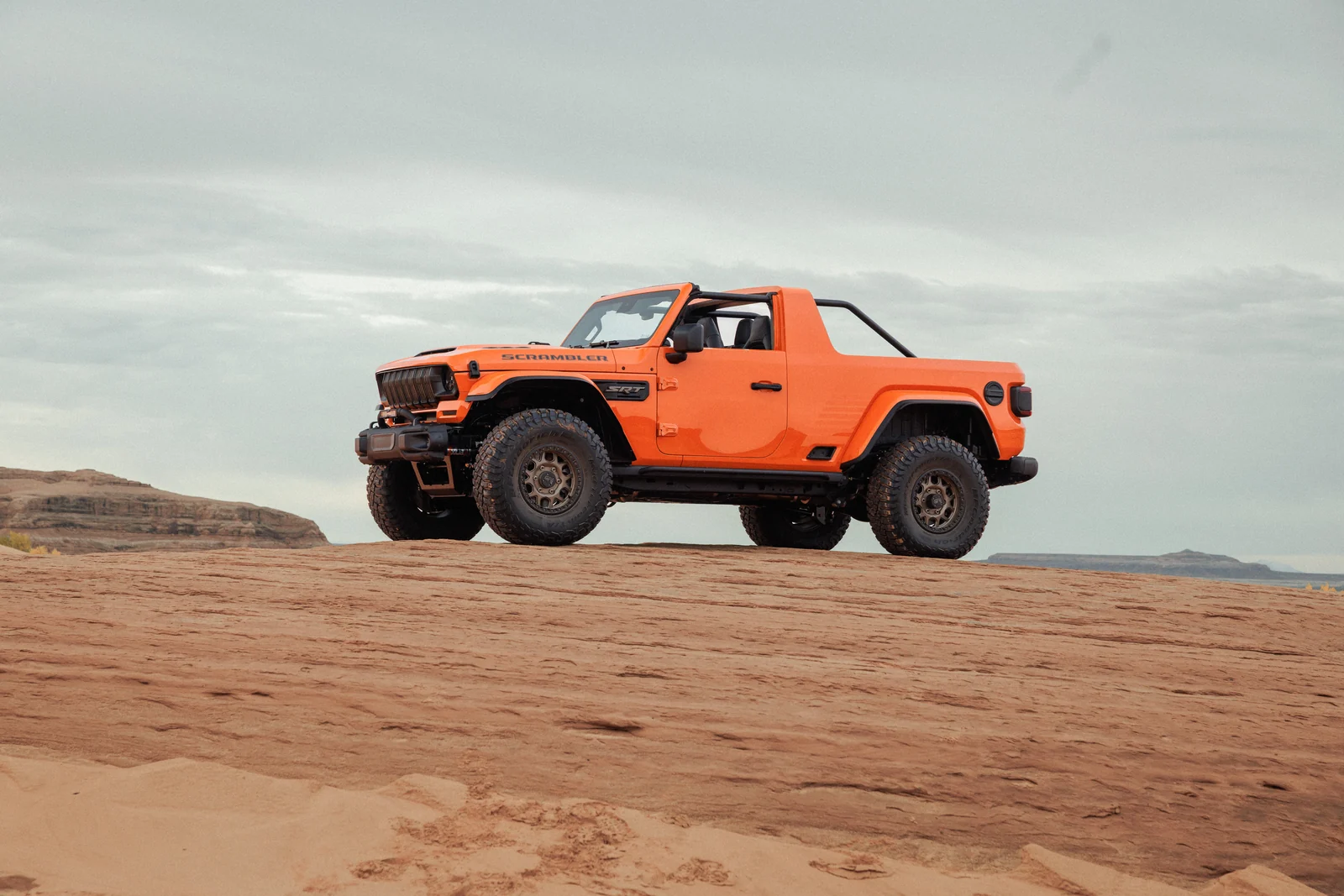
The Wrangler Scrambler SRT Concept applies SRT’s performance approach to a Jeep intended for fast off-road driving. The release is dated 2 November in Las Vegas and appeared on Stellantis’ regional portal on 3 November. Its central engineering change is bespoke long-travel independent front suspension. It remains a concept: the announcement neither opens orders nor confirms a production derivative.
What matters
The useful idea is wheel control tailored to fast desert use, combined with an open vehicle and load bed. An SRT badge and a Wrangler foundation do not make the concept’s solutions available customer equipment.
A new interpretation built from a Wrangler chassis
SRT begins with a Wrangler chassis and reshapes the vehicle from the A-pillar rearwards. The release lists longer doors, bespoke rear bodywork, an integrated load bed, a new tailgate, distinctive flares and a structural roll cage. This is therefore more involved than removing the roof from a showroom Wrangler and adding a cargo compartment.
The CJ-8 Scrambler provides the historical reference through its combination of an open vehicle and pickup utility. The new interpretation retains that relationship in a body with longer doors and a bespoke rear section. The bed and roll cage are part of the overall layout: occupants, cargo and structure shape the concept’s proportions.
Independent front suspension is the central proposal
Jeep presents the bespoke long-travel independent front suspension as a first for a Wrangler concept focused on high-speed desert performance. It was developed with Casey Currie. The manufacturer attributes greater steering precision, wheel control and stability to the arrangement. Those are the company’s objectives and assessments, not measured comparative results published alongside the announcement.
The useful engineering distinction is that independent suspension gives each front wheel movement defined by its own arm arrangement. That changes the available tools for tuning responses to bumps and steering inputs. It does not make every independent design superior on every surface. Travel, geometry, tyres, damping and intended use must be evaluated together. This release cannot rank all off-road suspension architectures on a single scale of capability.
The competition connection has a specific scope
The release links the architecture to the system shown on the Jeep Striker Concept and to Currie’s custom Gladiator Striker, which won its class at the NORRA 500. That background identifies some of the development experience behind the project. It does not say that this Scrambler won the event or that the photographed concept is the competition vehicle.
SRT adds a trophy-truck-inspired rear axle, a heavy-duty wheel package and hardware informed by desert racing. The concept therefore pairs independent front suspension with that racing-inspired rear package. That invites a useful engineering reading: tune the front end for steering and wheel control while the rear manages drive and load demands. The release provides no numerical suspension travel or comparative Scrambler test results.
A load bed and reversible seats serve different purposes
The rear seats attach to floor-mounted hooks and can be removed or turned through 180 degrees. Removing them frees space for camping equipment and other gear. A spray-applied liner protects the integrated bed. These are features described for the concept, demonstrating how its layout can switch between passenger and cargo missions.
This makes the rear space an active part of the design. With the seats removed, Jeep envisages carrying camping equipment or motorcycles. A production vehicle would still need defined payload, load restraints and approved seating conditions. The present announcement demonstrates the change of use without settling those customer specifications.
SRT identity without a complete powertrain specification
Punk’n orange paint combines with bronze beadlock wheels, SRT details and a sharknose front treatment drawing on Gladiator styling and classic Jeep trucks. Jeep had shown that front-end approach on a concept at the 2026 Easter Jeep Safari. Inside are Dark Graphite leather, orange inserts, contrast stitching, bronze details, bespoke grab handles and SRT embroidery.
The text places the project within a V8 performance vision but identifies no displacement, output, torque or transmission. Its clearest contribution is the chassis and body package. The SRT badge connects the build with the North American performance division, which also develops production vehicles, Direct Connection parts and motorsport programmes. Here it accompanies a physical experiment without an announced production decision.
The suspension change gives this Scrambler a clear engineering question: how to combine wheel control on rough terrain at speed with the utility of an open pickup. That exploration is its value. Quantified capability, road approval and any eventual customer offering still require specific evidence.
Sources & editorial policy
Written by Autohaus Zephyr from the linked sources. Manufacturer figures are attributed claims, not our own tests. The practical comparisons and clearly identified examples are editorial analysis. Market availability and specifications require confirmation for the exact car.
Corrections: [email protected]
How we work →Keep reading
- Toyota Woodland at SEMA: five prototypes rather than an accessory catalogue
- Peugeot E-T16 Concept: Announced 816 hp, but no offer to buy