
Market · News & analysis
GM earns $3.335 billion: results, cash flow and the buyback boundary
GM increased third-quarter adjusted EBIT by 21.6%, led by North America, while revenue grew 2.9%. On 20 October it narrowed annual operating-profit guidance and raised its automotive cash-flow outlook. The new $20 billion buyback authorisation is a future programme, separate from the previous one that has been completed.
What matters
Profit, adjusted cash flow and an authorised buyback are not interchangeable measures.
The quarter's principal figures
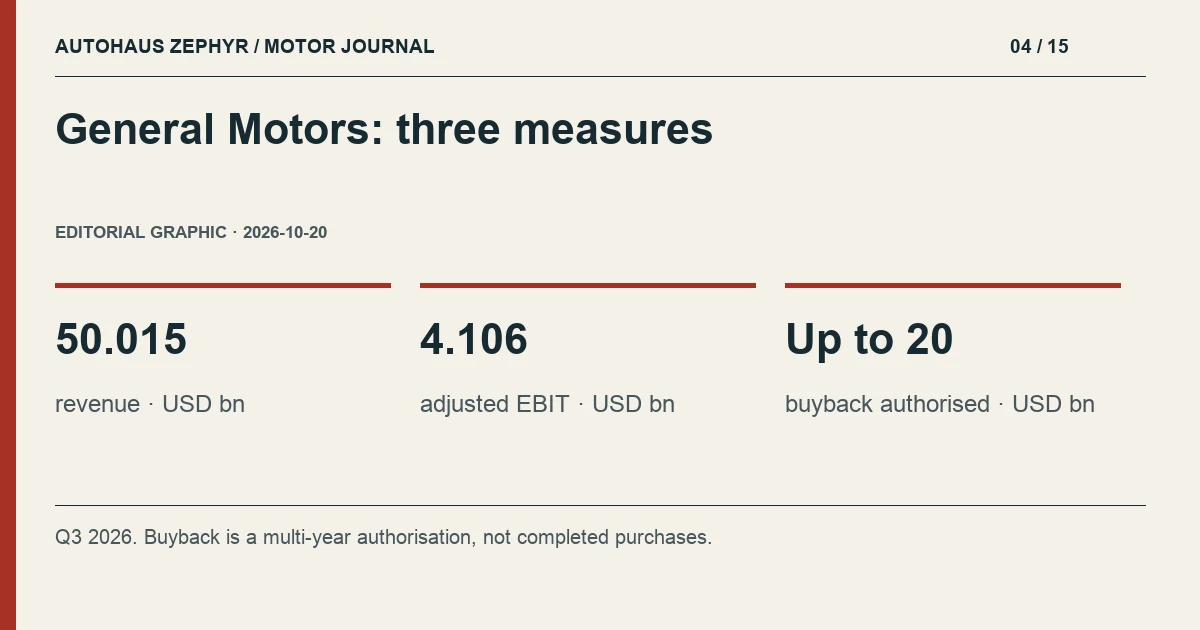
GM reported $50.015 billion in revenue, $3.335 billion in net income attributable to stockholders and $4.106 billion in adjusted EBIT. It narrowed full-year adjusted EBIT guidance to $14.5–15.5 billion. The board also authorised a multi-year share repurchase programme of up to $20 billion. The programme may be suspended or discontinued; the authorisation does not establish completed purchases of that amount.
Source: GM, comunicado financiero Q3 2026 y conciliaciones ↗
Profit grew faster than revenue
Revenue increased from $48.591 billion to $50.015 billion, up 2.9% year on year. Adjusted EBIT rose from $3.376 billion to $4.106 billion, up 21.6%, while its margin moved from 6.9% to 8.2%. Earnings improved more quickly than sales, so the quarter cannot be explained simply by a proportionate increase in revenue.
Automotive cash generation also increased. Operating cash flow was $8.049 billion and adjusted automotive free cash flow $5.882 billion, against $6.070 billion and $4.201 billion a year earlier. These are company-defined measures covering that business. Comparing them directly with another manufacturer’s consolidated free cash flow requires checking the adjustments and scope first.
Source: GM, comunicado financiero Q3 2026 y conciliaciones ↗
North America carries the operating improvement
GM North America increased adjusted EBIT from $2.506 billion to $3.592 billion and its margin from 6.2% to 8.7%. GM International instead fell from $226 million to $28 million. China equity income declined from $80 million to $32 million. The group’s positive headline therefore does not describe uniform improvement across its activities.
GM Financial reported $668 million of adjusted earnings before tax, down from $804 million. That measure is EBT, different from the EBIT used for industrial segments. Keeping the definitions visible avoids treating figures as interchangeable merely because all are denominated in dollars. North America was the clearest operating support for the improvement, while other areas still warrant scrutiny of the business mix.
Source: GM, comunicado financiero Q3 2026 y conciliaciones ↗
An authorised buyback has not necessarily happened
A board decision creates an option to allocate capital under stated conditions. Later disclosures establish actual purchases, their timing and prices. Treating the authorised ceiling as money already spent brings forward an operation that the release itself allows the company to change.
For automotive readers, the industrial question is how competing requirements coexist: products, factories, software, debt and shareholder returns. The size of an authorisation does not itself establish which project will be funded or cancelled. Nor does it determine a future share price. This analysis explains the distinctions; it is not an investment recommendation.
The EBIT range narrows while the cash-flow midpoint rises
Annual adjusted EBIT guidance moves from $14–16 billion to $14.5–15.5 billion. Its midpoint remains $15 billion: GM reduces the width of the forecast without increasing its centre. Adjusted automotive free cash flow instead moves from $9.5–11.5 billion to $11.5–12.5 billion, lifting the midpoint from $10.5 billion to $12 billion. These are editorial calculations from the published ranges.
The difference prevents every guidance change being described as an equivalent upgrade. The new buyback authorisation must also be separated from the $6 billion programme announced in January, which GM says is complete. The new $20 billion limit is multi-year and has no expiration date: it describes potential capital allocation rather than spending already completed.
Source: GM, comunicado financiero Q3 2026 y conciliaciones ↗
What a vehicle buyer can conclude
Financial resources can support complex programmes, but accounts do not verify the condition of a particular car or the availability of a feature. A purchase still requires checks on specification, contracts, maintenance and support in the destination market. The financial announcement cannot replace those checks.
The distinction also prevents strong cash generation becoming an assumption about future discounts or extra warranty coverage. Commercial terms exist when documented for a specific offer. GM's results are important evidence about industrial capacity and capital decisions; they are not a vehicle quotation or a service promise to every owner.
Questions answered
Has GM already spent $20 billion on this buyback?
The announcement authorises a programme. Actual purchases require the relevant execution disclosures.
Is annual guidance a guaranteed result?
No. It is management guidance for a defined measure, subject to assumptions and adjustments.
The quarter provides a basis for following activity, cash and expectations using different measures. The buyback adds a potential capital decision which still depends on execution. Keeping these layers separate makes the announcement useful without assigning commercial or market effects it cannot establish.
Sources & editorial policy
Written by Autohaus Zephyr from the linked sources. Manufacturer figures are attributed claims, not our own tests. The practical comparisons and clearly identified examples are editorial analysis. Market availability and specifications require confirmation for the exact car.
Corrections: info@autohauszephyr.ch
How we work →