
Safety · News & analysis
November Euro NCAP results: why nine five-star cars differ
Euro NCAP released ten assessments under its 2026 framework on 18 November: nine SUVs earned five stars and the Nissan Leaf received four. The useful detail lies beneath those ratings. The Škoda Peaq leads on crash protection, while the Mercedes-Benz GLE leads this group on safe driving and crash avoidance. Equal stars do not mean identical strengths.
What matters
Compare the assessment year, tested version and four pillars before using stars to choose a car.
One release, four different safety questions
The 2026 framework divides assessment into Safe Driving, Crash Avoidance, Crash Protection and Post Crash Safety. These are different stages of the same journey: helping the driver before danger develops, avoiding a collision, limiting its consequences and supporting rescue afterwards. Reading only the headline rating discards that sequence. It can also hide a limitation that matters particularly to a family carrying rear-seat passengers or to someone regularly negotiating busy urban junctions.
A sound comparison begins with the protocol year and the equipment covered. Older percentages cannot be added to a 2026 ranking as though the exercises and weighting were unchanged. Nor is this release a separate assessment of assisted-driving performance. Our guide to reading assisted-driving gradings explains that different tool. Neither assessment makes a vehicle autonomous, and neither removes the driver’s responsibility to supervise the road and the car’s behaviour.
Source: Euro NCAP · 2026-11-18 ↗
Peaq and GLE lead in different areas
The Peaq scores 65% for Safe Driving, 78% for Crash Avoidance, 94% for Crash Protection and 92% for Post Crash Safety. Euro NCAP describes the 94% as the highest Crash Protection score recorded by that point among cars tested to its 2026 standard. That qualification is essential. It does not name the Peaq the safest car ever, and 94% is not a prediction of survival in any possible accident.
The GLE records 74%, 87%, 90% and 92% respectively. It leads this group in the first two pillars, while the Peaq scores higher in the third. Those results answer different questions: which features help prevent a collision, and what protection is measured when one happens? A buyer cannot exchange one for the other through an improvised average. The overall rating follows the programme’s rules, rather than a calculation invented from the published percentages.
Source: Euro NCAP · 2026-11-18 ↗ · Euro NCAP · Peaq · 2026 ↗
The X5 shows why speed-limit accuracy matters
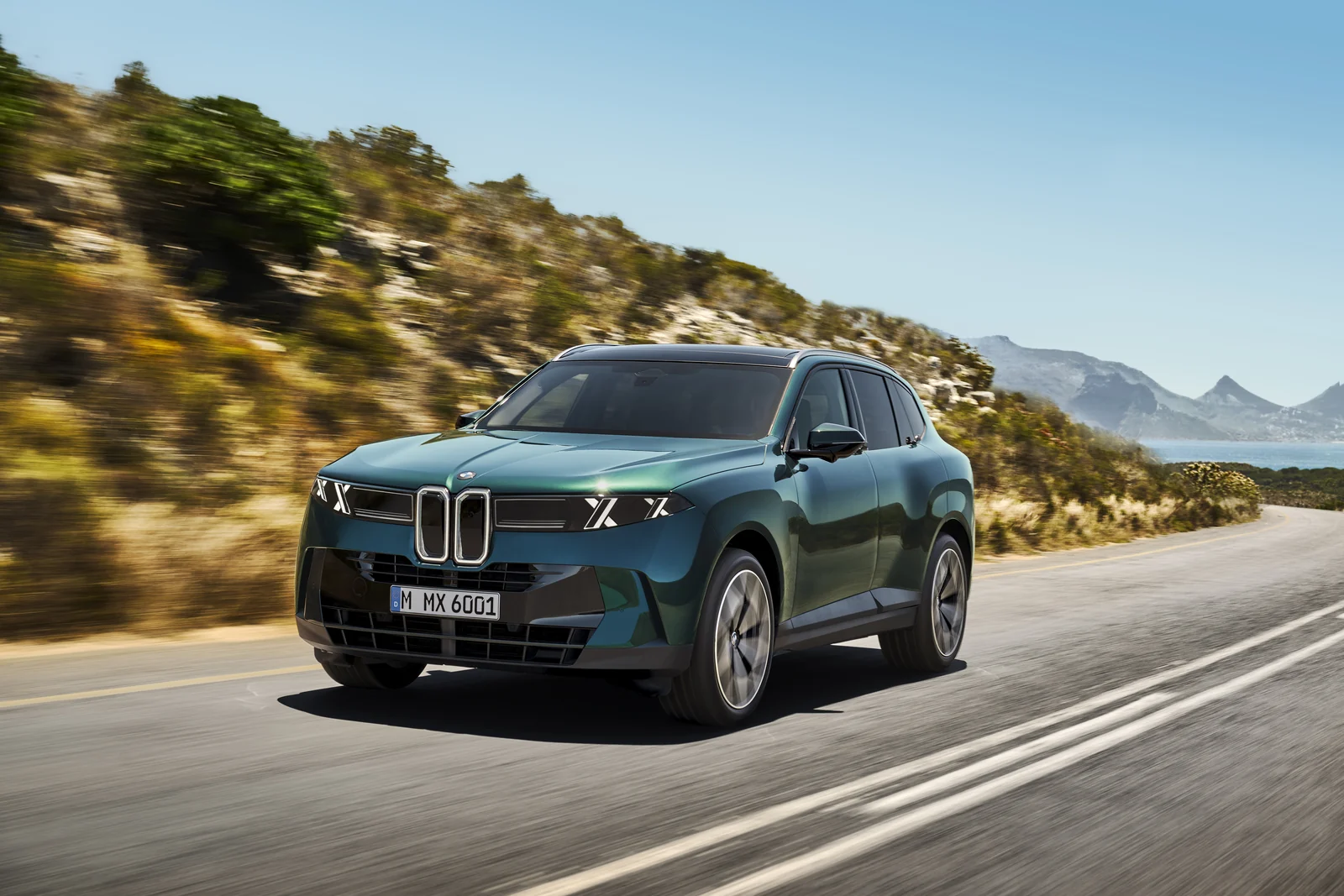
The diesel BMW X5 assessed here receives 71%, 85%, 87% and 92%. Euro NCAP highlights its speed-limit recognition in an on-road verification across Spain, Italy and France. It identified the correct limit in 91% of cases, accounting for 97% of the distance travelled. Those percentages use different denominators. Reporting 97% as the share of signs correctly read would change what the organisation actually measured.
That strong performance coexists with marginal driver chest protection in the frontal offset test, marginal rear-passenger chest protection in the full-width frontal test and weak pedestrian pelvis protection. Five stars do not mean there is nothing left to improve. On a used car, correctly installed cameras and sensors also matter. Our ADAS calibration guide explains why windscreen replacement or collision repairs can require documented checks before the advertised assistance equipment should be treated as properly verified.
Source: Euro NCAP · 2026-11-18 ↗
The Leaf’s four stars have specific explanations
The Leaf scores 59%, 58%, 78% and 85%. Euro NCAP links its main limitations to the lack of standard front corner radars, restricting crossing-traffic avoidance performance, and to a centre airbag that is optional rather than standard. It would be misleading to turn that finding into a claim that all its systems perform poorly. The car takes full marks for manual controls, driver acceptance of lane support and post-crash extrication provisions.
Adding an option does not automatically justify advertising a fifth star either. A rating applies to the assessed vehicle and its stated scope, under the programme’s rules, rather than to an imagined specification assembled from a brochure. If a listing mentions a safety package, request the official assessment that identifies which result covers it. That check matters particularly where a model name, market specification and standard equipment differ between countries.
Source: Euro NCAP · 2026-11-18 ↗
Six more SUVs and a separate 2025 result
GWM ORA 5, GWM H7, Kia Seltos and Lepas L4, L6 and L8 PHEV also receive five stars. The ORA 5 performs strongly for pedestrian pelvis and leg protection, but loses automatic emergency braking points in crossing-traffic scenarios. The Seltos performs well for seatbelt misuse detection and occupant-position recognition, while showing weak front-passenger chest protection in the frontal offset collision. These particular strengths and weaknesses provide more buying context than a simple list of winners.
The Lepas L6 and L8 PHEV both achieve 95% for Post Crash Safety, ahead of the other models in this group in that pillar. The release additionally includes a five-star Denza BAO 5 result based largely on 2025 ANCAP testing. It is an additional assessment, not an eleventh vehicle tested against the four 2026 pillars. Its percentages should therefore not be slipped into a direct ranking alongside the ten current-framework results.
Source: Euro NCAP · 2026-11-18 ↗
Turn the findings into a useful comparison
Make a short record for each candidate: exact model, assessment year, version, market and included equipment. Then compare the comments that affect your use, such as rear-seat occupants, crossing urban traffic, vulnerable road users or the behaviour of driver warnings. A strong rescue score does not remove a prevention gap. Accurate speed-limit recognition in a test route does not guarantee that every limit on your own journey will be interpreted correctly.
Keep independent assessments separate from manufacturer demonstrations as well. The October Mercedes CLA side-impact demonstration describes a scenario presented by Mercedes; it is not a Euro NCAP rating or a GLE update. Preserving that distinction makes both reports useful without combining their conclusions or reducing safety to a league table of brands. Before buying, consult the full official result and the documents for the actual car being considered.
Source: Euro NCAP · 2026-11-18 ↗ · Euro NCAP · Peaq · 2026 ↗
November’s results show how the same overall rating can cover different safety balances. Start with the stars, then read the pillars, protocol year and comments on the assessed version to understand what they mean.
Sources & editorial policy
Written by Autohaus Zephyr from the linked sources. Manufacturer figures are attributed claims, not our own tests. The practical comparisons and clearly identified examples are editorial analysis. Market availability and specifications require confirmation for the exact car.
Corrections: [email protected]
How we work →Keep reading
- Euro NCAP and assisted driving: how to interpret the rating before you buy
- ADAS Calibration: What Should Be Clear After a Repair
- The Mercedes CLA’s new crash test: what it shows—and what it doesn’t