
Motorsport · News & analysis
Citroën Racing and HRX: what changes in a Formula E race suit
Citroën Racing has announced HRX as its racewear partner ahead of the 2027 Formula E season. The described work concerns colour, materials and fit; the announcement does not establish a lap-time gain or a quantified improvement in protection.
What matters
A race suit brings protection and movement together. Team colours cannot replace approval of the actual garment, and fit needs to be understood in the driving position.
A partnership focused on what the driver wears
The 9 November 2026 announcement introduces Citroën Racing’s collaboration with HRX, an Italian specialist in bespoke motorsport clothing. The team connects it to preparation for the 2027 Formula E season and the GEN4 era. It names Jean-Éric Vergne and Nick Cassidy and says driver feedback has informed the development. This is not a road-car launch or evidence of a sporting result achieved in a race.
The useful technical detail is what the partners describe working on: a distinctive red developed on FIA-homologated base materials, stretch areas and construction tailored to the wearer. Those specifics make the announcement more informative than a simple logo change. However, the release does not publish the finished suit’s mass, its thermal-test results or a homologation number identifying the particular garment. Those omissions set the boundary of what can be concluded.
Source: Citroën Racing · 2026-11-09 ↗
Developing a red within a technical system
Citroën and HRX describe successive colour-matching tests while preserving the fabric’s technical properties, breathability and safety requirements. This is the issuer’s account of its process. It includes no comparative figures that would measure improvement over the previous supplier, so the established news is the announced joint development rather than demonstrated superiority across every parameter.
Appearance and performance are not interchangeable. Two equally coloured suits can differ in construction and approval, while a photograph cannot identify the composition of their layers. Here the partners place colour development within the technical work. That should not be read as encouragement for someone to dye, print or otherwise alter their own homologated clothing in order to reproduce a team’s look. Personalisation needs to respect the requirements applying to the actual garment.
Source: Citroën Racing · 2026-11-09 ↗ · FIA · Protective Clothing Guidelines · explanatory, non-regulatory · checked 2026-11-10 ↗
Armholes and lower back make the ergonomics specific
The release identifies stretch panels around the armholes and lower back, together with tailored construction intended to reduce excess material. These are specific areas of development rather than a generic sportswear description. The stated purpose is easier movement and greater comfort in the cockpit. A seam’s position or tension in a sleeve may matter even when it is invisible to a spectator watching from a grandstand.
As an engineering interpretation, that makes fit in the driving position more relevant than appearance while standing: arms reaching towards the controls, back supported and contact with the seat. This is not a test of the HRX suits or a measurement of fatigue. It explains why direct driver feedback can help the clothing manufacturer, and why a pattern that works for one person should not automatically be regarded as suitable for another.
Source: Citroën Racing · 2026-11-09 ↗
What 8856-2018 actually explains
The FIA introduced 8856-2018 as an evolution of protective-clothing requirements and explained its application to Formula E from Season 6. Its 2019 technical article discusses heat-transmission testing and tougher requirements than the preceding standard. The clothing system includes items beyond the visible outer suit, such as underwear, gloves and footwear. Driver protection cannot be reduced to the single layer seen in a team photograph.
That background explains why weight, breathability and freedom of movement must coexist with minimum protective performance. It does not mean the 2026 partnership creates a new standard or justify assigning one universal survival time to a driver. A standardised test operates under defined conditions, whereas an actual incident can differ. Nor do we use the release’s general reference to approved base materials to certify the exact suit model from its appearance in a photograph.
Source: FIA · 2019-11-15 ↗
Approval and personalisation answer different questions
The FIA’s protective-clothing guide distinguishes product standards from the regulations governing their use in a particular competition. It also explains approval marking and the constraints on personalisation: embroidery must respect the outer fabric and changes must follow the applicable instructions, rather than pass unchecked through protective layers. That provides context for the role of a specialist supplier, rather than permission from this article to modify clothing. These guidelines are explanatory and have no regulatory value: they do not replace the official documents applying to each championship.
For followers of the championship, the useful question is which finished product is being used and under which approval. A supplier carrying the same logo in another catalogue does not answer it. The Citroën/HRX release supplies no approval identifier here that would let us match an individual garment against it. Keeping that limit visible avoids presenting a commercial partnership announcement as a material inspection conducted by Autohaus Zephyr.
Source: Citroën Racing · 2026-11-09 ↗ · FIA · Protective Clothing Guidelines · explanatory, non-regulatory · checked 2026-11-10 ↗
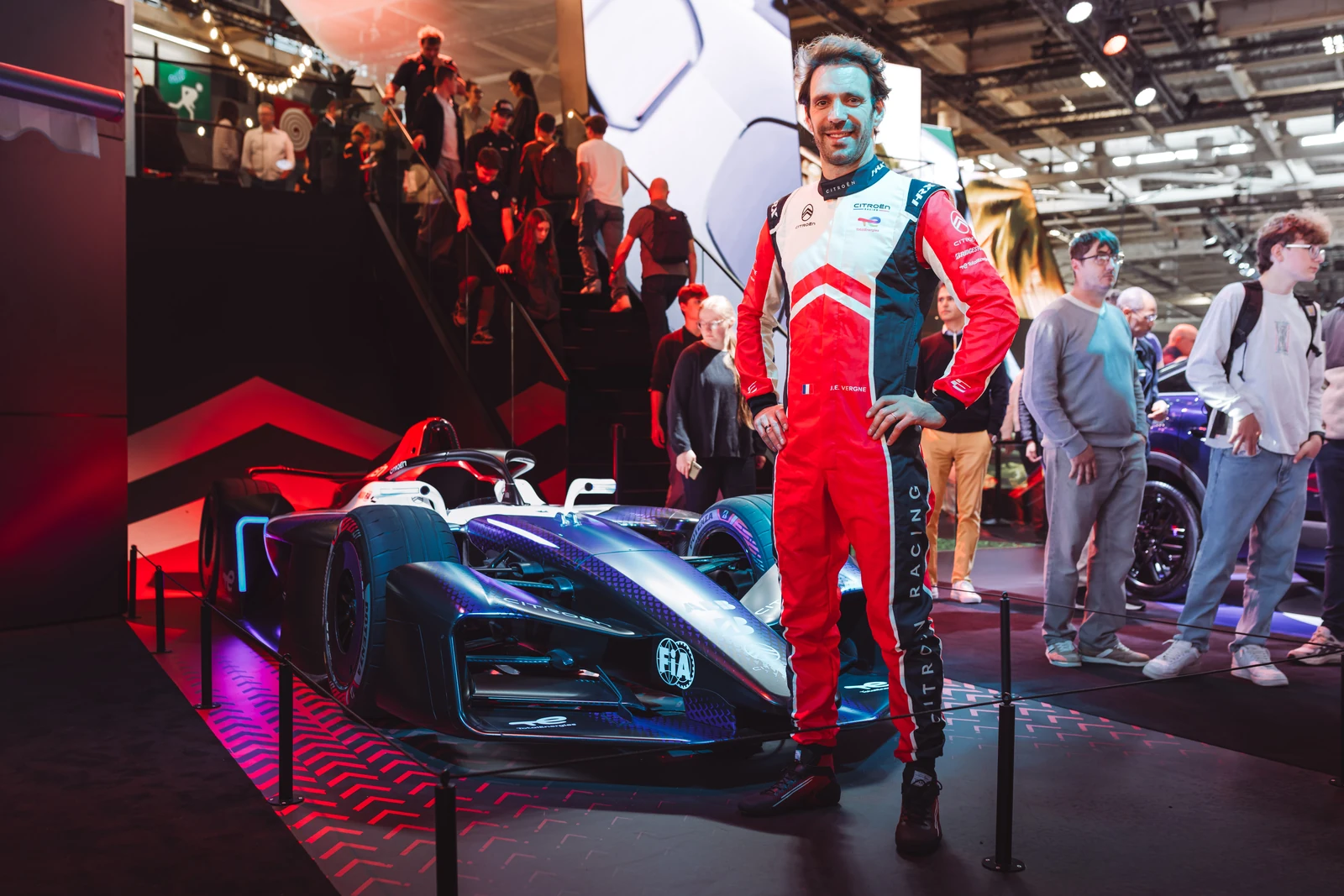
The photograph has a date of its own
The selected official photograph shows Jean-Éric Vergne wearing a suit marked HRX on the Citroën Racing stand. The file’s caption places him at the Paris motor show on 16 October 2026 and credits Clément Choulot/DPPI. The image was distributed with the 9 November announcement. However, IPTCDateCreated contains 20250906, which conflicts with that caption; the exact capture date remains unresolved. It is therefore presented as archive photography connected to the people and clothing involved, rather than a scene photographed on the announcement date.
It also has a clear evidential limit: this is neither a fire-resistance test nor a demonstration of the single-seater’s performance. Naming the driver, setting and photographer provides useful identification. Protection is evaluated through the product and its approval procedures. Keeping those functions separate allows a real photograph to illustrate the story without being turned into a technical certificate.
Source: Citroën Racing · 2026-11-09 ↗
What to watch as the partnership develops
Three concrete areas can make later coverage informative: identification of the approved equipment actually used, changes described by the team and drivers, and continuity of supply during the racing programme. The announcement sets no weight-saving or lap-time target for a later report to confirm. It also does not connect the supplier change to an eventual championship position, which will depend on many more variables.
Our coverage of Nissan’s GEN4 preparation examines another part of the same environment, centred on drivers and vehicle development. This story concerns personal equipment. They are different layers of a team’s work. Citroën and HRX provide a specific example of colour, pattern construction and approval needing to fit together. The interesting point is not that the suit looks technical, but that its visual and ergonomic decisions must coexist with requirements capable of being checked.
HRX and Citroën describe specific colour and ergonomic work for 2027. Keep that contribution and its limits together: claimed comfort, materials within an approval framework, and no published results that would quantify a sporting or protective advantage.
Sources & editorial policy
- Citroën Racing · 2026-11-09 ↗
- FIA · 2019-11-15 ↗
- FIA · Protective Clothing Guidelines · explanatory, non-regulatory · checked 2026-11-10 ↗
Written by Autohaus Zephyr from the linked sources. Manufacturer figures are attributed claims, not our own tests. The practical comparisons and clearly identified examples are editorial analysis. Market availability and specifications require confirmation for the exact car.
Corrections: [email protected]
How we work →Keep reading
- Nissan retains Bird and Pulling as Formula E moves towards GEN4
- Formula 1 2026: How to Read the Relationship Between Aerodynamics and Energy