
Technology · News & analysis
Automotive recycling: turning a startup landscape into industrial supply
Circular Startup Landscape 2026, presented by BMW on 9 November, maps around 2,800 European circular-economy startups. It does not announce that Europe has closed the automotive material loop. Circular Republic’s analysis instead highlights the difficulty of scaling innovation into industrial operations. A project’s practical value depends less on appearing on a map than on the material recovered, its quality and cost, and a customer prepared to use it.
What matters
A recycling pilot needs reliable inputs, repeatable quality and demand before it becomes a stable industrial alternative.
A company map does not measure recovered tonnes
Circular Republic is an initiative established by BMW and UnternehmerTUM. Its analysis describes a business ecosystem rather than a recycling census of every European vehicle. According to the summary, around 15% of the identified startups work on closed loops, while fewer than 5% focus on recovering critical raw materials. Those proportions classify companies; they are not the share of European materials being recycled.
A small business may develop an important technology while another processes greater volumes using an established method. Counting each once helps explore activity but cannot estimate operating capacity or supply share. The summary also does not establish whether categories overlap. Turning them into an exhaustive division of the whole industry, or an effectiveness ranking, would require further methodology and production data rather than a count of enterprises alone.
Funding uses another period and denominator
The report attributes about 55% of global circular-economy startup funding in 2024 to Europe. That measures money invested in a particular year. It does not mean 55% of materials are recovered in Europe, that the same proportion of batteries contains recycled material or that all the funded projects have reached commercial operation. Investment and output describe different stages of industrial development.
This distinction helps assess execution risk. A funding round may pay for equipment, testing or facilities without establishing stable yield or profitable contracts. Comparing a funding share with the proportion of companies working in a field can generate useful questions. It cannot independently prove that a sector is overfunded or neglected, because the year, unit of measurement and observed population all change between the two figures.
The first constraint is the incoming material
A technology may perform well on a known batch and behave differently with mixed waste or variable composition. Before scaling, ask which components it accepts, how it identifies material and what happens to rejected inputs. Dismantling also determines what reaches the next process. Selective separation can retain value that would be lost if everything were mixed before the material could be identified.
As an editorial example, a line designed for one consistent component does not automatically become a solution for every end-of-life vehicle. It would need checking against variants, joints, contamination and damage. This is not an allegation about a named supplier. It is an acceptance question that distinguishes a demonstration chosen by its promoter from a process able to sustain the less uniform inputs encountered in wider industrial supply.
Recovered material needs a useful destination
Producing a recycled fraction is only part of the task. A buyer needs its composition, variability and specification before incorporating it into another process. Rejected batches or additional treatment can change the project’s economics. A recovery-rate headline therefore says little without explaining the final material’s quality and the application into which it can return. Recovering mass and preserving its usefulness are related but different outcomes.
Our proposed assessment starts with a clearly bounded input-output balance: incoming mass, saleable product, losses and residual waste requiring other treatment. Energy, transport and subsequent processing also belong in a comparison. We provide no emissions or savings calculation here because an identified facility and a comparable baseline would be needed. The practical value lies in identifying which numbers such a calculation would require rather than inventing a result.
Robotics needs information about the component
BMW points to opportunities to combine sensors, robotics and artificial intelligence for dismantling, material identification and sorting. The interest is in acting before the information distinguishing materials is lost. Recognising a part can support a more selective operation, but the result must be checked on physical components and against the mistakes that escape the controls, rather than inferred from the presence of an algorithm.
A buyer evaluating such a system should distinguish identification accuracy, speed, availability and operating safety. A fast demonstration cannot answer all four questions. It also matters how the system is updated when a component changes and who maintains the reference data. The algorithm, physical tool and incoming material together form a process. Announcing one element does not establish the performance of the others under normal production conditions.
Wackersdorf separates existing work from a future facility
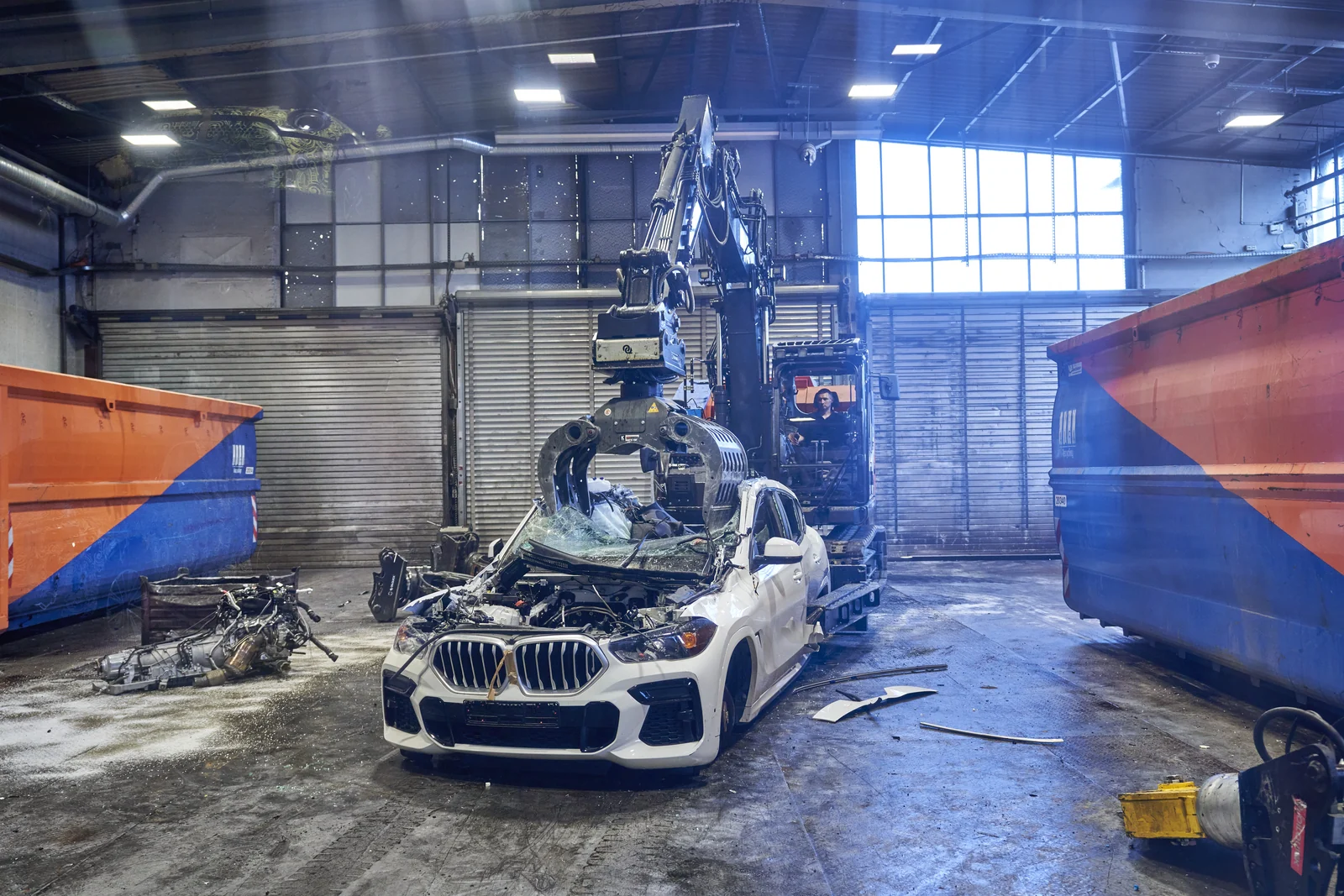
As a specific point of context, BMW announced the relocation and expansion of its recycling and dismantling centre to Wackersdorf in March 2026, with commissioning planned for early 2029. That source still describes a future facility. The photograph here shows a physical dismantling operation at the existing centre in an archive image. It does not show the new centre already inaugurated or represent every startup covered by the report.
Our coverage of reused Circular Autopeças components and Redwood’s second-life battery work addresses different circular-economy questions: retaining a part’s function and extending a battery’s usefulness. The new report adds business context. Those models should remain distinct from raw-material recovery, because each has different evidence requirements, processing needs and commercial destinations.
Source: BMW Group / Circular Republic · 2026-11-09 ↗ · BMW Group · 2026-03-26 ↗
The report identifies activity and gaps in Europe’s ecosystem. Industrial proof still lies in the material flow: adequate input, a repeatable process, an accepted output and an application that can sustain demand.
Sources & editorial policy
Written by Autohaus Zephyr from the linked sources. Manufacturer figures are attributed claims, not our own tests. The practical comparisons and clearly identified examples are editorial analysis. Market availability and specifications require confirmation for the exact car.
Corrections: [email protected]
How we work →Keep reading
- Circular Autopeças: recognised for giving traceable components a second life
- Redwood explains used-battery integration: second life needs a complete system
- BMW adds Samsung SDI and LG to Gen6: contracts now, supply later this decade