
Technology · News & analysis
Electric BMW M3 at Miramas: what four motors could change
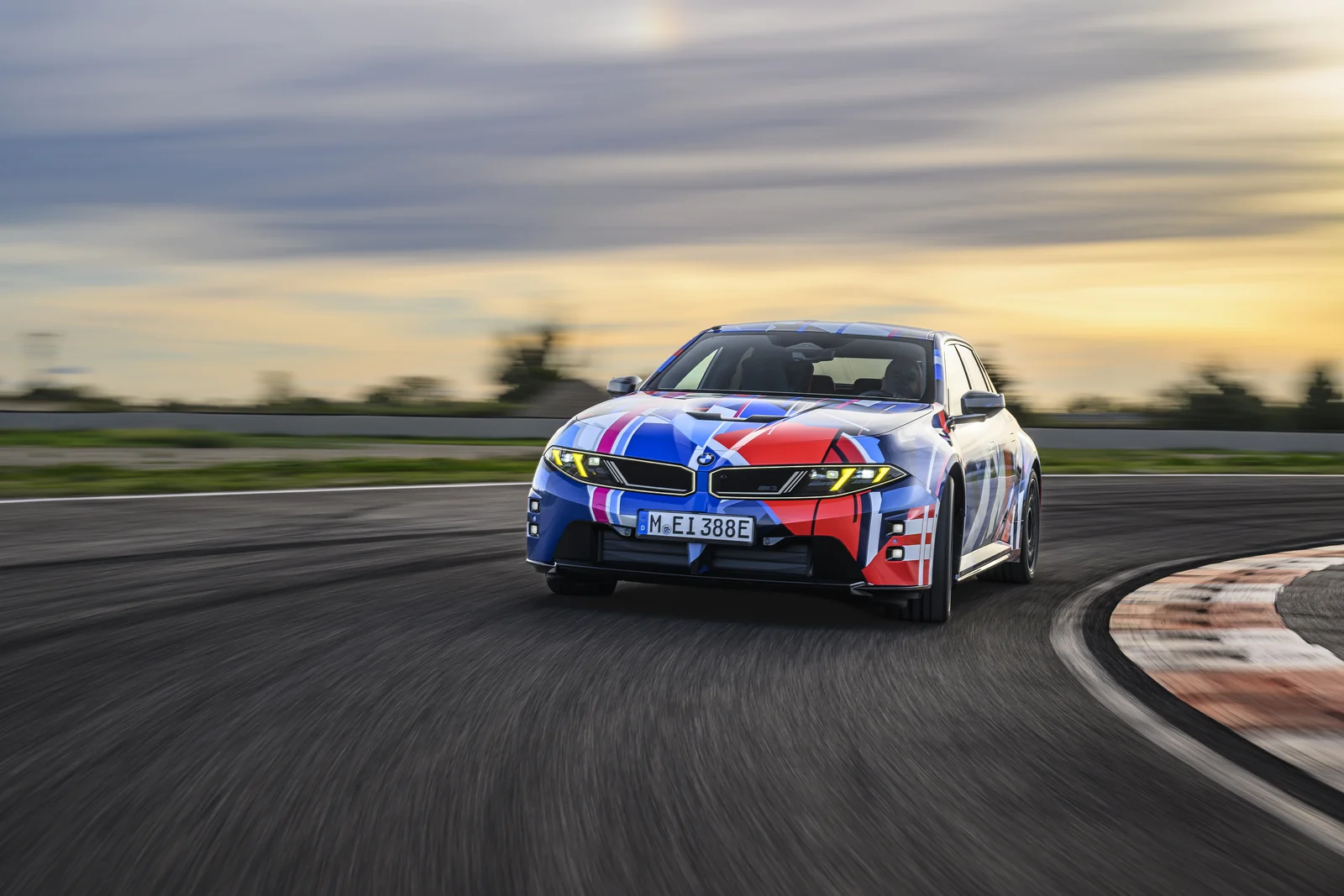
BMW released details of a first media preview drive of its fully electric M3 at Miramas on 18 November. It confirms four motors, BMW M eDrive, M Dynamic Performance Control and an M-specific sixth-generation high-voltage battery. This is a development demonstration, not an Autohaus drive, an order opening or a complete commercial specification.
What matters
Four motors create more control possibilities; repeatable performance, thermal behaviour and driving feel still need proper evidence.
What has been shown, and what has not
BMW places a newly developed electric architecture and the vehicle structure at the centre of its pursuit of precision and agility. The accompanying gallery shows camouflaged cars at the Miramas circuit and describes an initial media preview. The company calls the project its fastest and most powerful M3 yet. That remains its statement: this release supplies no independent comparison of lap times and does not entitle Autohaus to claim personal driving impressions.
The November release does not provide a complete specification for power, mass, usable battery capacity, homologated range, price or market-specific deliveries. We do not fill those gaps with figures from other Neue Klasse models, leaks or calculations based on motor count. Four motors do not reveal how much output the battery, inverters and cooling system can sustain simultaneously. Nor does a preview establish that the photographed development car matches the equipment a future customer will receive.
Source: BMW M · 2026-11-18 ↗
Four motors offer more control possibilities
The background is BMW’s M Neue Klasse programme, disclosed on 13 January in the United States and published on 14 January in Central European time. It described one motor per wheel and a front axle that could be decoupled. That is development context, not the commercial M3 specification. Physically, different longitudinal forces on the two sides can create a turning moment. Four motors therefore matter for more than simply adding output.
In a corner, each tyre shares its capacity between steering and transmitting longitudinal forces. An acceleration command therefore affects lateral balance as well. That is the control problem making the announced architecture interesting; it is not evidence that every possible benefit has already been measured. The finished response will depend on calibration, tyres, suspension and road conditions. Four motors provide tools. Their practical value will lie in working together without leaving the driver to correct unexpected interventions.
Source: BMW M · 2026-11-18 ↗ · BMW M · 2026-01-13 US / 2026-01-14 CET ↗
Control software matters as much as hardware
BMW names M Dynamic Performance Control alongside BMW M eDrive. The problem it must solve is coordinating the force requested by the driver with the grip available at each wheel. If the car starts to tighten its line, the useful intervention may differ from what is needed when it runs wider. A fixed front-to-rear allocation alone cannot be expected to produce an identical response in every situation.
Several repeated manoeuvres would be more informative in a future evaluation than one acceleration run: corner entry and exit, lifting off the accelerator and responses when grip differs across the car. We are not claiming BMW has published those results here. They are criteria for checking whether complexity produces confidence and consistency. The Hyundai Ioniq 6 N’s approach offers context from another electric performance car, without making its features specifications of this M3.
Source: BMW M · 2026-11-18 ↗
An M battery cannot be described by kWh alone
BMW confirms an M-specific sixth-generation high-voltage battery. January’s technical announcement also described its housing as a structural component connected to both axles. The pack therefore contributes to energy supply and overall rigidity. That integration makes it useful to assess battery and chassis together. Knowing the kWh figure alone does not explain how mechanical loads are distributed or how the entire car responds through a succession of corners.
Our report on Gen6 cell suppliers in Europe and the United States explains the industrial context. It does not automatically identify the final cell, factory or configuration of every M3. Likewise, a maximum power figure does not explain how long it lasts or when it is reduced. The missing specification should help distinguish momentary output from sustained capability. Until those details are available, a performance promise cannot become a quantified advantage for every track session.
Source: BMW M · 2026-11-18 ↗ · BMW M · 2026-01-13 US / 2026-01-14 CET ↗
Repeatability will matter more than one sprint
For an electric performance car, the start of a session and recovery between runs both matter. Battery temperature, state of charge and cooling time affect whether comparisons are fair. A lap achieved in ideal conditions does not necessarily describe the following session or the journey home. This is a general limitation of the evidence needed for such cars, not a fault demonstrated in the M3 shown at Miramas.
Charging also requires context. Our guide to charging power and the charging curve separates a peak claim from energy recovered over an interval. We do not transfer another model’s charging figures to the M3 because it shares a technology generation. Assessing road-and-track use will require charging windows, thermal preparation, consumption and operating conditions. Comparing refuelling and charging on one headline number alone can otherwise produce either an excessively favourable picture or an unfairly negative one.
Source: BMW M · 2026-11-18 ↗
What an interested buyer can conclude today
The event is a demonstration of a development programme to media, supported by partial technical information and official photographs. An interested buyer can follow the architecture and prepare questions. They cannot infer an immediate Spanish delivery date, available stock or a price. Reservation, order opening and delivery are separate stages. A development vehicle driving in front of cameras does not establish that any of them has occurred.
The next announcement should be checked for market-specific commercial specifications, weight and usable battery capacity, power and its operating conditions, homologation, tyres and brakes, warranty and use restrictions. Independent testing should then describe its method and conditions. That sequence recognises the progress shown at Miramas without presenting a final verdict prematurely. The photograph illustrates BMW’s camouflaged car; it is not evidence of Autohaus driving, owned stock or performance measured by this publication.
Source: BMW M · 2026-11-18 ↗
The electric M3’s interest lies in treating four motors, battery and control as one system. Miramas establishes the development direction. Commercial specifications and repeated independent testing will need to establish the outcome and its limits.
Sources & editorial policy
Written by Autohaus Zephyr from the linked sources. Manufacturer figures are attributed claims, not our own tests. The practical comparisons and clearly identified examples are editorial analysis. Market availability and specifications require confirmation for the exact car.
Corrections: [email protected]
How we work →Keep reading
- 800-Volt Charging: How to Tell Whether It Will Really Save Time
- Hyundai IONIQ 6 N: what to ask of an electric sports-car test
- BMW adds Samsung SDI and LG to Gen6: contracts now, supply later this decade