
Motorsport · News & analysis
Austin 2026: Antonelli wins on one stop, but the title remains open
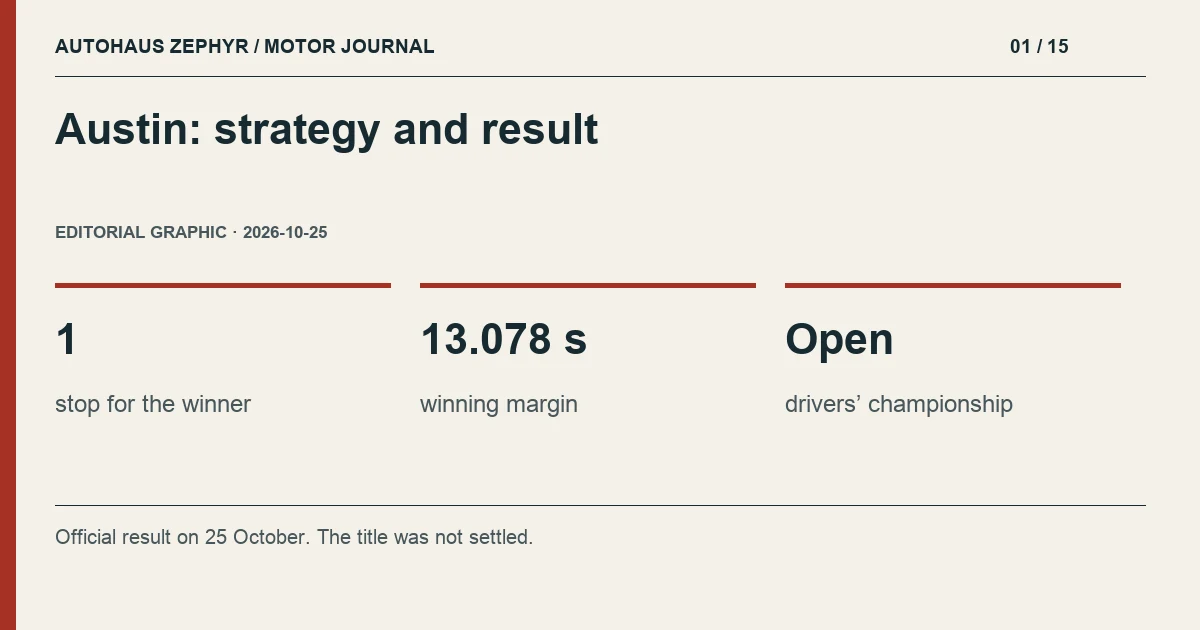
Kimi Antonelli won at Austin on 25 October with a single switch from medium to hard tyres. Leclerc recovered to second and Verstappen completed the podium. Russell’s eighth place and Hamilton’s fourth prevented the championship being settled, despite the winning Mercedes’ comfortable margin.
What matters
A one-stop strategy works only when tyre performance and track position support it.
What the result establishes
Antonelli finished ahead of Charles Leclerc and Max Verstappen. Formula 1's official report records his ninth Grand Prix win of the season and a 13.078-second winning margin. Mercedes combined medium and hard tyres on a one-stop strategy while several rivals stopped twice. The drivers' title remained undecided. These are the Sunday outcomes, rather than pre-race predictions.
Source: Fórmula 1, crónica oficial del GP de Estados Unidos ↗
The strategies diverged at the start
Antonelli started from pole on mediums. Mercedes and McLaren chose that compound, while other front-runners began on softs. The difference mattered before anyone stopped: the winner needed a longer opening stint to avoid a second pit visit, whereas his opponents could use early performance and change tyres again later.
Verstappen stopped on lap 14. Antonelli waited until the end of lap 24 to switch to hards and rejoined fourth, ahead of Hamilton. Those are observable milestones in the official report. The ten-lap difference cannot be translated into an exact tyre-related saving because traffic and track position also changed.
Source: Fórmula 1, crónica oficial del GP de Estados Unidos ↗
Leclerc exploited the tyre pressure on Norris
Second place did not follow the winner’s exact strategy. Late in the race, Leclerc passed Norris and then Verstappen to finish 13.078 seconds behind Antonelli. Norris lost ground on older tyres and ended up fifth, behind Hamilton. The classification illustrates the two possible outcomes of retaining track position: defending it to the flag or becoming vulnerable as performance falls away.
That distinction matters when explaining a one-stop race. Antonelli had enough performance to sustain his plan; Norris could not retain a podium place. This does not establish that every car needed two stops. It shows why counting pit visits without examining the stints gives an incomplete account of Sunday’s execution.
Source: Fórmula 1, crónica oficial del GP de Estados Unidos ↗
A worked example of the trade-off
Consider a different, hypothetical race. None of these numbers represents Austin. An extra stop costs eighteen seconds, while fresh tyres save eight tenths per lap for twenty laps. The theoretical gain totals sixteen seconds, leaving a two-second shortfall before traffic, overtaking or a neutralisation enters the calculation.
If the improvement lasts longer, or a rival's degradation accelerates, the answer changes. This is why one quick lap immediately after stopping cannot validate an entire strategy. A team needs the accumulated benefit and the conditions supporting it. The example illustrates the reasoning; it does not reconstruct Mercedes' private modelling or claim access to another team's telemetry.
Russell and Hamilton kept the championship open
The pre-race combination required Antonelli to win, Russell to finish ninth or lower and Hamilton outside the top four. Only the first condition was met: Russell finished eighth and Hamilton fourth. That is why the championship remained undecided. Austin’s classification explains the outcome without assumptions about what might happen in the remaining races.
Russell received a five-second penalty after the incident with Piastri, but eighth was still high enough to prevent the title being settled. Antonelli leaves with his ninth Grand Prix victory of the season and another opportunity to secure the championship. The official report identifies Mexico, on 30 October–1 November, as the next round.
Source: Fórmula 1, crónica oficial del GP de Estados Unidos ↗
What to watch in a replay
Start by comparing stint lengths, the sequence of stops and the positions in which drivers rejoined. Then look at whether gaps change steadily or shift around traffic and neutralisations. Public radio messages supply context, but a single sentence from a driver is not a complete engineering diagnosis.
Evaluating the losing alternative requires a specific counterfactual: what would have needed to happen for it to succeed? The answer might involve greater rival degradation, a clear rejoin or a different overtaking window. Keeping that assumption separate from the actual result prevents every decision being judged with information that the team did not yet possess.
Questions answered
Did Antonelli clinch the championship in Austin?
No. The official report confirms the race victory while the title remained undecided.
Are the worked-example figures Mercedes data?
No. They are explicitly hypothetical numbers illustrating the trade-off between a stop and the resulting lap-time gain.
Austin rewarded a strategy that its winner could sustain to the flag. The lesson is to compare total race time and the options available at each decision. Antonelli won, and the championship remained open. Reporting both accurately gives the race its proper significance.
Sources & editorial policy
Written by Autohaus Zephyr from the linked sources. Manufacturer figures are attributed claims, not our own tests. The practical comparisons and clearly identified examples are editorial analysis. Market availability and specifications require confirmation for the exact car.
Corrections: info@autohauszephyr.ch
How we work →