
News · News & analysis
Giulia Luna Rossa: ten finished cars, not ten new order slots
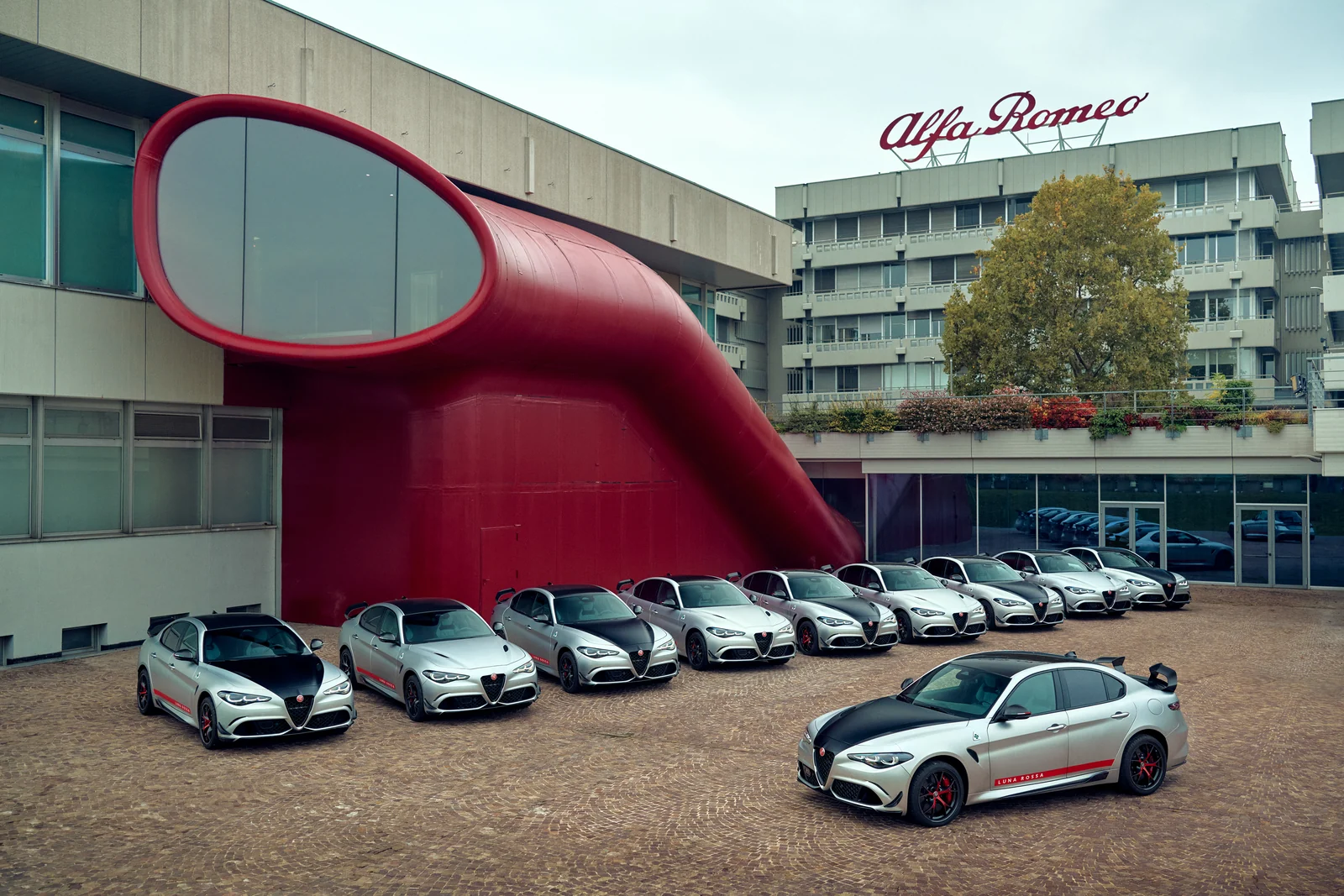
Alfa Romeo brought the ten Giulia Quadrifoglio Luna Rossa cars together at its Arese museum before handing them to their owners. Its 19 November release confirms completion of an already sold-out series. It does not reopen orders or turn the January premiere into a new launch.
What matters
Verify identity and specification, and keep the speed attached to any aerodynamic load figure.
What has changed since the January premiere
The new milestone is the gathering of all ten completed cars before handover. The world premiere took place in Brussels in January 2026. Revealing a project, finishing its production run and delivering each vehicle are separate stages. The Arese photographs document completed cars and a meeting ahead of delivery; they do not establish that every owner has already received their vehicle.
That distinction matters especially for a tiny series. A resale listing might use manufacturer photographs and name the edition without establishing the identity, ownership or availability of a particular example. Alfa’s statement that the series is sold out does not set a price for a subsequent private transaction either. This gathering provides no basis for a valuation, investment return or Autohaus stock offer. It tells readers where the project has reached in its production journey.
Source: Alfa Romeo · 2026-11-19 ↗
From Cassino to specialist craftsmanship
The starting point is a Giulia Quadrifoglio produced at Cassino. Specialist conversion work takes place through BOTTEGAFUORISERIE, the operation combining Alfa Romeo and Maserati personalisation expertise. Separating the production car from its transformation explains the vehicle more accurately than describing it as an entirely new architecture. This is a specific execution built around an existing sports saloon.
Our report on BOTTEGAFUORISERIE’s first anniversary examines the organisation behind the programme. This milestone concerns its physical output: ten identifiable cars with a particular combination of materials, finishes and aerodynamics. Personalisation alone does not establish an improvement in every driving parameter. Assessing that would require measurements, conditions and a comparison baseline. A production announcement is not an independent road or circuit test.
Source: Alfa Romeo · 2026-11-19 ↗
140 kilograms at 300 km/h means load, not weight reduction
Alfa claims up to 140 kilograms of aerodynamic downforce at 300 km/h, five times that of the production version in its stated comparison. Kilograms here express an equivalent aerodynamic load. They do not mean that 140 kilograms have been removed from the vehicle’s mass, nor do they describe a constant force at every road speed. Dropping the 300 km/h condition would materially change the claim.
The package includes carbon-fibre components and a double-profile rear wing inspired by Luna Rossa’s AC75 foils. The sailing connection explains a development and design reference, rather than making the car equivalent to a yacht or establishing a lap time. Without complete lift, drag and front-to-rear balance data, the announcement cannot support a calculation of braking or grip improvement on a particular road. The published number describes the package’s stated objective under its specified condition.
Source: Alfa Romeo · 2026-11-19 ↗
Familiar powertrain, individually documented details
The release identifies a 2.9-litre twin-turbo V6 producing 520 hp in its English-language specification. November’s development is completion of the series around a familiar powertrain. Materials and aerodynamics should therefore be assessed as parts of a complete transformation, rather than attributing the car’s character solely to its power output.
Iridescent metallic paint is paired with a red side stripe. The cars show different combinations of black bonnet and boot lid, together with red or black wheels. Inside are sequential numbering, Sparco seats inspired by the crew’s flotation equipment and a thin layer of original team sail incorporated into the dashboard. These details make individual records valuable: a photograph of one numbered car cannot establish the finish on another example advertised for sale. Attractive materials and a recognisable livery still need to be matched to the actual vehicle.
Source: Alfa Romeo · 2026-11-19 ↗
How to assess a later resale listing
Start with the VIN and documents connecting that car to the conversion and its numbered place in the series. Then compare the original specification, finishes, invoices, service history and any repairs. A visible number helps identify a claim to check; it is not the complete evidence. A copied official photograph can reproduce that number without giving the advertiser access to the vehicle.
Inspect the edition-specific components next: carbon damage, aerodynamic fixings and documented repair methods. We cannot quote replacement costs because the release supplies neither parts prices nor availability. For such a limited run, obtaining those answers before purchase can be more useful than assuming a visually similar component is interchangeable. The 1970 Ghibli SS certification story illustrates why identity, originality and condition are separate questions, even though it concerns another programme and period.
Source: Alfa Romeo · 2026-11-19 ↗
Comparing a finished series with a development project
For an aerodynamic package, the location of a force matters alongside its total magnitude. An aggregate downforce figure does not by itself explain front-to-rear balance or changes with ride height, airflow direction and vehicle attitude. The rear wing is the most visible component, but the useful reference for an individual car is its specific documented and approved configuration. A replacement part that looks similar does not establish equivalent behaviour. This is an interpretation of the announcement, rather than a calculation of this series’ handling.
Comparisons also need consistent development stages. The electric M3 running at Miramas documents a development car still wearing camouflage. Arese shows a completed specialist series. Both interest sports-saloon enthusiasts, but they do not form a comparison test or establish a winner. The significance here is narrower and tangible: a promised edition has become ten finished cars. Keeping that milestone distinct from performance testing makes the report more useful to readers who may later encounter the edition in the used market.
Source: Alfa Romeo · 2026-11-19 ↗
Arese marks completion of an already allocated series. Enthusiasts gain a documented view of the finished project; prospective buyers are reminded that exclusivity requires records and that downforce figures need their speed condition.
Sources & editorial policy
Written by Autohaus Zephyr from the linked sources. Manufacturer figures are attributed claims, not our own tests. The practical comparisons and clearly identified examples are editorial analysis. Market availability and specifications require confirmation for the exact car.
Corrections: [email protected]
How we work →Keep reading
- BottegaFuoriserie at one: how a bespoke car project is organised
- The 1970 Ghibli SS: what Maserati Classiche certification establishes
- Electric BMW M3 at Miramas: what four motors could change