
Market · News & analysis
Tesla Q3 2026: $28.046 billion revenue and a 2.6% operating margin
Tesla’s quarterly revenue was almost unchanged, but operating income fell 56% year on year. Its 21 October update shows a 2.6% operating margin, a sequential cash-flow recovery and different trends across automotive, energy and services. The analysis separates those financial results from driving features that still require supervision.
What matters
The accounts describe a quarter; feature availability must be checked by vehicle and territory.
What the published accounts show
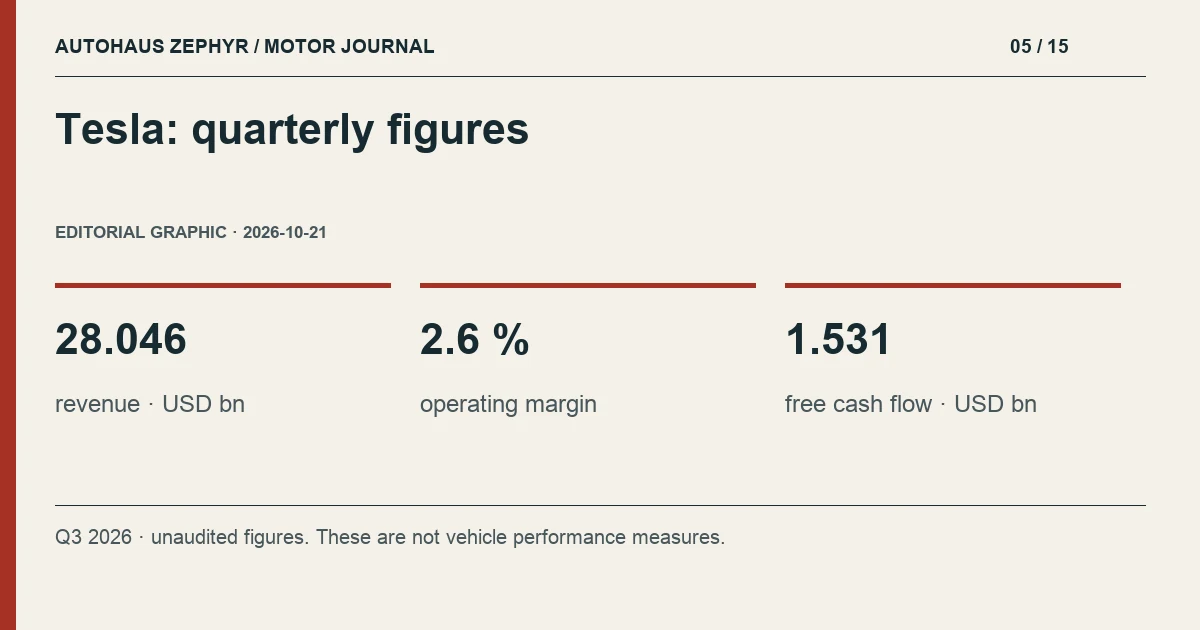
The unaudited update records revenue of $28.046 billion, operating income of $718 million and a 2.6% operating margin. Free cash flow was $1.531 billion, while automotive revenue totalled $20.560 billion. These are quarterly dollar amounts, not estimates of vehicle prices or values attributable to individual software functions.
Automotive revenue falls 3% as services grows 33%
Total revenue barely changed: $28.046 billion against $28.095 billion a year earlier. Underneath that stability, the businesses moved differently. Automotive contributed $20.560 billion, down 3%; energy generation and storage $2.881 billion, down 16%; and services and other $4.605 billion, up 33%. Growth in one activity cannot automatically be attributed to selling more cars.
The operating summary records 486,532 vehicle deliveries, down 2% year on year, and 13.7 GWh of storage deployed, up 10%. Rising physical energy deployments alongside falling quarterly energy revenue illustrate why volume and revenue recognition answer different questions. The table does not establish a single price or contract explanation for that divergence.
Margin recovers sequentially but remains below 2025
Operating income of $718 million exceeds the $398 million reported in the second quarter of 2026, but is below the $1.624 billion of a year earlier. The margin tells the same story: 2.6%, compared with 1.4% in June and 5.8% in September 2025. Selecting only one comparison would produce opposing headlines about the same quarter.
Gross profit rose year on year from $5.054 billion to $5.494 billion, while operating expenses increased from $3.430 billion to $4.776 billion. The difference helps locate the pressure between gross and operating profit. It does not allocate that pressure to individual future projects, but prevents flat revenue being described as equally stable profitability.
Free cash flow turns positive despite substantial investment
Tesla reports $6.263 billion of operating cash flow and $4.732 billion of capital expenditure. Their difference produces the reported $1.531 billion of free cash flow, compared with −$1.092 billion in the previous quarter. The calculation makes the measure checkable without confusing it with $787 million of GAAP net income.
The sequential recovery matters, although one observation cannot establish a permanent cash-generation level. Tracking it requires keeping operating cash and investment together. Reducing either to a profit headline, or treating all investment as a loss, would remove the information needed to understand how Tesla finances expansion.
Supervised software is not general autonomy
The report retains the requirement for active driver supervision for FSD (Supervised) and states that it does not make the vehicle autonomous. That distinction belongs beside any discussion of commercial adoption. Service availability in one territory also cannot establish authorisation, functionality or terms in another.
A buyer should begin with the actual car and software version, then check contractual and territorial conditions. Ask what is available today, what requires an update and which subscriptions or charges may apply. A future intention should not be valued as delivered equipment or treated as permission to stop paying attention to driving.
Compare an offer without speculating about the future
A useful comparison starts with documented, available capabilities alongside charging, insurance, repairs and the complete purchase budget. Announced programmes can provide context, but should not be the only reason for valuing a vehicle as though it already possessed those capabilities. The uncertainty needs to remain visible.
The same discipline applies to a new product presentation. Announcement, manufacturing and customer delivery are separate milestones. Mentioning a product in a quarterly report does not automatically establish approval or availability in every market. Keeping those labels intact helps prevent a purchase decision being built around a feature or timetable that does not yet apply to the offer.
Questions answered
Is total revenue divided by deliveries a Tesla average selling price?
Not a clean one: total revenue includes activities beyond vehicle sales.
Does FSD (Supervised) allow the driver to stop paying attention?
No. The update requires active supervision and says the feature does not make the vehicle autonomous.
The quarter describes a business with substantial revenue, a defined operating margin and future programmes. Its useful interpretation separates segments, profit, cash and technical availability. A vehicle purchase should rest on capabilities available under verified conditions, rather than the combined value of expectations.
Sources & editorial policy
Written by Autohaus Zephyr from the linked sources. Manufacturer figures are attributed claims, not our own tests. The practical comparisons and clearly identified examples are editorial analysis. Market availability and specifications require confirmation for the exact car.
Corrections: info@autohauszephyr.ch
How we work →