
Technology · News & analysis
BMW M 1000 RR for 2027: why the new frame is designed to flex
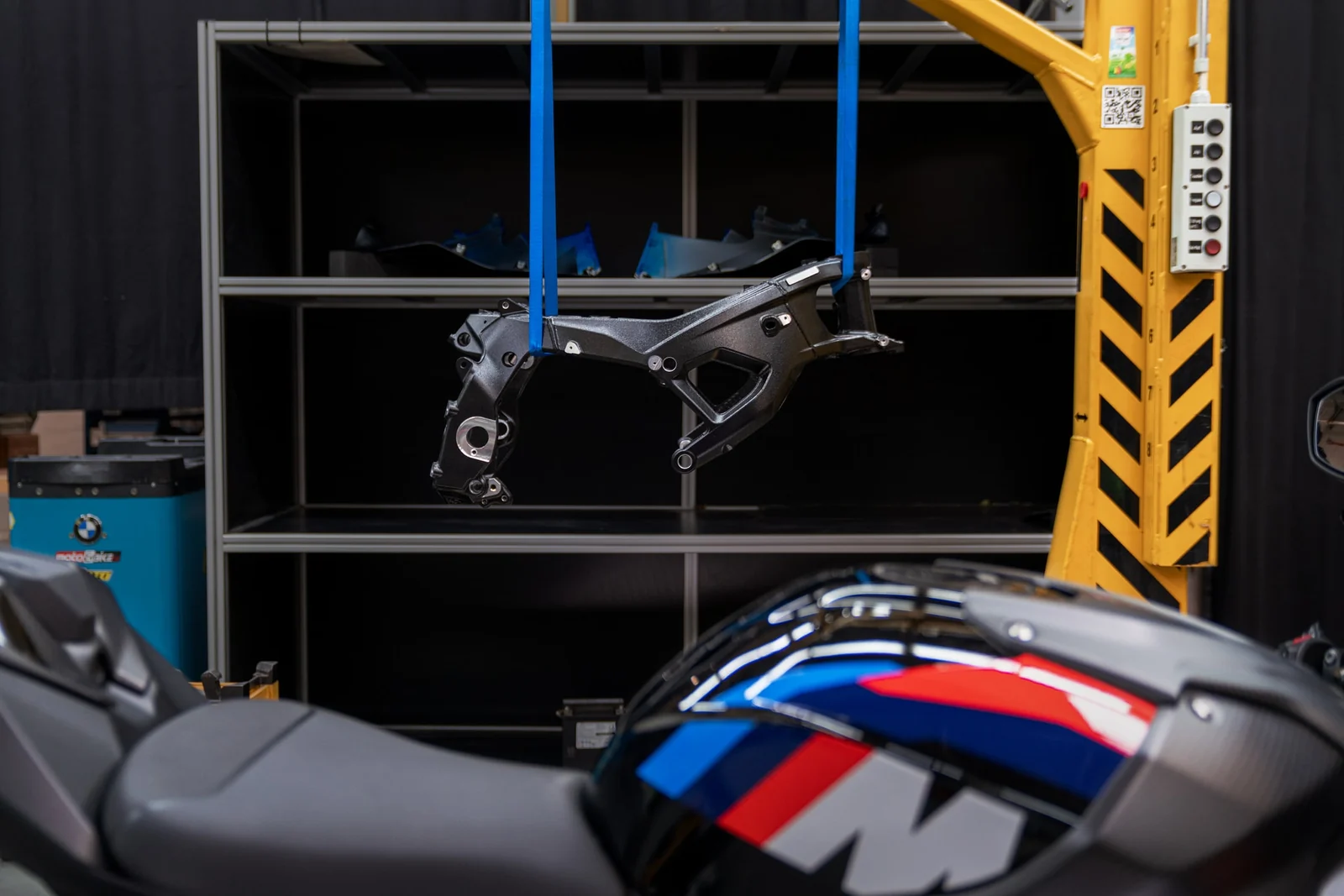
BMW Motorrad announced on 30 October that its third-generation M Motorsport frame will be standard on the M 1000 RR from model year 2027. The frame is about 1.3 kg lighter than its predecessor, with wall thicknesses reduced by up to 30%. The engineering goal extends beyond mass: defined lateral flex is combined with stiffness for transmitting braking and drive forces.
What matters
On a leaning motorcycle, maximum stiffness in every direction is not automatically the objective. BMW describes a tuned distribution of flexibility; the announcement supplies neither a lap-time improvement nor a complete motorcycle weight.
The component and its introduction
The announcement concerns the third-generation aluminium M Motorsport frame, confirmed as standard equipment on the M 1000 RR from model year 2027. BMW presents it as a platform for the production bike, factory teams and customer racing. The braking, steering and drive loads encountered in competition feed into development of the component intended for customers.
The roughly 1.3 kg saving compares the frame with its predecessor. Reducing mass changes a central part of the motorcycle, while wall-thickness tuning changes how it transmits loads. Mass and stiffness are addressed together from the design stage. The release gives neither a complete-bike weight nor a lap-time improvement; subtracting the frame saving from an earlier specification would not establish either.
Source: BMW Motorrad — third-generation M Motorsport frame, 30 October 2026 ↗
Lateral flex when the motorcycle is leaning
BMW says the frame can flex laterally to a defined degree at lean, supplementing the suspension as it deals with road-surface inputs. The company links this to more consistent tyre contact, clearer feedback and more even wear. These are manufacturer-described benefits within a technical explanation, without published numerical comparative test results in this release.
The relevant principle is that the direction of a surface input relative to the machine changes as it leans. This makes controlled structural compliance in particular planes useful to investigate. The intention is not an indiscriminately soft frame. It is to coordinate the structure with tyres and suspension while maintaining predictable responses to forces that arrive together. That distinction makes flexibility an engineering parameter rather than a synonym for poor control.
Source: BMW Motorrad — third-generation M Motorsport frame, 30 October 2026 ↗
Longitudinal stiffness remains important
Longitudinally, BMW retains high stiffness to transmit braking and drive forces precisely. Wall-thickness reductions of up to 30% help tune the balance between stiffness and flexibility. That maximum does not necessarily apply to every wall, and it does not mean the entire frame is 30% lighter. Percentage thickness and component mass are different measures.
This gives useful context to sports-bike language. Calling a frame stiffer or more flexible is incomplete without a direction, location and objective. BMW describes a distribution rather than a contest to maximise one figure. A track assessment would need to examine corner entry, support at lean and corner exit in comparable conditions. A general impression of firmness would not, by itself, establish whether the intended balance has improved.
Source: BMW Motorrad — third-generation M Motorsport frame, 30 October 2026 ↗
Four castings connected by a digital development process
Geometry, wall thicknesses and stiffness distribution are developed in Munich using simulation, test rigs and riding tests. Approved production data then support manufacturing in Landshut. The frame consists of four cast components: steering head, left and right side sections, and rear section. Process integration matters because a finely tuned design is valuable only if it can be reproduced consistently.
Landshut uses low-pressure aluminium casting, with controlled filling to reduce turbulence and air inclusions. Temporary quartz-sand cores form the internal cavities. Before tooling is made, simulation examines the flow, packing and curing of the sand-air mixture. This helps define the core-shooting nozzles and vents before committing the design to physical tooling.
Source: BMW Motorrad — third-generation M Motorsport frame, 30 October 2026 ↗
Quality checks continue after casting
The intricate cores are made using a cold-box process, positioned in the mould and removed after casting. X-ray inspection, wall-thickness checks and coordinate measurement assess internal quality and dimensions. The sequence addresses different risks: a part may look correct externally yet contain an internal defect, or be structurally sound but fail to meet the required geometry.
In Berlin, the four components are positioned and joined through TIG welding. Cathodic dip coating provides corrosion protection, including inside enclosed cavities. Final milling finishes functional surfaces and mounting points, after which another coordinate measurement verifies the complete frame before release for motorcycle assembly. Approval therefore does not stop at a satisfactory mould or an individually inspected casting; it also covers the joined and finished structure.
Source: BMW Motorrad — third-generation M Motorsport frame, 30 October 2026 ↗
What to establish when comparing two M 1000 RRs
When comparing vehicles, confirm the model year and frame specification of each. The announced milestone is standard fitment from MY2027; the release establishes no retrofit programme for earlier bikes. A recent registration date alone does not identify the production specification being offered.
A future track assessment should examine support at lean together with precision under braking and acceleration. BMW attributes better tyre contact and more even wear to the design without quantifying the differences. The Munich–Landshut–Berlin chain shows how it aims to reproduce the intended response: define the flex, control cavities and wall thicknesses, then verify the welded frame.
Source: BMW Motorrad — third-generation M Motorsport frame, 30 October 2026 ↗
This frame illustrates why sports-bike development involves more than removing kilograms. The intended distribution of flex and stiffness needs manufacturing and measurement capable of reproducing it. Standard fitment from model year 2027 is the confirmed milestone; quantified whole-bike performance requires separate evidence.
Sources & editorial policy
Written by Autohaus Zephyr from the linked sources. Manufacturer figures are attributed claims, not our own tests. The practical comparisons and clearly identified examples are editorial analysis. Market availability and specifications require confirmation for the exact car.
Corrections: [email protected]
How we work →Keep reading
- MotoGP 2027: from the first engine-bench test to a racing motorcycle
- Maserati Track Assist: active control planned for 2027 training